
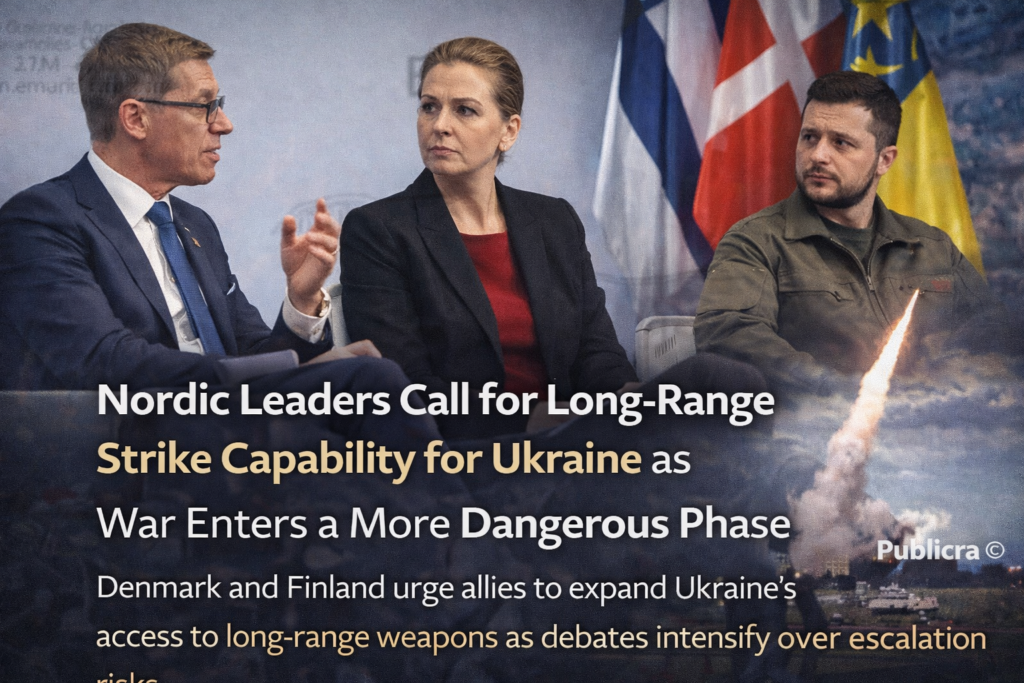
Denmark and Finland urge allies to lift limits on deep-strike weapons, while Moscow warns of “overwhelming” retaliation and wider escalation.
As the war in Ukraine grinds into another year of high-intensity conflict, senior leaders from Northern Europe are pressing Western allies to remove restrictions on long-range weapons that would allow Kyiv to strike deep into Russian territory. Denmark’s prime minister and Finland’s president have publicly argued that Ukraine cannot prevail while constrained by limits on where Western-supplied weapons may be used. Their remarks underscore a growing rift within allied capitals over how far military support should go—and how to balance battlefield effectiveness against the risk of wider escalation.
The call comes amid heightened concerns about deterrence, alliance unity, and the trajectory of the conflict. While some governments fear that deep strikes into Russia could provoke retaliation and broaden the war, others argue that denying Ukraine the ability to hit rear-area logistics and command nodes entrenches a strategic disadvantage. The debate reflects a fundamental tension in Western policy: whether to prioritize escalation control or military effectiveness as the war enters a more perilous phase.
The Strategic Rationale for Deep-Strike Capability
Proponents of lifting restrictions on long-range weapons contend that modern warfare is won by disrupting an adversary’s logistics, command-and-control networks, and production capacity. In this view, limiting Ukraine to strikes near the front lines enables Russian forces to operate with relative sanctuary in rear areas, where depots, airfields, and coordination hubs can function with reduced risk.
Deep-strike capability could alter operational dynamics by forcing Russia to disperse assets, invest more heavily in air defense, and stretch supply chains. Advocates argue that this pressure would degrade battlefield effectiveness and potentially shorten the conflict by increasing the costs of continued operations. The logic mirrors historical cases where rear-area sanctuaries prolonged wars by insulating critical infrastructure from disruption.
Alliance Red Lines and the Politics of Escalation
Despite the military rationale, alliance politics remain fraught. Several Western governments have drawn informal red lines around the use of certain weapons on Russian territory, seeking to avoid direct confrontation between NATO and Moscow. These constraints are rooted in concerns about escalation management, nuclear signaling, and domestic political risk.
The Nordic leaders’ public push to loosen these restrictions challenges a cautious consensus. Their stance reflects growing frustration with incrementalism—providing advanced systems while constraining their use. Critics of red lines argue that ambiguity and hesitation embolden Moscow by signaling a lack of resolve. Supporters of restraint counter that calibrated limits reduce the risk of miscalculation and preserve space for diplomatic off-ramps.
Moscow’s Warnings and the Escalation Ladder
Russia has warned that long-range strikes into its territory would trigger a strong response. Such warnings are part of a broader deterrence strategy that blends conventional retaliation threats with strategic signaling. The escalation ladder in this conflict is complex, involving cyber operations, missile strikes, maritime disruptions, and potential vertical escalation.
The risk calculus is not merely theoretical. As weapons ranges increase, so does the potential for strikes on sensitive sites, including critical infrastructure and military installations far from the front. Each step up the ladder raises the probability of retaliatory cycles that could draw additional actors into the conflict. Policymakers must weigh whether the deterrent value of deep strikes outweighs the risks of a widened confrontation.
The Role of Long-Range Missiles in Modern Warfare
Long-range precision strike systems have become central to contemporary military doctrine. Their value lies not only in range but in accuracy, survivability, and integration with intelligence networks. When combined with real-time targeting data, such systems can impose disproportionate costs on adversaries by disabling high-value assets with relatively limited expenditure.
For Ukraine, access to long-range systems would expand options across domains: targeting airfields that support aerial attacks, logistics hubs that sustain ground operations, and command nodes that coordinate multi-domain campaigns. However, the effectiveness of such strikes depends on sustained intelligence support, resilient communications, and robust air defense to protect launch platforms—areas where allied assistance remains critical.
Defense Industrial Capacity and Co-Production Debates
The push for deeper strike capability intersects with debates over defense industrial capacity. European states are expanding production of munitions and exploring co-production arrangements to sustain Ukraine’s war effort. These initiatives aim to shorten supply chains, increase throughput, and build long-term capacity that reduces dependence on limited stockpiles.
Yet industrial scaling takes time. Even with political will, ramping up production of advanced missiles requires specialized components, skilled labor, and secure supply chains. The gap between strategic intent and industrial reality complicates policy choices: commitments to provide long-range systems must be matched by credible production and sustainment plans to avoid hollow promises.
NATO Unity and the Burden-Sharing Question
Calls to lift red lines expose underlying tensions within NATO over burden-sharing and strategic risk. Frontline states closer to the conflict often favor more assertive support, arguing that deterrence fails when it is hedged. Others prioritize alliance cohesion and domestic consensus, wary of moves that could fracture unity.
Managing these differences requires diplomatic choreography. Consensus-based decision-making can slow responses, but unilateral actions risk undermining alliance solidarity. The challenge is to craft policies that maintain unity while adapting to battlefield realities—a balancing act that grows harder as the conflict drags on and fatigue sets in.
Legal and Ethical Considerations of Cross-Border Strikes
Cross-border strikes raise legal and ethical questions, particularly regarding proportionality, distinction, and the protection of civilians. Even when targets are military in nature, the proximity of critical infrastructure and civilian populations complicates compliance with humanitarian principles. Policymakers must ensure that any expansion of strike permissions is accompanied by stringent targeting protocols and accountability mechanisms.
The ethical debate also touches on reciprocity: expanding strike envelopes could normalize broader targeting patterns, increasing the risk of civilian harm across borders. Advocates of restraint argue that maintaining limits helps preserve norms; proponents of deep strikes counter that norms must adapt to realities when an aggressor exploits sanctuary to prolong conflict.
Information Warfare and Strategic Signaling
Public statements by leaders are not merely policy signals; they are tools of information warfare. Calls for long-range strikes communicate resolve to allies and deterrence to adversaries. They also shape domestic narratives, framing support for Ukraine as necessary for regional security.
Moscow’s responses similarly seek to shape perceptions, projecting readiness to escalate while portraying Western support as reckless. In this contest of narratives, managing expectations becomes part of strategy. Leaders must calibrate messaging to deter without cornering opponents into escalation driven by reputational stakes.
Regional Security Implications for Northern Europe
For Nordic countries, the debate is not abstract. Regional security calculations have shifted dramatically, with increased attention to air defense, maritime security, and resilience of critical infrastructure. Supporting Ukraine is framed as forward defense—containing threats before they reach Northern Europe’s doorstep.
This perspective explains why leaders from the region advocate for fewer constraints on Ukraine’s military options. The argument is that a stronger Ukraine enhances deterrence across the European security architecture. Critics caution that proximity also increases vulnerability to spillover risks, including cyber and hybrid operations targeting Northern European states.
Diplomatic Off-Ramps and Conflict Termination
Even as military options are debated, the question of conflict termination looms. Deep strikes may improve Ukraine’s bargaining position by altering battlefield dynamics, but they could also harden negotiating stances. Effective diplomacy often requires a mix of pressure and reassurance—credible military leverage paired with clear pathways to de-escalation.
Designing off-ramps amid active conflict is notoriously difficult. Confidence-building measures, crisis communication channels, and third-party mediation can help manage escalation. Policymakers must ensure that expanded military support does not foreclose future diplomatic opportunities.
Economic and Energy Security Fallout
Escalation risks extend into economic and energy domains. Wider conflict could disrupt supply chains, energy flows, and investment confidence across Europe. Governments face the dual task of sustaining military support while mitigating domestic economic pressures. Public tolerance for prolonged conflict support is shaped by inflation, energy prices, and social spending trade-offs.
These pressures feed back into policy debates over red lines. Leaders must justify military choices to electorates that are sensitive to economic costs. Transparent communication about objectives, risks, and timelines is essential to maintaining democratic legitimacy.
Scenarios Ahead and Policy Choices
Three broad pathways are emerging. The first involves a cautious relaxation of restrictions, allowing limited deep strikes under strict conditions. The second maintains current constraints while expanding other forms of support, such as air defense and industrial capacity. The third entails a more decisive shift toward unrestricted use of long-range systems, accepting higher escalation risk in pursuit of battlefield advantage.
Each pathway carries trade-offs. Incrementalism may preserve stability but prolong conflict. Bold shifts could accelerate outcomes but heighten risks. Policymakers must decide which risks are more acceptable in a war that shows few signs of abating.
A Turning Point in the War’s Trajectory
The Nordic leaders’ call to enable long-range strikes into Russia crystallizes a pivotal moment in the war’s trajectory. It reflects growing impatience with constraints perceived to limit Ukraine’s chances and a willingness among some allies to accept higher risks to alter battlefield dynamics. At the same time, warnings of “overwhelming” retaliation underscore the stakes of crossing longstanding red lines.
The path forward demands strategic clarity: aligning military effectiveness with escalation management, alliance unity with operational flexibility, and short-term gains with long-term stability. Whether allies choose to loosen restrictions or hold the line, the decisions made now will shape not only the course of the war in Ukraine but the broader security order in Europe for years to come.