
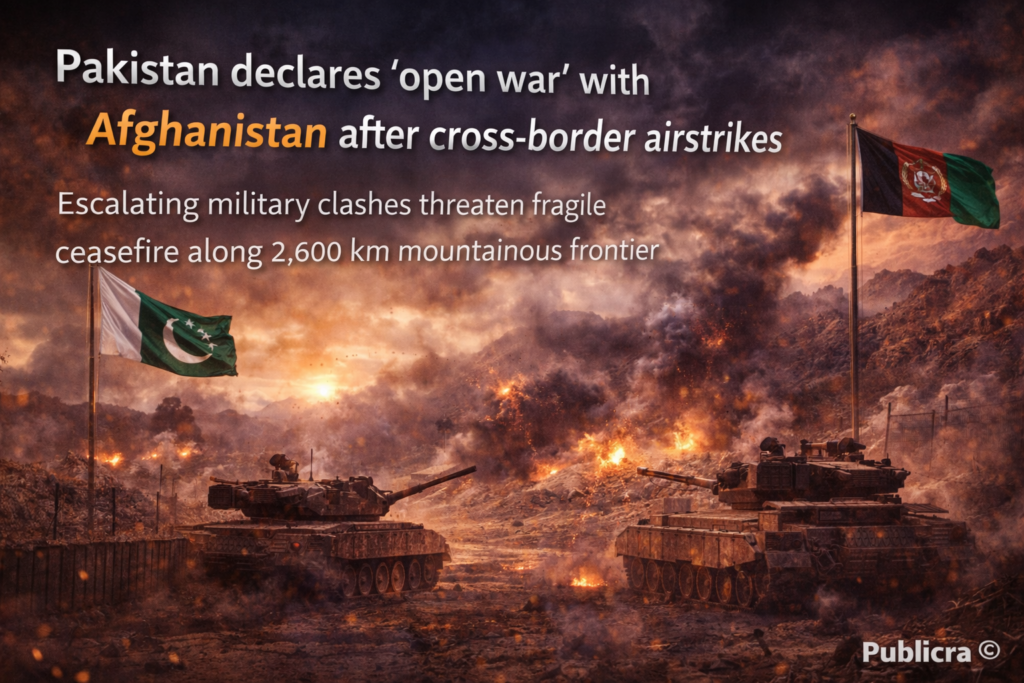
Escalating military clashes threaten fragile ceasefire along 2,600 km mountainous frontier
Pakistan’s defence minister has declared that the country is now in “open war” with Afghanistan following a dramatic escalation of cross-border hostilities. The announcement came after Pakistan launched a series of airstrikes inside Afghanistan in response to Taliban attacks on Pakistani military positions along the border.
The latest confrontation marks one of the most serious breakdowns in relations between the two neighbors in recent years. Despite a ceasefire agreement reached months ago, tensions have steadily risen amid accusations of militant support, territorial violations, and security failures.
How the latest escalation unfolded
The violence intensified after Afghan Taliban forces announced what they described as a retaliatory operation targeting Pakistani military posts near the frontier. Taliban officials claimed to have seized multiple positions and inflicted significant casualties on Pakistani troops.
Pakistan swiftly rejected those claims and accused Taliban fighters of initiating unprovoked attacks across several border locations in its north-western province. Islamabad responded with artillery fire and aerial bombardments targeting cities including Kabul, Kandahar, and Paktika.
Military officials on both sides have reported heavy casualties, though independent verification remains difficult due to restricted access and conflicting statements.
Competing casualty claims and information warfare
Both governments have issued sharply contrasting accounts of the clashes. Pakistan’s military has stated it struck numerous Afghan targets and eliminated hundreds of Taliban fighters. Taliban spokespeople, meanwhile, have reported far lower losses while claiming success in damaging Pakistani positions.
In modern conflicts, narratives often evolve alongside battlefield developments. Information warfare plays a crucial role in shaping domestic and international perception. As such, casualty figures and operational outcomes remain disputed.
Fragile ceasefire collapses under mounting distrust
The two countries had agreed to a fragile ceasefire last October following months of sporadic clashes. However, negotiations aimed at reaching a comprehensive peace framework failed to produce lasting stability.
Each side has accused the other of failing to engage sincerely in dialogue. Pakistan alleges that Afghan authorities have allowed anti-Pakistan militant groups to operate from Afghan territory. Kabul denies these claims and insists it does not permit cross-border attacks.
The collapse of the ceasefire underscores the depth of mistrust that continues to define bilateral relations.
Border geography complicates security efforts
The Pakistan-Afghanistan border stretches roughly 2,600 kilometers across mountainous terrain, making surveillance and enforcement challenging. The rugged landscape has historically enabled militant groups to operate across both sides.
Security analysts note that the porous nature of the frontier complicates accountability. Cross-border movements are difficult to track, and both governments face internal pressure to demonstrate control over their territories.
The current escalation reflects how fragile stability remains along this strategically sensitive frontier.
Domestic political pressures in Pakistan
Pakistan’s leadership faces intense domestic scrutiny over security concerns. Militant attacks within Pakistan have increased in recent months, placing pressure on the government to take decisive action.
The defence minister’s declaration of “open war” signals a hardened stance intended to reassure the public and demonstrate resolve. Prime Minister Shehbaz Sharif has vowed that there will be no compromise in defending national sovereignty.
Such rhetoric, while domestically resonant, also narrows diplomatic space for rapid de-escalation.
The Taliban’s strategic calculus
For Afghanistan’s Taliban leadership, cross-border clashes carry both risks and opportunities. Demonstrating strength against Pakistan may consolidate internal support. However, sustained conflict risks international isolation and economic consequences.
Afghanistan continues to face significant humanitarian and economic challenges. Prolonged hostilities could further strain limited resources and complicate regional trade routes.
Regional powers call for restraint
Several regional and international actors have urged de-escalation. Iran has offered to facilitate dialogue between the two sides, emphasizing neighborly relations and regional stability.
Diplomatic outreach has also taken place involving Turkey and Saudi Arabia, reflecting broader concern about instability in South Asia. Western governments have called for renewed talks and immediate steps to prevent civilian harm.
The rapid involvement of multiple diplomatic actors highlights the regional significance of the conflict.
Humanitarian implications
Reports from border areas indicate civilian anxiety and displacement as clashes intensified. Refugee camps and populated districts near the frontier face heightened risk during cross-border exchanges.
Humanitarian agencies warn that escalation could exacerbate already fragile living conditions in both countries. Infrastructure damage and restricted mobility can quickly compound existing economic hardships.
The protection of civilians remains a critical concern as military operations continue.
Drone warfare and evolving tactics
Both sides have reportedly utilized drones and precision strikes during the confrontation. The increasing role of drone technology reflects evolving military tactics in regional conflicts.
Unmanned aerial systems allow rapid cross-border engagement but also increase the risk of miscalculation. With both governments asserting defensive motives, the threshold for escalation remains dangerously low.
Broader geopolitical implications
The confrontation occurs within a wider context of shifting regional alliances and security recalibrations. South Asia remains a complex strategic theater involving multiple powers.
Persistent instability between Pakistan and Afghanistan risks disrupting trade corridors, energy routes, and counterterrorism cooperation.
Analysts caution that prolonged hostilities could draw in external actors or alter existing diplomatic alignments.
Prospects for de-escalation
Despite strong rhetoric, both governments may seek behind-the-scenes negotiations to prevent a prolonged conflict. Economic pressures and humanitarian considerations provide incentives for restraint.
Confidence-building measures, joint border monitoring mechanisms, and renewed diplomatic channels could offer pathways toward stabilization.
However, rebuilding trust after open declarations of war will require sustained effort.
a dangerous turning point
Pakistan’s declaration of “open war” with Afghanistan marks a dangerous turning point in bilateral relations. Cross-border airstrikes, competing casualty claims, and escalating rhetoric have deepened mistrust.
The coming days will determine whether the confrontation remains contained or spirals into a broader conflict. Regional stability hinges on diplomatic engagement, clear communication, and restraint from both sides.