
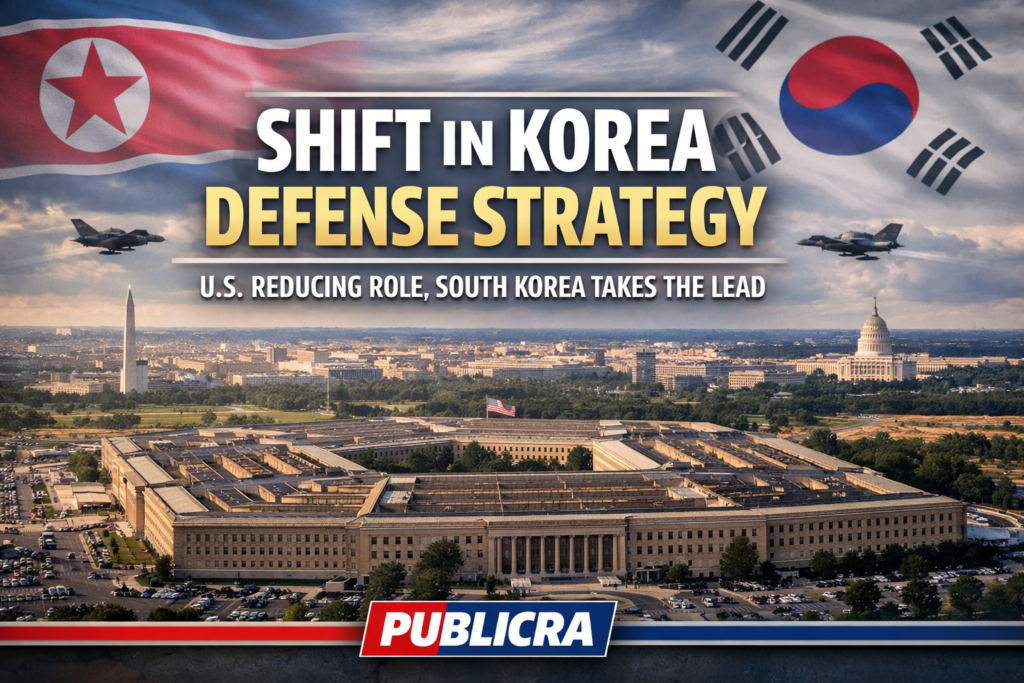
Washington eyes reduced frontline presence against North Korea while urging Seoul to lead deterrence efforts
A Strategic Pivot in U.S. Military Planning
The United States is signaling a significant recalibration of its military posture on the Korean Peninsula, according to a newly released Pentagon policy document. The strategy outlines a future in which South Korea assumes primary responsibility for deterring North Korea, with the U.S. playing a more limited but still critical supporting role.
This shift reflects broader changes in Washington’s global defense priorities, where homeland security and competition with China increasingly dominate strategic thinking.
While no immediate troop withdrawal has been announced, analysts say the language used by the Pentagon opens the door to potential reductions or redeployments of U.S. forces stationed in South Korea over the coming years.
28,500 U.S. Troops and a Changing Balance of Responsibility
For decades, approximately 28,500 U.S. troops have been stationed in South Korea as a central pillar of deterrence against North Korea’s nuclear and conventional military threat. The presence has symbolized Washington’s firm commitment to the defense of its Asian ally.
However, the Pentagon’s latest National Defense Strategy (NDS) makes clear that this balance is evolving.
According to the document, South Korea now possesses the military capability to assume a leading deterrence role, supported by U.S. forces rather than directed by them. Seoul has steadily expanded its defense capacity, including advanced missile systems, naval power, air defense, and cyber capabilities.
South Korea also increased its defense budget by 7.5% this year, underscoring its intent to shoulder more responsibility in regional security.
Why the Pentagon Is Reassessing Its Role
The shift is not occurring in isolation. U.S. defense planners are increasingly focused on a world where military resources must be flexible and globally deployable rather than fixed in long-standing regional arrangements.
Key Drivers Behind the Shift
- Homeland Defense First: The Pentagon now explicitly lists defending the U.S. homeland as its top priority.
- China as the Primary Strategic Challenge: Preventing China from dominating the Indo-Pacific region is central to U.S. planning.
- Global Force Flexibility: U.S. forces in South Korea may be expected to respond to crises beyond the peninsula, including Taiwan and regional maritime security.
- Alliance Modernization: Encouraging capable allies to take greater responsibility reduces long-term U.S. military strain.
The strategy suggests that deterrence does not necessarily require large permanent deployments, but rather credible capabilities, rapid response options, and strong alliances.
South Korea’s Position: Supportive but Cautious
Seoul has responded carefully to the Pentagon’s language. South Korea’s Defense Ministry emphasized that U.S. forces remain the “core” of the alliance and a critical factor in deterring North Korean aggression.
At the same time, South Korea has long pursued the goal of assuming wartime operational control of combined U.S.–South Korean forces, a transition that has been discussed for more than two decades.
With approximately 450,000 active-duty troops, South Korea already maintains one of the largest and most technologically advanced militaries in the world.
Officials in Seoul stress that any shift in responsibility must be gradual, coordinated, and grounded in shared strategic planning.
North Korea’s Likely Reaction
North Korea has consistently condemned the U.S. military presence in South Korea, accusing Washington of preparing for invasion under the guise of joint military exercises.
Pyongyang is expected to view any reduction in U.S. troop levels as a propaganda victory, even if U.S. strategic capabilities in the region remain intact.
However, defense experts warn that misinterpretation by North Korea could increase the risk of miscalculation, particularly if Pyongyang perceives weakening alliance resolve.
The Broader Indo-Pacific Strategy
The Pentagon’s strategy document places the Korean Peninsula within a wider Indo-Pacific framework dominated by competition with China.
Rather than framing the rivalry as an existential struggle, the document emphasizes the goal of maintaining a “favorable balance” that prevents any single power from dominating the region.
This approach prioritizes:
- Strong regional alliances
- Forward deterrence
- Denial strategies along critical maritime routes
- Preventing coercion without pursuing regime change
While Taiwan is not named directly, the document’s emphasis on the first island chain — stretching from Japan through Taiwan to the Philippines — makes its strategic importance clear.
Taiwan and Regional Defense Networks
Officials in Taiwan welcomed the Pentagon’s emphasis on denial defense and regional stability. Taipei continues to invest heavily in asymmetric defense capabilities designed to deter aggression without provoking escalation.
Taiwanese leaders view the U.S. strategy as confirmation that Washington remains committed to preventing unilateral changes to the regional status quo, even as it seeks to rebalance force deployments.
Middle East and Europe: A Secondary but Persistent Focus
While China dominates U.S. strategic thinking, the Pentagon document also addresses other global flashpoints.
Iran
- The strategy notes that Iran, despite recent setbacks, may attempt to rebuild military capacity.
- Washington sees Israel as a key regional security partner capable of defending itself with U.S. support.
Europe and Russia
- Russia is described as a “persistent but manageable” threat.
- The U.S. will remain engaged in Europe but expects allies to increase their own defense commitments.
- The document signals a more pragmatic tone compared to earlier rhetoric questioning Europe’s reliability.
What This Means for the U.S.–South Korea Alliance
Despite speculation, the Pentagon’s strategy does not signal abandonment. Instead, it reflects an evolution toward a more balanced alliance model where:
- South Korea leads conventional deterrence
- The U.S. provides strategic backing, intelligence, and rapid reinforcement
- Both sides retain strong interoperability and shared command structures
Experts emphasize that alliance credibility depends not on troop numbers alone, but on political commitment, military readiness, and shared strategic goals.
Looking Ahead: Gradual Change, Not Sudden Withdrawal
Any reduction or redeployment of U.S. forces in South Korea would likely unfold over years, not months. Domestic politics in both countries, regional security dynamics, and North Korea’s behavior will all influence future decisions.
The upcoming visit of senior U.S. defense officials to Asia is expected to focus on reassurance, coordination, and alliance adaptation rather than abrupt policy shifts.
Conclusion: A New Phase in Alliance Management
The Pentagon’s latest defense strategy marks a clear moment of transition. As South Korea grows more capable and the United States faces expanding global demands, deterrence on the Korean Peninsula is being redefined rather than diminished.
The challenge for Washington and Seoul will be ensuring that strategic evolution strengthens stability rather than creating uncertainty in one of the world’s most volatile regions.