
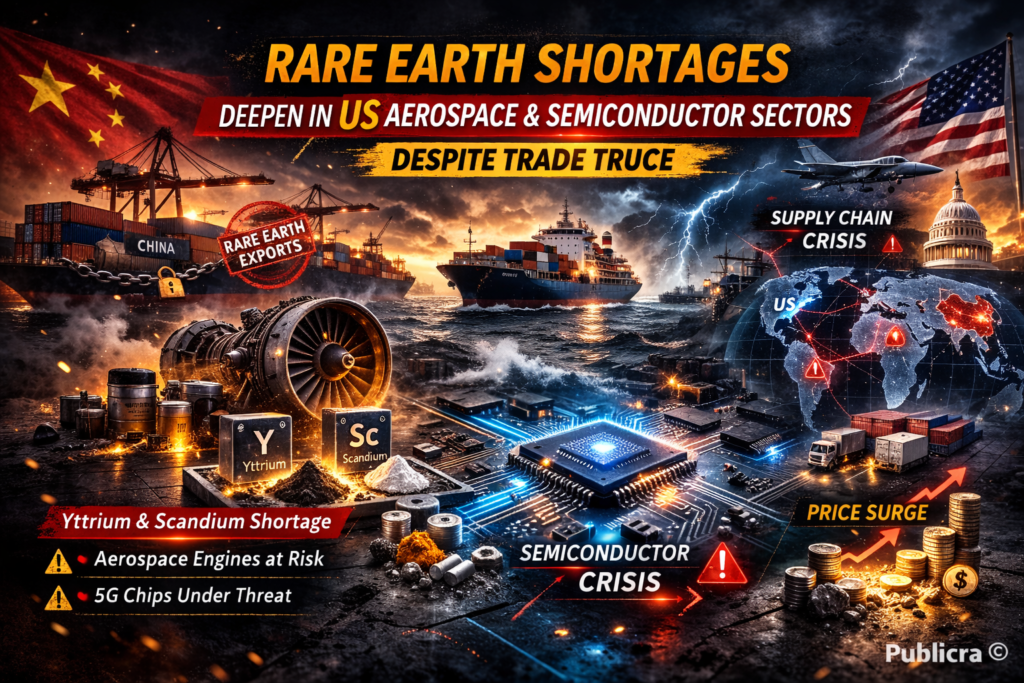
Yttrium and scandium constraints expose fragile supply chains ahead of high-level US-China summit
Rare earth shortages are intensifying across key US industries, particularly aerospace and semiconductor manufacturing, despite recent efforts to ease trade tensions between Washington and Beijing.
Industry sources indicate that critical elements such as yttrium and scandium remain in tight supply, threatening production stability in advanced manufacturing sectors. The supply squeeze comes just weeks before an anticipated summit between US and Chinese leadership, where mineral access is expected to be a central issue.
Yttrium shortages strain aerospace engine production
Yttrium plays a small but essential role in high-performance aerospace coatings. These coatings allow jet engines and turbine components to withstand extreme temperatures during operation. Without them, engines risk overheating and structural failure.
Suppliers in North America report increasing difficulty sourcing yttrium oxide, forcing some to ration material and temporarily pause production. In certain cases, smaller customers have been turned away in favor of priority clients tied to major aerospace manufacturers.
While engine production has not yet halted, industry analysts describe the situation as increasingly fragile. Aerospace supply chains are already under pressure from rising demand and lingering production backlogs. The additional constraint of critical mineral shortages introduces a new layer of risk.
Scandium constraints threaten next-generation chip production
In the semiconductor industry, scandium shortages present a different but equally concerning challenge. Though global production volumes of scandium are small, the element is vital in specialized alloys and advanced chip packaging used in 5G devices and high-performance computing.
Industry analysts warn that delays in securing export approvals have created bottlenecks. Some semiconductor manufacturers are reportedly operating on limited stockpiles, measured in months rather than years.
With the United States currently lacking domestic scandium production, reliance on imports remains near total. The absence of diversified supply sources highlights structural vulnerabilities within the semiconductor ecosystem.
Export controls continue to shape supply realities
Despite partial easing of trade tensions, export restrictions on certain rare earth elements remain influential. Data trends suggest that shipments of yttrium to the United States have not returned to pre-restriction levels.
The licensing framework governing exports requires detailed end-user disclosures, adding complexity and delays to procurement processes. For industries operating on tight production schedules, such administrative slowdowns can translate into tangible operational disruption.
While some shipments to other countries have partially resumed, access for US buyers remains inconsistent.
Price volatility adds financial pressure
Rare earth prices have experienced sharp increases, particularly for yttrium oxide. The price surge reflects constrained supply, speculative trading, and uncertainty over regulatory developments.
For aerospace and semiconductor firms already managing inflationary pressures, higher mineral costs erode margins. Smaller suppliers in particular face difficult choices between absorbing costs or passing them on to downstream customers.
In sectors where product development cycles span years, sustained price volatility complicates long-term planning and investment decisions.
Aerospace production under watch
Major aerospace manufacturers continue to face high demand for commercial aircraft and replacement parts. Engine producers must meet both new aircraft orders and airline maintenance needs.
Although current shortages have not halted engine assembly lines, executives describe rare earth supply as a “watch item.”
If access deteriorates further, production schedules could face delays. Given the interconnected nature of aerospace supply chains, disruptions in coatings or specialized materials can ripple through multiple tiers of suppliers.
Semiconductor sector vulnerability
The semiconductor industry operates within one of the most globally integrated supply chains. From raw minerals to finished chips, production spans multiple countries and regulatory environments.
Rare earth inputs, though small in volume, play critical enabling roles in chip performance. Advanced packaging technologies, essential for next-generation connectivity devices, depend on consistent material supply.
Should scandium shortages intensify, delays in 5G chip production and specialized computing hardware could follow.
Strategic importance of critical minerals
Rare earth elements have become central to geopolitical competition. They are essential for renewable energy systems, defense technology, aerospace engineering, and electronics manufacturing.
The concentration of production within a limited number of countries amplifies supply risks. Efforts to diversify mining and processing capacity are underway in several regions, but scaling production requires years of investment and regulatory approval.
Until alternative supply chains mature, industries remain exposed to export controls and diplomatic fluctuations.
US policy response and alternative sourcing
US policymakers have emphasized the importance of securing reliable access to critical minerals. Strategies include encouraging domestic mining projects, investing in recycling technologies, and forming mineral partnerships with allied nations.
However, developing new supply chains is complex. Environmental permitting processes, capital requirements, and technical expertise all present barriers.
Industry experts note that while long-term solutions are progressing, short-term shortages remain difficult to mitigate.
The role of the upcoming US-China summit
The anticipated summit between US and Chinese leadership is expected to address trade and strategic competition, including mineral exports.
Rare earth access has become a bargaining point within broader economic negotiations. While previous agreements have reduced some trade tensions, the persistence of export licensing requirements underscores ongoing strategic leverage.
The outcome of high-level discussions may influence short-term supply flows, but structural diversification will likely remain a priority regardless of diplomatic outcomes.
Broader economic implications
Rare earth shortages extend beyond aerospace and semiconductors. Clean energy systems, electric vehicles, defense technologies, and telecommunications infrastructure all rely on specialized minerals.
Supply instability in one sector can cascade across others, amplifying economic uncertainty. As industries compete for limited resources, allocation decisions may prioritize strategic applications over commercial uses.
This dynamic raises questions about long-term industrial resilience and national security planning.
Supply chain lessons and industry adaptation
The current situation highlights the risks of concentrated supply chains. Over the past decade, efficiency-driven globalization prioritized cost reduction over redundancy.
Today’s rare earth constraints underscore the importance of resilience. Companies are reassessing sourcing strategies, building larger inventories where feasible, and exploring substitution technologies.
Some firms are investing in research aimed at reducing reliance on scarce elements, though material substitution often involves performance trade-offs.
a fragile balance
Rare earth shortages affecting US aerospace and semiconductor industries illustrate how tightly linked global supply chains remain to geopolitical developments.
Even amid trade truces and diplomatic engagement, strategic materials continue to serve as leverage in broader economic competition.
As policymakers and industry leaders navigate these constraints, the balance between cooperation and competition will shape the stability of advanced manufacturing sectors in the years ahead.