
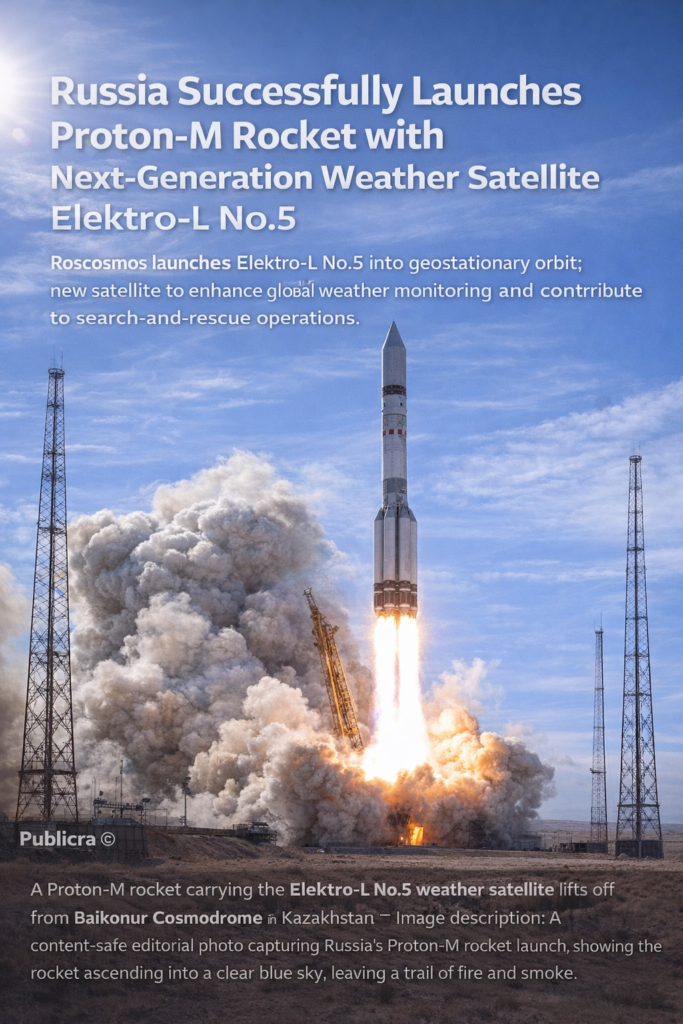
Roscosmos successfully places advanced meteorological satellite into geostationary orbit, strengthening weather forecasting, aviation safety, and Earth monitoring capabilities.
Russia has successfully launched its heavy-lift Proton-M rocket carrying the advanced Elektro-L No.5 meteorological satellite into space, marking another significant milestone for the country’s space and Earth-observation program. The launch took place from the Baikonur Cosmodrome in Kazakhstan and represents a major step in strengthening Russia’s ability to monitor weather systems, climate patterns, and environmental changes across the planet.
The mission placed the Elektro-L No.5 spacecraft on a trajectory toward geostationary orbit, where it will operate more than 35,000 kilometers above the Earth. From this high vantage point, the satellite will provide continuous round-the-clock monitoring of the planet’s atmosphere and surface conditions.
A Powerful Rocket with a Long Legacy
The Proton rocket family has served as a backbone of Russia’s space launch capability for more than six decades. The modernized Proton-M variant, introduced in the early 2000s, continues to play a crucial role in deploying heavy payloads into high orbits. Standing nearly 58 meters tall and weighing more than 700 tonnes at liftoff, the three-stage Proton-M is among the most powerful operational launch vehicles in the world.
This latest mission also represents one of the final chapters in the Proton rocket’s operational life, as Russia gradually transitions to newer launch systems. Despite this, Proton-M remains a trusted platform for delivering large satellites into geostationary orbit, particularly for meteorological and communications purposes.
Elektro-L No.5: A Next-Generation Weather Satellite
The Elektro-L series is Russia’s flagship geostationary meteorological satellite program. Elektro-L No.5 belongs to the latest generation of spacecraft designed to deliver high-resolution images of the Earth in both visible and infrared wavelengths.
Once fully operational, the satellite will:
- Provide continuous full-disk images of the Earth
- Track cloud movements, storms, and cyclones
- Monitor ocean conditions and large-scale weather patterns
- Support aviation and maritime safety through real-time weather data
- Contribute to long-term climate observation
With imaging resolutions of approximately 1 kilometer in visible light and 4 kilometers in infrared bands, Elektro-L No.5 will significantly enhance the precision of weather forecasting and environmental monitoring across Russia and surrounding regions.
Supporting Disaster Response and Search-and-Rescue
Beyond routine weather monitoring, the new satellite plays a crucial role in disaster management. Its data will support early warning systems for severe weather events such as hurricanes, heatwaves, and heavy rainfall. Rapid detection of dangerous atmospheric conditions can help authorities issue timely alerts and reduce the impact of natural disasters on vulnerable communities.
Elektro-L No.5 will also contribute to international search-and-rescue coordination systems. In emergency situations involving ships or aircraft, satellite-based distress signals can be detected and relayed to rescue teams, improving response times and saving lives.
Strengthening Russia’s Space Infrastructure
Elektro-L No.5 joins other operational satellites in the same series already positioned in geostationary orbit. Together, these spacecraft provide continuous coverage of the Earth’s surface, ensuring that no region is left unmonitored.
The satellite has a planned operational lifespan of at least ten years, making it a long-term investment in Russia’s space-based observation network. Such systems are increasingly vital as climate change drives more extreme and unpredictable weather patterns worldwide.
Delays and Technical Challenges
The mission experienced a delay of several weeks due to technical checks conducted during pre-launch inspections. Engineers identified a localized issue in the rocket’s upper stage, prompting additional verification and corrective work before final approval for launch.
While delays are common in spaceflight operations, the successful liftoff highlights the importance of rigorous safety procedures in preventing mission failures. The resolution of technical concerns ensured the mission could proceed with a high level of confidence in the rocket’s performance and the satellite’s deployment sequence.
Geopolitical and Strategic Context
Russia’s continued investment in space-based Earth observation comes at a time of shifting geopolitical dynamics and growing competition in space technology. Meteorological satellites serve not only civilian purposes but also strategic interests, supporting national security, infrastructure protection, and economic planning.
Access to independent weather and environmental data allows countries to maintain autonomy in forecasting and disaster preparedness. For aviation, shipping, agriculture, and energy production, reliable satellite-based weather intelligence is an essential component of modern infrastructure.
The Role of Baikonur Cosmodrome
The Baikonur Cosmodrome, located in Kazakhstan, remains one of the world’s most historic and active launch sites. It has served as the launch point for many of humanity’s major space milestones, from the first human spaceflight to countless satellite deployments.
Despite Russia’s development of newer spaceports within its own territory, Baikonur continues to play a central role in heavy-lift missions such as the Proton-M program. The successful launch of Elektro-L No.5 underscores Baikonur’s enduring importance in global space operations.
The Future of Russia’s Space Program
As Russia modernizes its space infrastructure, future launches are expected to rely more heavily on newer rocket families and next-generation satellite platforms. However, missions like the Elektro-L No.5 launch demonstrate that legacy systems such as Proton-M still provide valuable service during this transitional period.
In the coming years, enhanced weather monitoring will become even more critical as climate-related risks intensify. Advanced satellites will be essential for tracking environmental changes, predicting extreme weather events, and supporting international cooperation on disaster response and climate research.
Looking Ahead:
The successful launch of the Proton-M rocket carrying the Elektro-L No.5 weather satellite marks a significant achievement for Russia’s space and meteorological programs. The mission strengthens global weather monitoring capabilities, supports disaster preparedness, and reinforces the strategic importance of space-based Earth observation in an era of increasing environmental uncertainty.
As Elektro-L No.5 begins its operational life in geostationary orbit, it will play a vital role in enhancing forecasting accuracy, protecting lives, and expanding scientific understanding of Earth’s complex climate systems.