
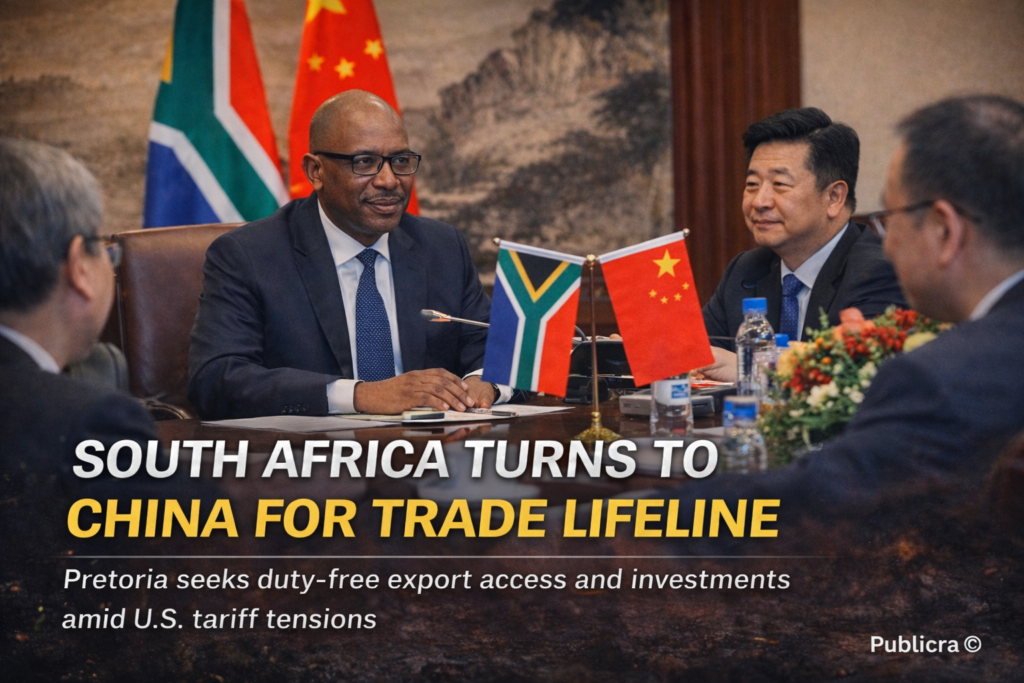
Pretoria seeks duty-free access to Chinese markets and new investment flows as export diversification becomes urgent
A Strategic Pivot in South Africa’s Trade Policy
South Africa is recalibrating its global trade strategy at a critical moment for its export-driven economy. As new tariffs imposed by the United States squeeze South African exporters, Pretoria is accelerating efforts to diversify markets and deepen economic partnerships beyond traditional Western trading partners. The latest move sees South Africa’s Minister of Trade, Industry and Competition, Parks Tau, heading to China to sign the China–Africa Economic Partnership Agreement, a deal expected to grant duty-free access to a range of South African exports entering the Chinese market.
This diplomatic and economic push reflects broader trends reshaping global trade: rising protectionism in developed economies, the growing economic weight of China, and Africa’s search for new pathways to industrial growth and export competitiveness. While China is already South Africa’s largest bilateral trading partner, the agreement aims to upgrade the relationship from commodity-heavy trade to a more diversified, value-added export model.
This article examines why South Africa is deepening trade ties with China now, what duty-free access could mean for key sectors, how U.S. tariffs are reshaping Pretoria’s trade calculus, and what this pivot signals for Africa’s evolving role in global commerce.
Why South Africa Is Seeking Duty-Free Access to China
China has emerged as South Africa’s most important trading partner over the past two decades. Bilateral trade has expanded rapidly, driven largely by South Africa’s exports of minerals and raw materials, including iron ore, platinum group metals, manganese, and coal. However, South African policymakers have long argued that this trade relationship is overly skewed toward primary commodities, leaving the country vulnerable to commodity price swings and limiting industrial development.
Duty-free access under the China–Africa Economic Partnership Agreement is intended to change that dynamic by:
- Improving competitiveness for South African manufactured goods
- Expanding market access for agricultural exports
- Encouraging value-added production
- Supporting export-led industrialization
For Pretoria, preferential access to the Chinese market offers an opportunity to boost non-mineral exports at a time when domestic economic growth remains sluggish and unemployment remains structurally high.
The Impact of U.S. Tariffs on South African Exports
South Africa’s renewed outreach to China is closely linked to growing trade friction with the United States. The imposition of steep tariffs on South African exports has disrupted key sectors, including automotive manufacturing, metals processing, and certain agricultural industries. The U.S. has historically been one of South Africa’s most important export destinations, particularly under preferential trade frameworks that allowed duty-free or reduced-tariff access.
The tariff hikes have had several immediate effects:
- Reduced price competitiveness of South African goods in the U.S. market
- Increased uncertainty for exporters reliant on long-term contracts
- Heightened pressure on industries already struggling with power shortages and logistics bottlenecks
- Accelerated the government’s push for export market diversification
By contrast, China offers scale, growing consumer demand, and a political willingness to deepen economic engagement with African partners through trade agreements, infrastructure investment, and industrial cooperation.
China’s Expanding Economic Footprint in Africa
China’s economic engagement with Africa has expanded dramatically over the past two decades, spanning trade, infrastructure financing, industrial parks, and technology cooperation. For many African governments, China represents not only a market for exports but also a source of capital, manufacturing capacity, and development financing.
In South Africa’s case, Chinese companies are already active in:
- Automotive assembly
- Renewable energy manufacturing
- Mining equipment supply
- Electronics and consumer goods production
During his visit, Trade Minister Parks Tau is expected to meet Chinese firms interested in expanding investment in South Africa. Pretoria hopes to channel these investments into sectors aligned with its industrial policy goals, including green manufacturing, advanced materials, and export-oriented processing industries.
What Duty-Free Access Could Mean for Key Sectors
Agriculture and Agro-Processing
South Africa’s agricultural exporters stand to gain significantly from improved access to China’s vast consumer market. Products such as citrus fruits, wine, beef, nuts, and processed food items could see increased demand if tariff barriers are reduced or eliminated.
However, exporters will still face challenges related to:
- Sanitary and phytosanitary standards
- Logistics and cold-chain infrastructure
- Competition from other agricultural exporters in Africa and Latin America
Duty-free access alone is not sufficient; exporters must also meet quality standards and ensure reliable supply chains.
Manufacturing and Industrial Goods
South Africa’s manufacturing sector has struggled with high production costs, energy constraints, and global competition. Preferential access to China could provide a boost for selected industries, particularly:
- Automotive components
- Machinery and equipment
- Chemicals and fertilizers
- Processed metals
If paired with targeted industrial policy and infrastructure upgrades, improved market access could help South Africa rebuild parts of its manufacturing base and integrate more deeply into global value chains.
Balancing Opportunity and Risk in the China Pivot
While closer trade ties with China offer clear opportunities, South African policymakers are also mindful of potential risks. Critics argue that trade agreements with China can deepen dependency on commodity exports and expose domestic industries to competition from low-cost Chinese imports.
Key concerns include:
- Trade imbalances if imports from China continue to outpace exports
- Pressure on local manufacturers competing with Chinese goods
- Debt sustainability risks linked to infrastructure financing
- Limited technology transfer if investment remains enclave-based
To address these concerns, Pretoria has emphasized the need for balanced agreements that promote local industrialization, skills development, and technology partnerships rather than purely extractive trade relationships.
Market Diversification as a National Strategy
The China outreach is part of a broader market diversification strategy aimed at reducing South Africa’s dependence on a narrow set of export destinations. In addition to China, Pretoria is actively seeking to expand trade with:
- Other African countries under the African Continental Free Trade Area (AfCFTA)
- The Middle East
- Southeast Asia
- Latin America
The AfCFTA, in particular, offers long-term potential to boost intra-African trade, build regional value chains, and reduce vulnerability to external shocks. However, implementation challenges remain, including infrastructure gaps, customs inefficiencies, and regulatory fragmentation.
Geopolitics and the Shifting Global Trade Order
South Africa’s trade diplomacy reflects wider shifts in the global economic order. As major powers increasingly weaponize trade policy for geopolitical purposes, middle-income countries face pressure to navigate competing spheres of influence.
Pretoria’s approach has been to pursue “strategic non-alignment” in trade policy, seeking to maintain economic ties with the West while deepening engagement with China and other emerging markets. This balancing act is becoming more complex as U.S.–China rivalry intensifies and trade rules become increasingly politicized.
Investment, Industrial Policy, and Job Creation
Beyond trade access, South Africa’s leadership views foreign investment as a critical lever for job creation and industrial upgrading. High unemployment remains one of the country’s most pressing challenges, particularly among young people.
Chinese investment, if aligned with national development priorities, could contribute to:
- Manufacturing job creation
- Skills development programs
- Infrastructure upgrades
- Export-oriented industrial clusters
However, achieving these outcomes requires careful negotiation to ensure that investments generate local value addition rather than simply using South Africa as a logistics hub for imported components.
Infrastructure and Logistics: The Missing Link
Trade agreements alone cannot overcome structural constraints in South Africa’s export ecosystem. Chronic challenges in ports, railways, and electricity supply have hampered exporters’ ability to compete globally. For duty-free access to translate into real export growth, parallel investments in:
- Port modernization
- Rail freight capacity
- Energy reliability
- Customs digitization
will be essential. WithouA Trade Strategy Shaped by Global Turbulence
South Africa’s push for duty-free access to China underscores the country’s need to adapt to a rapidly changing global trade environment. With traditional markets becoming more protectionist and geopolitical tensions reshaping supply chains, Pretoria is betting on diversification, South–South cooperation, and deeper engagement with China to sustain export growth and industrial development.
Whether this strategy delivers long-term economic benefits will depend on how effectively South Africa can pair new trade agreements with domestic reforms, infrastructure upgrades, and industrial policy alignment. In a fragmented global economy, the ability to pivot strategically may prove as important as the agreements themselves.t these reforms, South African exporters may struggle to capitalize fully on new market access opportunities.