
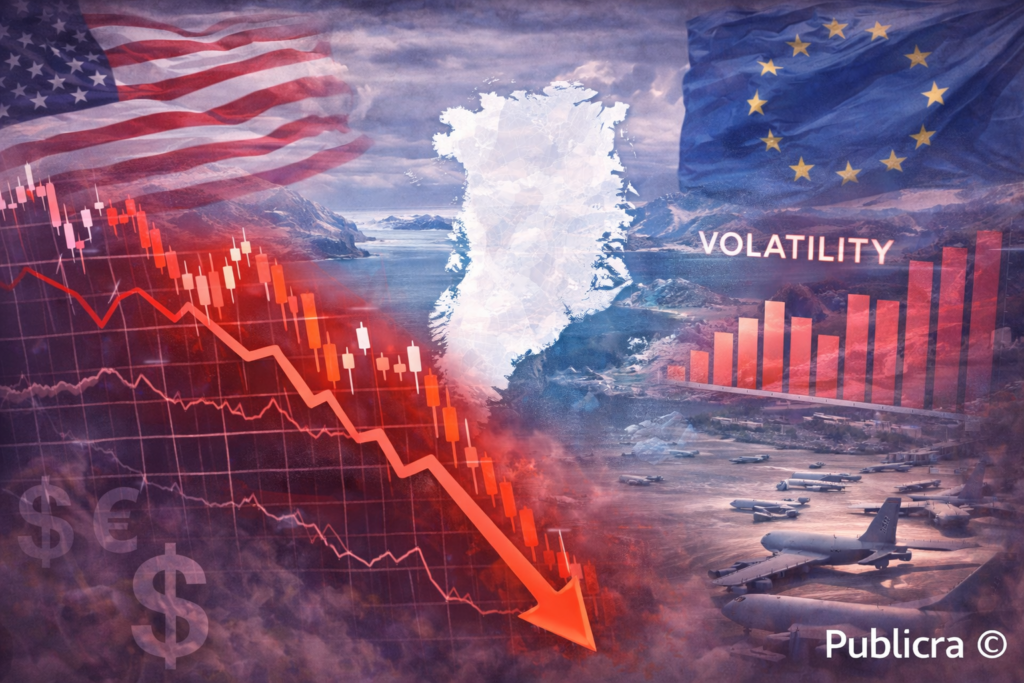
Trade threats tied to Greenland dispute spark sell-off across stocks, dollar and U.S. bonds
Global financial markets were jolted on Tuesday after escalating tensions between Washington and European leaders over Greenland triggered the sharpest stock market decline in months, underscoring growing investor unease over trade policy, geopolitics and the stability of the global economic order.
The S&P 500 fell more than 2 percent, marking its largest single-day decline since October. The drop came as President Donald Trump intensified warnings that the United States could impose steep tariffs on European allies unless they support his push for American control of Greenland, a strategically vital Arctic territory.
Market volatility surged alongside the sell-off. The VIX volatility index, often referred to as Wall Street’s “fear gauge,” climbed to its highest level since November, signaling heightened investor anxiety. While U.S. equities remain close to record highs, Tuesday’s move reflected a notable shift in sentiment after months of relative calm.
A rare “sell America” moment
Unlike previous geopolitical shocks, investors did not flock to traditional U.S. safe-haven assets. Both the U.S. dollar and Treasury bonds declined, suggesting that markets were engaging in what analysts described as a rare “sell America” trade — reducing exposure to U.S. assets rather than rotating within them.
Historically, geopolitical crises have had limited and short-lived effects on corporate earnings. But analysts say the Greenland dispute is being interpreted differently, as it directly threatens trade relations with key European partners and raises the prospect of a new round of tariffs at a time when global growth remains fragile.
Tuesday’s opening losses were the most severe since April, when Trump first proposed sweeping tariffs on nearly all U.S. trading partners. That episode rattled markets but ultimately faded as investors bet the measures would be softened or delayed.
Confidence shaken despite upbeat rhetoric
The market turbulence contrasted sharply with the president’s own remarks. Speaking to reporters, Trump praised what he described as strong investment inflows and robust market performance during his presidency. “We have the hottest country in the world right now,” he said.
Financial markets told a different story. Investors appeared increasingly concerned that trade policy is being used as leverage in broader geopolitical disputes, creating uncertainty for multinational companies and global supply chains.
Broader implications for investors
Wealth managers and strategists urged caution. Eric Teal, chief investment officer at Comerica Wealth Management, said the current environment calls for defensive positioning, including greater geographic and sector diversification.
Beyond equities, European markets also showed signs of stress, while energy and defense stocks experienced mixed reactions as investors attempted to gauge potential winners and losers from a prolonged standoff.
A fragile moment for global markets
The sell-off highlights how quickly investor sentiment can shift when political disputes intersect with economic policy. While the immediate fallout remains contained, analysts warn that prolonged uncertainty over trade, tariffs and geopolitical alliances could weigh more heavily on markets in the months ahead.
For now, investors are watching Washington and Brussels closely, aware that further escalation over Greenland could transform a political dispute into a broader economic confrontation.