
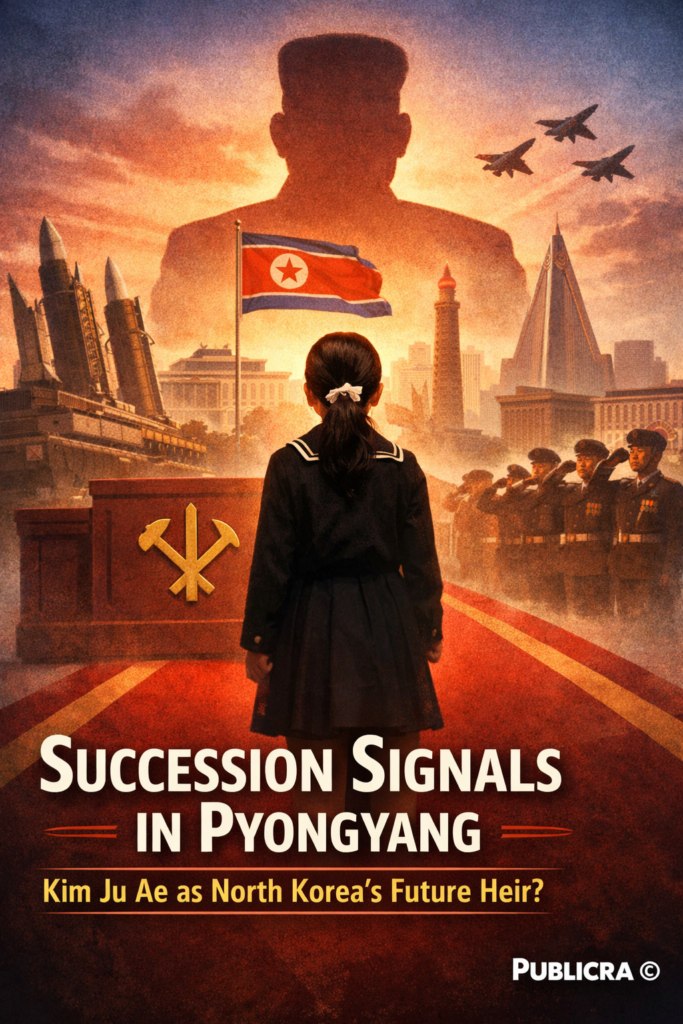
South Korea’s intelligence agency says North Korea’s leader is increasingly positioning his teenage daughter as heir amid rising regional tensions and a crucial ruling party congress.
Succession Signals in Pyongyang: Kim Jong Un’s Teen Daughter Emerges as Future Leader
North Korea’s tightly controlled political system may be preparing for a historic shift. South Korea’s intelligence agency has informed lawmakers that North Korean leader Kim Jong Un is increasingly positioning his teenage daughter, Kim Ju Ae, as a potential successor. While Pyongyang has not made any official announcement, the growing visibility of the young girl at high-profile state events has triggered serious discussion about the future leadership of one of the world’s most secretive regimes.
This development comes at a time of heightened regional tension, expanding military programs, and renewed global scrutiny of North Korea’s nuclear ambitions. The idea that a teenage girl could eventually become the face of the Kim dynasty marks a potentially dramatic evolution in the country’s political narrative.
Growing Visibility of Kim Ju Ae
Kim Ju Ae first appeared publicly alongside her father in recent years, capturing international attention during high-profile military and state events. Unlike previous family members who remained hidden from the public eye until adulthood, her repeated appearances signal a deliberate political choice.
State media coverage has shown her accompanying Kim Jong Un during key moments tied to national security, defense symbolism, and ideological milestones. In North Korea, such appearances are rarely accidental. The regime carefully curates every image released to the public, using visual symbolism to reinforce political messaging.
Her presence at events linked to the military is particularly notable. In North Korean political culture, the military is central to national identity and regime legitimacy. Introducing a potential future leader in this context suggests an effort to associate her image with strength, continuity, and national defense.
What South Korea’s Intelligence Assessment Means
South Korea’s National Intelligence Service (NIS) has reportedly assessed that Kim Ju Ae has moved beyond informal “training” and into a stage of more explicit “successor designation.” This does not mean she has been officially named heir, but rather that her role in public life reflects increasing political significance.
Such assessments are based on a combination of factors:
- Frequency of her public appearances
- Her positioning in official photographs and ceremonies
- The tone and language used by state media when referring to her
- Her presence at strategically important national events
In North Korea, symbolism often carries as much weight as formal titles. Even subtle shifts in protocol or media framing can signal changes in internal hierarchy.
The Importance of the Ruling Party Congress
North Korea’s ruling Workers’ Party is expected to hold a major congress, a rare political event that sets the country’s priorities for the coming years. These congresses often outline national strategies on economic management, military planning, and foreign policy direction.
Analysts believe that any appearance by Kim Ju Ae at this gathering—especially in a prominent position—would reinforce the perception that she is being introduced to political elites as part of a long-term succession plan. The congress serves as a platform for signaling unity, stability, and continuity within the leadership structure.
For Kim Jong Un, showcasing a next-generation figure during such a moment could strengthen internal confidence in the regime’s future and project an image of long-term stability to both allies and adversaries.
A Fourth Generation of the Kim Dynasty?
Since the founding of North Korea, leadership has remained within the Kim family:
- Kim Il Sung established the state
- Kim Jong Il inherited power
- Kim Jong Un became the third-generation leader
If Kim Ju Ae eventually succeeds her father, it would mark the fourth generation of the same family ruling the country. Few modern political systems operate as hereditary monarchies in all but name, yet North Korea has successfully maintained this dynastic model for decades.
This continuity is central to the regime’s identity. The Kim family is portrayed not just as political leaders but as symbolic guardians of the nation’s destiny. Introducing a future heir helps reinforce the narrative that the state and the family are inseparable.
Gender and Power in North Korea
The prospect of a female successor is striking in a system historically dominated by men. North Korean society, particularly its military and political institutions, remains deeply patriarchal. While women hold visible roles in state organizations, ultimate authority has always rested with male leaders.
However, within a dynastic system, bloodline often outweighs traditional gender roles. If Kim Ju Ae is being positioned as successor, it suggests that maintaining the family lineage may be prioritized over cultural norms. This could gradually reshape internal perceptions of leadership, at least within the elite class.
That said, the regime may still be keeping multiple succession options open. In North Korea’s opaque political environment, strategic ambiguity is often used to maintain control and prevent power struggles.
Implications for Nuclear Policy and Security
The succession narrative unfolds against the backdrop of North Korea’s expanding military capabilities. The country continues to invest heavily in missile development, nuclear deterrence, and defense infrastructure. For regional and global security planners, the key concern is continuity of policy rather than the identity of a future leader.
If the regime is signaling a long-term succession plan, it suggests that North Korea intends to maintain its strategic posture for decades to come. This has implications for:
- South Korea’s defense planning
- Regional security dynamics in East Asia
- Long-term diplomatic strategies involving the Korean Peninsula
A clear message of leadership continuity may also be aimed at discouraging expectations of rapid political change or policy moderation.
Domestic Messaging and Regime Stability
Domestically, showcasing a future heir can serve as a powerful tool of regime stability. For North Korea’s elite and general population, the image of a next-generation leader reinforces the idea that the political system is enduring and inevitable.
This can help:
- Strengthen loyalty among officials
- Reduce uncertainty about the future
- Reinforce ideological narratives of destiny and continuity
In tightly controlled political systems, uncertainty is often more dangerous than repression. By presenting a vision of continuity, the regime can discourage internal dissent and power struggles.
International Perception and Strategic Signaling
Externally, the emergence of Kim Ju Ae as a visible political figure sends a message that North Korea views its current leadership structure as stable and forward-looking. This can influence how other countries approach diplomacy, deterrence, and long-term policy planning.
Rather than signaling vulnerability, the succession narrative appears designed to project permanence. For adversaries, it suggests that waiting for regime change may be unrealistic. For allies, it underscores the need for sustained engagement strategies over the long term.
What to Watch Going Forward
Several indicators could clarify whether Kim Ju Ae’s role continues to grow:
- Increased Public Appearances
Continued presence at national ceremonies, military events, and political gatherings would reinforce her emerging status. - Changes in Official Titles or Language
Subtle shifts in how state media refers to her could indicate rising political importance. - Expanded Role Beyond Symbolism
Appearances in governance-related contexts—such as economic inspections or diplomatic events—would suggest broader leadership grooming.
A Carefully Scripted Future
The idea that Kim Jong Un’s teenage daughter is being positioned as a future leader marks a significant moment in North Korea’s evolving political narrative. While no official declaration has been made, the regime’s carefully choreographed symbolism points toward a long-term plan of dynastic continuity.
For the world, this is less about a single individual and more about what the message represents: North Korea intends to project stability, permanence, and continuity in its leadership and strategic direction. Whether Kim Ju Ae ultimately becomes the country’s leader remains uncertain, but her emergence on the global stage is already reshaping how observers interpret the future of Pyongyang.