
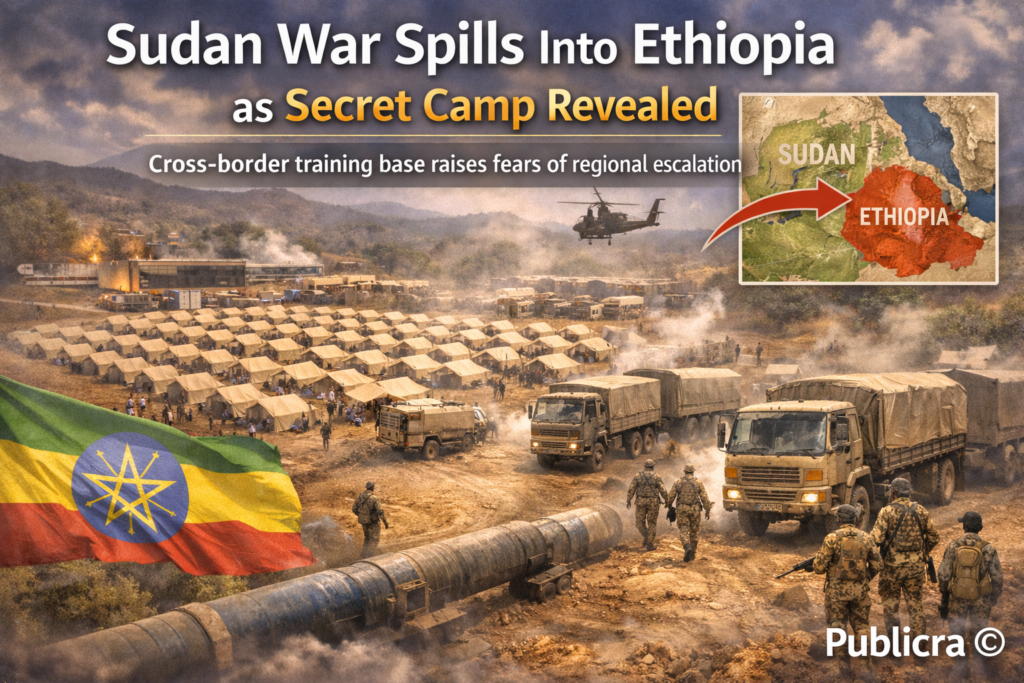
Satellite evidence and diplomatic sources point to covert cross-border military support, raising fears of a wider regional conflict in the Horn of Africa
A Conflict That Refuses to Stay Contained
Sudan’s devastating civil war, now entering its fourth year, is increasingly reshaping the political and security landscape of the Horn of Africa. What began as a power struggle between rival military factions in Khartoum has evolved into one of the world’s gravest humanitarian crises, displacing millions and destabilizing neighboring states. Recent findings based on satellite imagery, diplomatic cables, and regional security sources indicate that the conflict is no longer confined within Sudan’s borders.
According to multiple sources familiar with developments on the ground, a previously undisclosed training site has been established in western Ethiopia to prepare fighters aligned with Sudan’s Rapid Support Forces (RSF). If confirmed, this would represent the first direct evidence of Ethiopia’s involvement in the Sudan conflict and signal a dangerous expansion of the war into an already fragile region.
The revelations raise urgent questions: Why would Ethiopia become entangled in Sudan’s internal war? What role are external actors playing in fueling the conflict? And how might this cross-border militarization affect regional security, humanitarian conditions, and fragile diplomatic balances in Northeast Africa?
Sudan’s Civil War: A Brief Context
Sudan’s civil war erupted after a breakdown in the uneasy power-sharing arrangement between the Sudanese Armed Forces (SAF) and the RSF. What was initially framed as a contest for political control quickly spiraled into a nationwide conflict marked by urban warfare, mass displacement, and widespread human rights abuses.
Humanitarian Fallout
The war has triggered one of the largest displacement crises in recent history:
- Millions have fled to neighboring countries, including Chad, Egypt, South Sudan, and Ethiopia.
- Famine conditions have emerged in multiple regions.
- Ethnic violence and targeted attacks have drawn international condemnation.
As the conflict persists, the growing involvement of regional and external actors has complicated peace efforts, transforming Sudan into a focal point of proxy competition and strategic maneuvering.
The Alleged Training Camp in Western Ethiopia
Satellite Imagery and Ground Reports
Recent satellite images from commercial providers show the rapid construction of a large encampment in Ethiopia’s Benishangul-Gumuz region, close to the Sudanese border. The site features:
- Hundreds of tents arranged in military-style formations
- Newly cleared forest areas and vehicle tracks
- Heavy truck traffic and ongoing construction
Defense analysts who reviewed the imagery noted patterns consistent with temporary training facilities, though imagery alone cannot conclusively establish military purpose.
Location and Strategic Significance
The camp’s reported location is strategically sensitive. Benishangul-Gumuz borders Sudan and lies near key transport routes linking Ethiopia, Sudan, and South Sudan. The proximity to critical infrastructure, including Ethiopia’s major hydroelectric installations, adds another layer of security concern.
Regional diplomats have expressed alarm that the area could become a flashpoint if hostilities spill over, potentially threatening vital economic and energy assets.
Ethiopia’s Regional Calculus
Ethiopia occupies a pivotal position in the Horn of Africa, sharing borders with several conflict-affected states. Its own internal security challenges and geopolitical interests complicate its role in regional conflicts.
Why Ethiopia Matters
- Ethiopia has historically acted as a mediator in regional disputes.
- It hosts the African Union headquarters, giving it diplomatic prominence.
- Border stability is critical for its domestic development and security.
Allegations of hosting a training camp for foreign fighters would mark a significant departure from Ethiopia’s traditional posture of cautious non-intervention, potentially undermining its role as a regional stabilizer.
External Actors and the Shadow of Proxy Warfare
Sudan’s war has drawn in multiple external players, each pursuing distinct strategic interests. The reported involvement of foreign funding and logistical support underscores how the conflict is becoming increasingly internationalized.
Proxy Dynamics in the Horn of Africa
The Horn of Africa has long been a theater for overlapping rivalries:
- Gulf states seeking influence along Red Sea trade routes
- Global powers competing for strategic footholds
- Regional governments balancing security concerns and alliances
Such dynamics risk transforming Sudan’s internal conflict into a broader proxy war, with neighboring countries becoming staging grounds for armed groups.
The RSF’s Expanding Footprint
The RSF, originally formed as a paramilitary force, has evolved into a formidable military actor with access to external support networks. Reports of cross-border training and recruitment suggest the group is seeking to replenish its ranks and sustain operations in contested regions of Sudan.
Recruitment Beyond Sudan
Sources indicate that recruits may include individuals from neighboring countries, reflecting how economic hardship, porous borders, and local grievances create fertile ground for transnational recruitment. This trend mirrors patterns seen in other protracted conflicts across Africa and the Middle East.
Security Implications for the Region
Risk of Escalation
The establishment of training facilities near international borders increases the risk of accidental or deliberate clashes between state forces and armed groups. Such incidents could rapidly escalate, drawing neighboring states deeper into the conflict.
Threats to Critical Infrastructure
Concerns have also been raised about the proximity of alleged military facilities to strategic infrastructure, including dams, transport corridors, and energy projects. Any spillover of violence could jeopardize regional development initiatives and exacerbate existing economic strains.
International Reactions and Diplomatic Pressure
The international community has repeatedly called for de-escalation in Sudan and urged neighboring countries to avoid actions that could widen the conflict. However, enforcement mechanisms remain limited.
Calls for Accountability
Human rights organizations and diplomatic missions have urged greater transparency regarding cross-border military activities and the flow of weapons and fighters into Sudan. Without meaningful accountability, the risk of regional destabilization remains high.
Peace Prospects: Dim but Not Extinguished
Efforts to broker a ceasefire in Sudan have repeatedly faltered, undermined by distrust among warring parties and the involvement of external actors. The emergence of alleged training camps beyond Sudan’s borders complicates peace negotiations by altering the military balance on the ground.
Nevertheless, regional and international mediators continue to press for:
- Humanitarian corridors
- Confidence-building measures
- Inclusive political dialogue
Without sustained diplomatic engagement, the conflict’s regionalization could make a negotiated settlement even more elusive.
A Widening Arc of Instability
The emergence of alleged training facilities beyond Sudan’s borders underscores a troubling reality: Sudan’s civil war is no longer a contained national tragedy but a growing regional security crisis. As neighboring states and external actors become more entangled, the risk of a wider conflagration increases—one that could destabilize the Horn of Africa for years to come.
Preventing further escalation will require urgent diplomatic engagement, transparent investigations into cross-border activities, and sustained international pressure to halt the flow of arms and fighters. Without these measures, the conflict’s regionalization may prove irreversible, deepening human suffering and undermining prospects for lasting peace.