
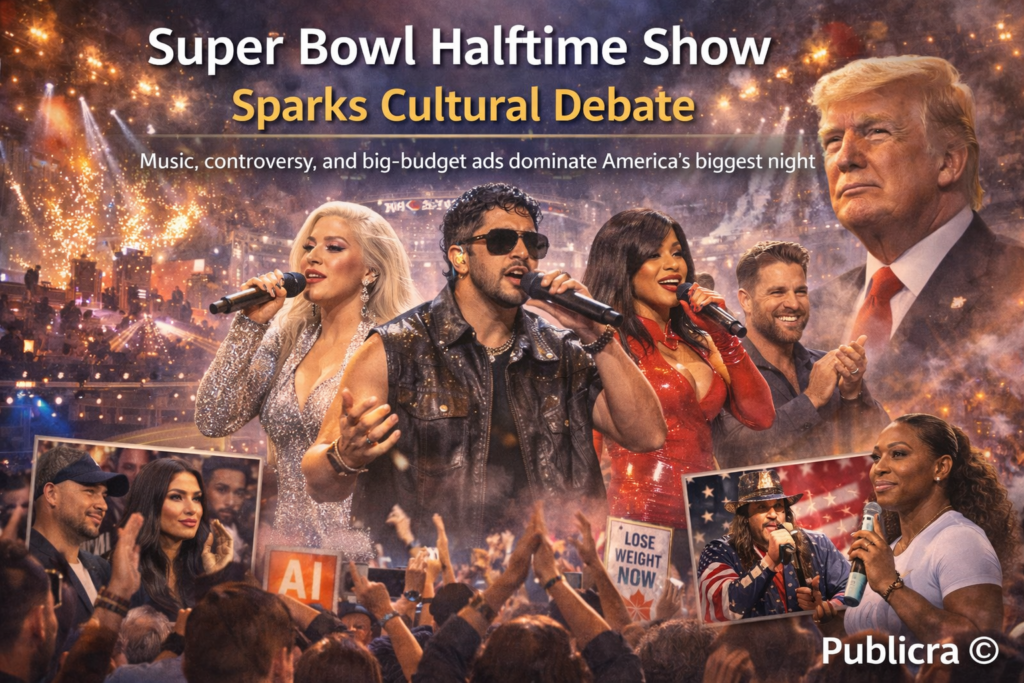
From Bad Bunny’s polarizing halftime show to AI ad battles and celebrity endorsements, America’s biggest sports night becomes a mirror of its cultural divides
When the Super Bowl Becomes a Cultural Barometer
The Super Bowl has long been more than a championship football game. It is America’s most-watched annual media event—a stage where music, celebrity, politics, advertising, and national identity collide. This year’s Super Bowl once again proved that the halftime show and ad breaks can spark as much debate as the game itself.
From a star-studded halftime performance led by global music icon Bad Bunny to celebrity sightings in the stands and a wave of controversial advertisements featuring AI companies and weight-loss drugs, the event became a cultural flashpoint. Reactions ranged from enthusiastic praise to sharp political criticism, highlighting how entertainment, identity, and commerce intersect in an increasingly polarized society.
This article explores the biggest takeaways from the Super Bowl spectacle: the cultural significance of the halftime show, the politicization of pop culture, the rise of AI in advertising, the ethics of celebrity endorsements, and what it all says about the evolving American media landscape.
The Halftime Show: Global Pop Meets American Prime Time
The halftime show has become a defining element of the Super Bowl’s global appeal. This year’s performance leaned heavily into Latin pop and pan-American cultural symbolism, signaling the NFL’s growing recognition of diverse audiences both in the United States and worldwide.
A Global Stage for Latin Music
Bad Bunny, one of the world’s most-streamed artists, brought Spanish-language music to one of the largest television audiences on Earth. Joined by fellow global stars, the performance celebrated Caribbean and Latin cultural motifs through set design, dance, and visual storytelling.
Supporters praised the show for expanding representation and reflecting the multicultural reality of modern America. Critics, however, questioned whether a performance dominated by Spanish-language lyrics resonated with traditional Super Bowl audiences, illustrating the ongoing debate over cultural inclusion in mainstream entertainment.
Celebrity Culture in the Stands: When Sports Meets Pop Spectacle
The Super Bowl’s allure extends beyond the field. Celebrity sightings have become a staple of the broadcast, transforming the event into a convergence point for sports, entertainment, and fashion.
High-profile appearances by figures from sports, music, and reality television fueled online speculation and tabloid headlines, underscoring how celebrity culture now functions as a parallel narrative to the game itself. For many viewers, these moments are part of the entertainment package—blurring the line between sport and celebrity spectacle.
Politics and the Halftime Show: When Art Becomes a Battleground
The backlash against the halftime performance highlighted how pop culture has become increasingly politicized. Criticism from political figures and commentators framed the show as a symbol of broader cultural debates about language, national identity, and the role of global influences in American entertainment.
This dynamic reflects a wider trend: major cultural events are no longer viewed as neutral spaces. Instead, they become platforms where competing visions of national identity are contested. The Super Bowl, with its massive audience and symbolic importance, amplifies these debates.
Alternative Programming and the Fragmentation of Audiences
The emergence of alternative halftime programming streamed online points to a growing fragmentation of media audiences. Viewers dissatisfied with the official broadcast now have the option to seek out parallel content aligned with their political or cultural preferences.
This trend mirrors broader changes in media consumption, where streaming platforms and social media allow niche communities to curate their own “counter-programming.” The result is a media ecosystem where shared national moments are increasingly contested rather than universally experienced.
Super Bowl Ads: The High-Stakes Marketing Arena
Super Bowl advertising remains one of the most expensive and high-impact marketing opportunities in the world. Brands spend millions for a few seconds of airtime, hoping to capture attention in a crowded media environment.
This year’s ads reflected two major trends:
1. The Rise of AI in Consumer Marketing
Artificial intelligence companies used Super Bowl slots to introduce their products to mainstream audiences. The messaging focused on everyday utility—positioning AI assistants as tools for communication, productivity, and emotional support.
These ads signal a turning point in how AI firms market themselves: moving beyond tech-savvy early adopters to target households and families. The presence of multiple AI brands competing for attention also highlights the intensifying race for consumer trust in a rapidly evolving sector.
2. Health and Wellness Advertising Under Scrutiny
Ads promoting weight-loss medications and telehealth services sparked debate about the ethics of pharmaceutical marketing during a family-oriented event. Celebrity endorsements added star power but also raised concerns about body image, medicalization of weight management, and the influence of celebrity culture on health decisions.
Public reaction revealed a growing skepticism toward wellness marketing that blends lifestyle branding with medical products. The controversy underscores the need for transparent, responsible advertising in an era where health products are increasingly marketed through celebrity narratives.
The Commercialization of Culture: Where Do We Draw the Line?
The Super Bowl’s blend of entertainment and advertising raises broader questions about the commercialization of culture. When global pop stars perform on one of the world’s largest stages and pharmaceutical or tech companies dominate ad breaks, the event becomes a microcosm of how culture is monetized in the modern media economy.
Critics argue that the spectacle risks overshadowing the sport itself, turning the game into a vehicle for branding and cultural messaging. Supporters counter that this fusion is what makes the Super Bowl a uniquely American cultural phenomenon—one that reflects the country’s diversity, consumerism, and media power.
Social Media’s Role: Amplifying Praise and Backlash
Social media platforms have transformed how audiences experience the Super Bowl. Reactions to performances and ads unfold in real time, with viral clips, memes, and hot takes shaping public perception almost instantly.
This real-time feedback loop amplifies polarization. Supporters and critics alike find communities that reinforce their views, making it harder for a single narrative about the event to dominate. For brands and performers, social media engagement can be both a marketing boon and a reputational risk.
What This Year’s Super Bowl Says About America
Beyond the touchdowns and trophies, this year’s Super Bowl reflected several deeper trends in American society:
- Cultural diversification of mainstream entertainment
- Political polarization extending into pop culture
- Technological normalization of AI in daily life
- Commercial influence shaping public health narratives
The event served as a mirror of a society navigating rapid cultural change, technological disruption, and contested ideas about identity and values.
A Game That Reflects Its Time
The Super Bowl remains a defining moment in American popular culture—not just for sports fans, but for anyone interested in how entertainment, politics, and commerce intersect. This year’s event showed how a single night of football can spark nationwide conversations about representation, technology, health, and identity.
As the lines between sport, spectacle, and social debate continue to blur, the Super Bowl’s role as a cultural barometer is only likely to grow. Whether celebrated as a unifying event or criticized as a flashpoint for controversy, it remains a powerful mirror of the society that watches it.