
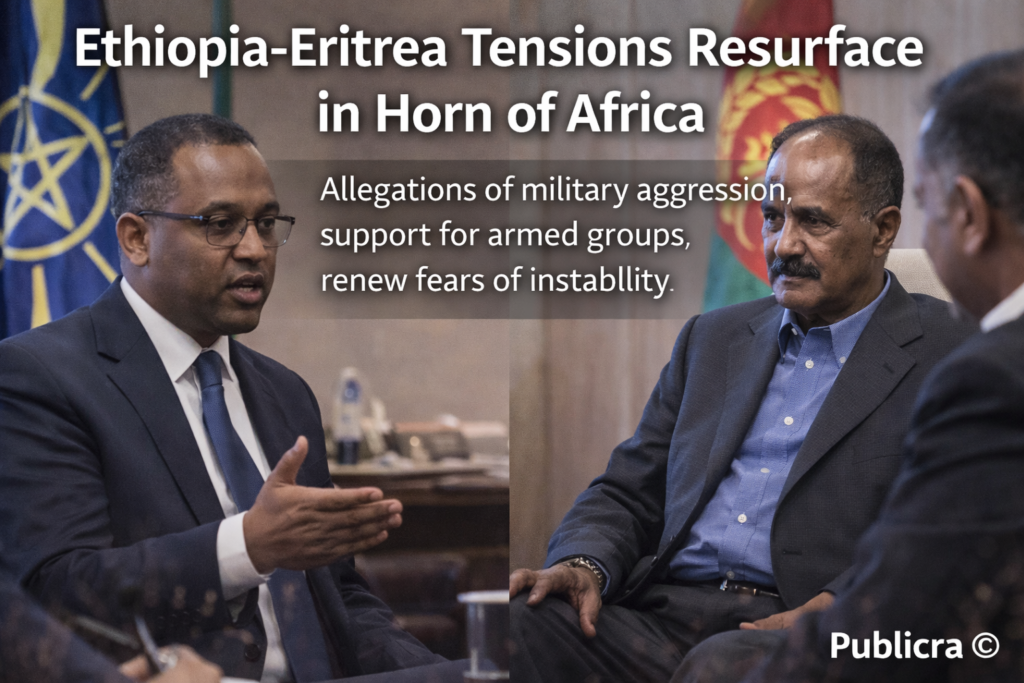
Addis Ababa warns of escalating security risks, alleges Eritrean military presence and support for armed groups, while calling for dialogue
A Fragile Peace Under Strain
Relations between Ethiopia and Eritrea—two nations whose modern history has been shaped by war, uneasy truces, and shifting alliances—have once again entered a dangerous phase. Ethiopian officials have accused neighboring Eritrea of conducting military incursions into Ethiopian territory and providing material support to armed groups operating inside the country. The allegations come amid renewed fighting in northern Ethiopia and growing concerns that the Horn of Africa could slide back into large-scale conflict.
While the two countries signed a landmark peace agreement in 2018 after decades of hostility, the post-war settlement that ended Ethiopia’s devastating conflict in Tigray in 2022 did not include Eritrea as a formal party. Since then, mutual suspicion has deepened, and diplomatic channels have grown strained. The latest accusations mark one of the most serious diplomatic confrontations between Addis Ababa and Asmara in recent years.
This article examines the roots of the Ethiopia–Eritrea dispute, the evolving security dynamics along their border, the regional implications of renewed tensions, and the prospects for de-escalation in one of Africa’s most strategically sensitive regions.
A History of Conflict and Fragile Reconciliation
Ethiopia and Eritrea share one of the most complex and volatile relationships in Africa. After Eritrea gained independence in 1993 following a long liberation struggle, tensions over border demarcation quickly escalated into a full-scale war between 1998 and 2000. The conflict claimed tens of thousands of lives and left both countries economically and politically scarred.
For nearly two decades after the war, relations remained frozen, with troops stationed along the border and diplomatic engagement minimal. The 2018 peace deal, brokered after Ethiopian Prime Minister Abiy Ahmed came to power, was hailed internationally as a breakthrough. The agreement reopened borders, restored diplomatic ties, and earned Abiy the Nobel Peace Prize.
However, the rapprochement proved fragile. While Ethiopia and Eritrea later aligned during Ethiopia’s war with the Tigray People’s Liberation Front (TPLF), that wartime alliance did not translate into a comprehensive, lasting settlement of their underlying disputes.
Post-Tigray Uncertainty and Renewed Friction
The 2022 agreement that formally ended Ethiopia’s conflict in Tigray brought a measure of relief to a region devastated by war, famine, and displacement. Yet the exclusion of Eritrea from that agreement has left unresolved questions about the future of Eritrean troops that had operated inside Ethiopian territory during the conflict.
Since the cessation of hostilities, sporadic clashes between Ethiopian federal forces and armed groups in northern regions have heightened fears of renewed instability. Against this backdrop, Ethiopian officials now allege that Eritrea is not only maintaining a military presence in disputed areas but also supporting armed factions hostile to Addis Ababa.
Eritrean authorities have denied wrongdoing in the past and have often accused Ethiopia of failing to fully implement aspects of previous agreements. The lack of transparent mechanisms for monitoring border security has fueled mistrust on both sides.
Border Disputes and the Question of Territorial Integrity
At the heart of the Ethiopia–Eritrea dispute lies the unresolved demarcation of their shared border. Although an international boundary commission ruled on the border following the 1998–2000 war, implementation has been uneven, with both sides contesting certain areas.
Ethiopia’s latest allegations point to what it describes as Eritrean military occupation of parts of Ethiopian territory. Such claims, if substantiated, could further complicate an already volatile security environment and risk drawing both countries into direct confrontation.
Border tensions are not merely symbolic; they have tangible implications for local communities, trade routes, and regional stability. Villages along the frontier have long borne the brunt of militarization, with residents facing displacement, restricted movement, and limited access to basic services.
Red Sea Access and Strategic Competition
Another sensitive dimension of the dispute involves Ethiopia’s long-standing quest for reliable access to the sea. As a landlocked country since Eritrea’s independence, Ethiopia depends heavily on ports in neighboring Djibouti for its imports and exports. Ethiopian leaders have periodically raised the issue of alternative maritime access, including through Eritrean ports.
While Addis Ababa frames such discussions as economic and strategic necessities, officials and analysts in Eritrea often interpret them as implicit pressure on Eritrean sovereignty. The Red Sea corridor is a vital global shipping lane, and any tensions involving access to ports along its coastline carry regional and international significance.
The strategic importance of maritime access has become more pronounced as global trade patterns shift and geopolitical competition in the Red Sea region intensifies. External powers with interests in shipping routes, energy security, and military basing are closely watching developments between Ethiopia and Eritrea.
Regional Implications: The Horn of Africa at a Crossroads
Renewed Ethiopia–Eritrea tensions threaten to destabilize a region already grappling with multiple crises. The Horn of Africa faces overlapping challenges, including civil conflicts, humanitarian emergencies, climate shocks, and fragile political transitions in neighboring countries.
Any escalation between Addis Ababa and Asmara could have ripple effects across the region, potentially affecting:
- Trade corridors linking East Africa to the Middle East and beyond
- Peace and security initiatives involving regional organizations
- Humanitarian access to conflict-affected populations
- The stability of fragile post-conflict arrangements in northern Ethiopia
The African Union, headquartered in Addis Ababa, has a vested interest in preventing renewed interstate conflict among its member states. Regional diplomats have emphasized the need for dialogue and confidence-building measures to prevent a return to war.
International Responses and Diplomatic Efforts
The international community has expressed concern over signs of rising tensions between Ethiopia and Eritrea. Western governments, the United Nations, and regional bodies have called for restraint and renewed diplomatic engagement. Russia and other global actors with ties to both countries are also monitoring the situation closely.
International mediators face a delicate task: encouraging dialogue without appearing to side with either party. The legacy of past interventions in the Horn of Africa has made both Ethiopia and Eritrea wary of external pressure, complicating efforts to broker de-escalation.
Diplomatic channels remain open, but trust deficits and competing strategic interests have hindered meaningful progress toward a comprehensive settlement of outstanding disputes.
Humanitarian Concerns and Civilian Impact
Beyond the geopolitical stakes, renewed tensions raise serious humanitarian concerns. Border regions are home to vulnerable populations still recovering from years of conflict and displacement. Any escalation could disrupt fragile recovery efforts, strain humanitarian supply chains, and worsen food insecurity.
Civil society organizations have urged both governments to prioritize civilian protection and avoid actions that could reignite large-scale hostilities. The memory of the humanitarian toll of the Tigray conflict remains fresh, underscoring the high cost of renewed war.
Prospects for Dialogue: Is De-Escalation Possible?
Despite the sharp rhetoric, Ethiopian officials have signaled openness to dialogue if Eritrea respects Ethiopia’s territorial integrity. The path to de-escalation likely depends on several factors:
- Establishing mechanisms for verifying troop movements along the border
- Reviving bilateral communication channels
- Engaging regional mediators to facilitate confidence-building measures
- Addressing underlying disputes over borders and maritime access
A durable peace will require more than tactical de-escalation. It will demand a comprehensive framework that addresses historical grievances, security concerns, and economic interdependence between the two neighbors.
A Critical Juncture for Peace in the Horn of Africa
The latest exchange of accusations between Ethiopia and Eritrea underscores how fragile the peace between the two neighbors remains. While the 2018 rapprochement raised hopes for a new era of cooperation, unresolved disputes and shifting regional dynamics continue to threaten stability.
As tensions rise, the choices made by leaders in Addis Ababa and Asmara will shape the future of the Horn of Africa. Whether the region moves toward renewed confrontation or finds a path back to dialogue will have far-reaching consequences—not only for the two countries involved, but for an entire region striving to emerge from years of conflict.