
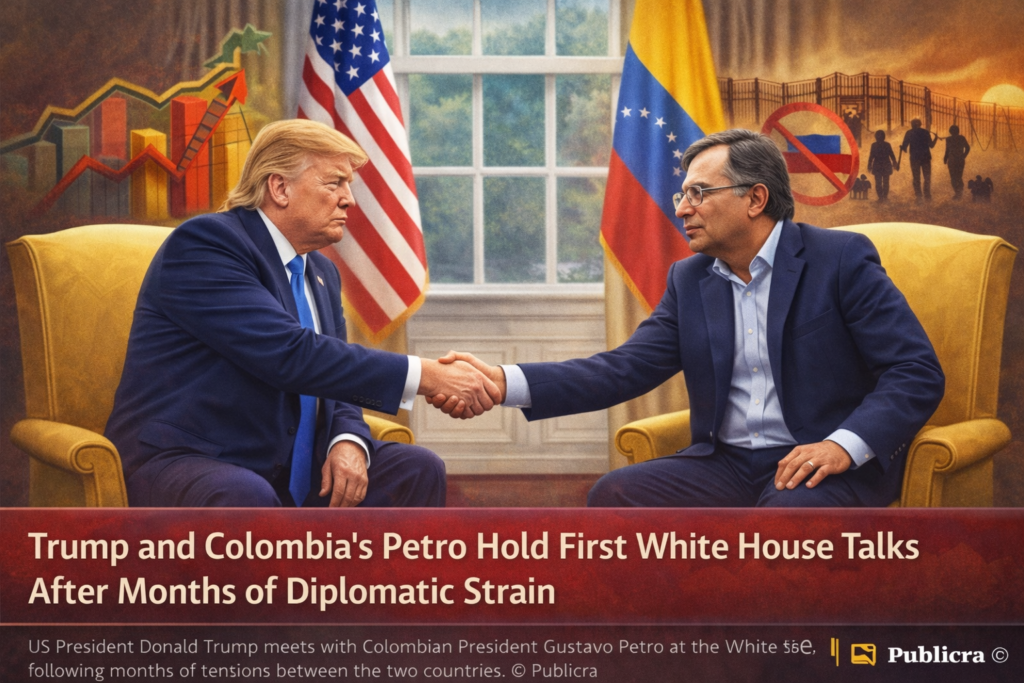
The first face-to-face meeting between President Donald Trump and Colombia’s Gustavo Petro comes after months of sharp rhetoric, sanctions, and tensions over Venezuela, drugs, and immigration.
A High-Stakes Diplomatic Encounter
President Donald Trump welcomed Colombian President Gustavo Petro to the White House on Tuesday, marking their first in-person meeting after months of diplomatic strain that had pushed one of Washington’s closest regional alliances to the brink.
The encounter follows a volatile period marked by public insults, visa revocations, sanctions, and threats of military action—triggered largely by disagreements over US operations in Venezuela, counter-narcotics strategy, and Trump’s aggressive immigration crackdown.
While both leaders have signaled a desire to cool tensions, analysts warn the meeting represents a fragile reset rather than a full reconciliation.
Why the Meeting Matters
The US–Colombia relationship has long been a pillar of American policy in Latin America. For decades, Colombia has been:
- A key US ally in counter-narcotics operations
- A strategic partner in regional security
- A recipient of billions in US military and development aid
The deterioration of ties under Trump and Petro has raised alarms across diplomatic and security circles, making Tuesday’s meeting a pivotal moment.
A Relationship Defined by Public Confrontation
Tensions between Trump and Petro escalated soon after Trump returned to office.
Key flashpoints included:
- US deportations of Colombian migrants
- Petro’s criticism of US policy toward Israel and Gaza
- US naval and boat strikes against alleged drug traffickers
- A controversial US military raid in Venezuela
Petro publicly condemned the US actions as “murders” and accused Washington of destabilizing the region. Trump responded by revoking Petro’s visa, imposing sanctions on members of the Colombian government, and labeling Petro a “sick man.”
Venezuela at the Center of the Dispute
The most serious rupture came after US forces captured Venezuelan President Nicolás Maduro in a military operation earlier this year.
Petro denounced the move and warned that Colombia could be next, framing the action as a violation of Latin American sovereignty. Trump, in turn, suggested that Colombia might face US military pressure if it obstructed American operations.
The exchange triggered nationwide protests in Colombia and led Petro to call for mass demonstrations against what he described as US imperialism.
Signs of a Thaw
Despite the confrontations, back-channel diplomacy helped avert a full breakdown.
Colombia’s ambassador to Washington rushed to arrange a phone call between the two leaders, which both later described as productive. Trump announced Petro’s invitation to the White House shortly afterward, suggesting a shift in tone.
“After the Venezuelan raid, he became very nice,” Trump said ahead of the meeting, adding that he expected a “good” discussion.
Drugs, Migration, and Security on the Agenda
Trump made clear that drug trafficking would be a central topic.
“We’re going to be talking about drugs,” Trump said, accusing Colombia of flooding the US with cocaine.
Petro’s government countered that Colombia has made significant gains in cocaine seizures and is investing in crop-substitution programs to help farmers transition away from coca cultivation.
As a symbolic gesture, Petro reportedly brought gifts of coffee and chocolate produced under legal crop-replacement initiatives.
Immigration Crackdown Looms Large
Immigration remains a major point of contention.
Trump’s administration has launched aggressive enforcement operations across the US, including controversial raids that have resulted in the deaths of two US citizens. Congressional Democrats have called for investigations into federal agents’ use of force.
Petro has compared US immigration practices to “slavery,” remarks that revived concerns ahead of the White House meeting.
Domestic Pressure on Petro
Before leaving Bogotá, Petro urged Colombians to take to the streets in solidarity, calling the meeting part of a broader “pact for life” that he hopes will include:
- Climate action
- Regional cooperation
- Reduced militarization
Supporters planned rallies in Washington outside Colombia’s embassy as the meeting took place.
The US Political Backdrop
The meeting unfolded amid broader domestic turmoil in Washington.
At the same time:
- The House prepared votes to end a partial government shutdown
- Democrats pressed for oversight of immigration enforcement
- Farm groups warned Trump’s policies could trigger an agricultural collapse
- Senate committees advanced contentious nominations
The administration’s foreign policy agenda is deeply intertwined with domestic political battles.
Analysts Warn of Volatility
Experts say the meeting carries both promise and risk.
Both leaders are known for:
- Fiery rhetoric
- Unscripted remarks
- Strong ideological positions
A single off-hand comment could derail progress, even as both sides seek stability.
Colombia’s Strategic Dilemma
Petro faces a delicate balancing act:
- Maintaining US security cooperation
- Asserting regional independence
- Managing domestic political expectations
Colombia’s economy and security remain closely tied to Washington, limiting Petro’s room to maneuver.
Climate Change: A Potential Area of Cooperation
One area of possible alignment is climate policy.
Petro has positioned himself as a regional environmental leader, calling for a transition away from fossil fuels and drug-war militarization. Trump, while skeptical of climate initiatives, has shown interest in strategic environmental partnerships tied to security and migration.
Whether climate issues gain traction remains uncertain.
What Success Would Look Like
Diplomats say a successful meeting would include:
- Restoration of visas and diplomatic channels
- Reduced public rhetoric
- Agreement on counter-narcotics cooperation
- Clear communication on Venezuela
Anything less may simply postpone further confrontation.
Reset or Temporary Truce?
Tuesday’s meeting between Trump and Petro represents a critical test for US–Colombia relations.
While both leaders have incentives to stabilize ties, deep ideological differences and unresolved disputes remain. Whether this encounter marks a genuine reset—or merely a pause in hostilities—will depend on what follows after the cameras leave the room.