
White House pivots to Section 122 authority, triggering fresh uncertainty for global trade, markets, and U.S. consumers
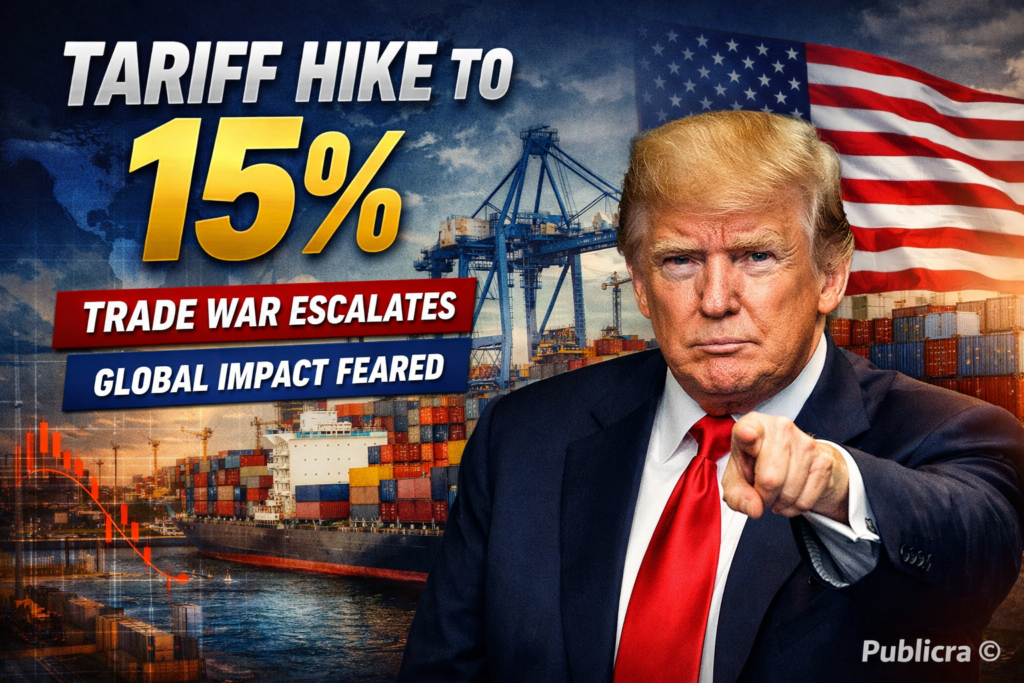
The United States has announced a temporary 15% tariff on nearly all imported goods, marking a significant escalation in its ongoing trade policy shift. The move follows a court ruling that blocked the government’s earlier attempt to impose sweeping tariffs under emergency powers.
By switching to a different legal provision that allows short-term tariff increases, the administration has restored its ability to apply broad import taxes — but only for a limited period. This has triggered fresh uncertainty across global markets, disrupted trade planning for businesses, and raised concerns about rising prices for American consumers.
While the tariff is officially temporary, the political and economic effects could last far longer.
Why the United States Raised Global Tariffs to 15%
The tariff hike is being implemented under a legal mechanism that permits the government to impose temporary trade restrictions when imports are believed to threaten economic stability. The 15% rate represents the maximum allowed under this provision and can only remain in force for a short period before legislative approval is required.
The administration argues that the higher tariff is necessary to protect domestic industries, reduce trade imbalances, and strengthen negotiating power with foreign governments. Supporters say the move will encourage local manufacturing and discourage excessive reliance on foreign goods.
Critics, however, warn that the policy may backfire by raising costs for businesses and consumers, weakening trade relationships, and slowing economic growth.
How the Tariff Could Affect Consumer Prices in the US
Tariffs are paid by importers when goods enter the country. In most cases, these additional costs are passed on to consumers through higher retail prices. Products ranging from electronics and household items to clothing and food packaging materials may see price increases.
Even goods produced domestically can become more expensive if manufacturers rely on imported raw materials or components. As a result, inflationary pressure may spread across multiple sectors of the economy.
Low- and middle-income households are expected to feel the impact most sharply, as they spend a higher proportion of their income on everyday consumer goods.
Impact on Businesses and Supply Chains
For businesses, the sudden shift in tariff policy creates operational challenges. Import-dependent companies must quickly adjust pricing strategies, renegotiate contracts, or absorb higher costs.
Many manufacturers and retailers are already exploring alternative supply chains, seeking suppliers in different countries, or relocating parts of their production process. While diversification can reduce long-term risk, it often increases short-term costs and complexity.
Smaller businesses, in particular, may struggle to adapt due to limited bargaining power and thinner profit margins.
Global Trade Relations and Diplomatic Tensions
The 15% tariff has implications far beyond the United States. Trading partners may view the move as a hostile trade action, potentially leading to retaliatory tariffs or diplomatic friction.
Countries that previously negotiated trade arrangements with the US may now question the reliability of those agreements, given how quickly trade policy can change. This erosion of trust could slow future negotiations and weaken international cooperation on trade and economic issues.
At the same time, the uncertainty surrounding future tariff decisions complicates long-term investment planning for multinational corporations.
The Temporary Nature of the Tariff and What Comes Next
The current tariff is legally limited in duration. Once the temporary window expires, lawmakers will be required to decide whether to extend, modify, or terminate the measure.
The government has indicated that additional trade actions may follow, potentially targeting specific countries or product categories through formal investigations. These future measures could replace the temporary global tariff with more targeted but longer-lasting import restrictions.
This means that even if the 15% tariff expires, the overall direction of trade policy may remain protectionist.
Refunds and Legal Uncertainty for Past Tariffs
Another unresolved issue is whether businesses that paid duties under the earlier, now-invalidated tariff program will be eligible for refunds. The legal and administrative process for recovering such payments is complex and could take years to resolve.
Many small and medium-sized enterprises lack the legal resources to pursue lengthy refund claims, which may result in uneven financial outcomes across different sectors of the economy.
What Importers and Exporters Should Prepare For
In response to the tariff hike, businesses are likely to accelerate strategic planning, including:
- Reviewing pricing structures and profit margins
- Renegotiating supplier and distributor contracts
- Exploring alternative sourcing and manufacturing locations
- Adjusting inventory management to reduce exposure to sudden cost increases
Companies that act early may be better positioned to manage volatility, while those that delay adjustments could face sudden financial strain.
How This Could Shape the Global Economy in 2026
The reintroduction of broad tariffs signals a shift toward a more fragmented global trading system. If other nations respond with their own trade barriers, international commerce could become more regionalized, reducing efficiency but increasing domestic production in some countries.
Such a trend may reshape global supply chains over the next several years, with long-term consequences for prices, availability of goods, and the pace of economic growth.
A Temporary Measure With Long-Term Consequences
Although the 15% global tariff is officially temporary, its impact is likely to extend far beyond its legal time limit. The move has already introduced new uncertainty into global trade, pressured businesses to rethink supply strategies, and raised concerns about inflation for consumers.
As policymakers debate the future of the tariff, the broader direction of trade policy suggests a continued reliance on import restrictions as a strategic tool. Whether this approach strengthens domestic industries or ultimately burdens households and businesses will become clearer as the global economy adjusts in the months ahead.