
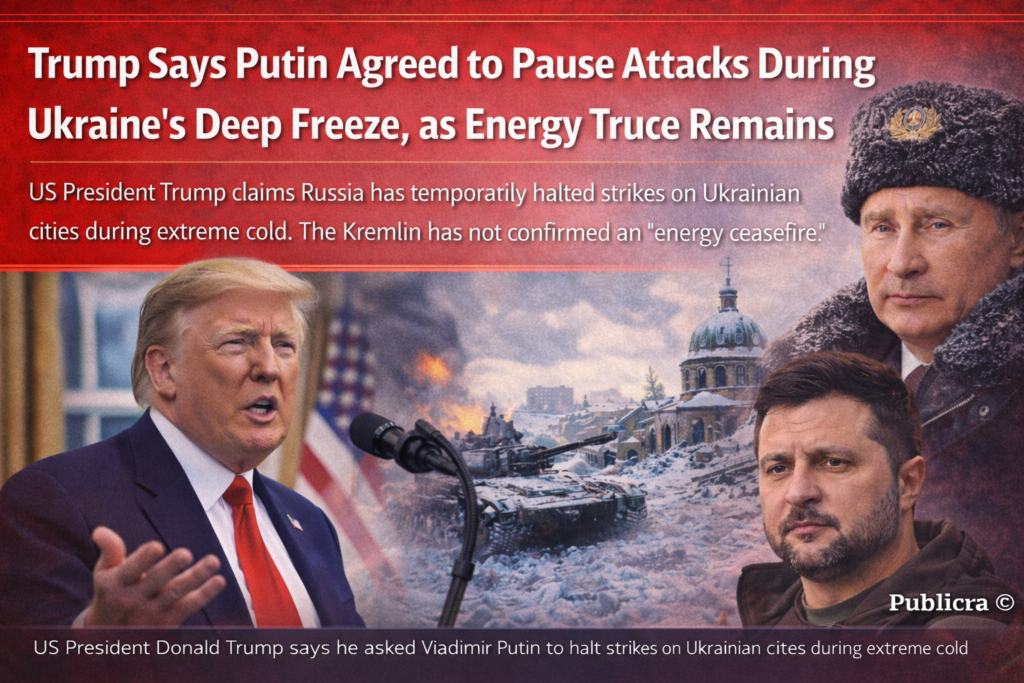
The US president claims Russia has temporarily halted strikes on Ukrainian cities amid extreme cold, but the Kremlin has not confirmed any formal “energy ceasefire.”
A Cold-Weather Pause Amid a Hot War
As Ukraine braces for some of the coldest temperatures of the winter, US President Donald Trump has claimed that Russia agreed to temporarily suspend attacks on Ukrainian cities following a personal request he made to Russian President Vladimir Putin.
According to Trump, Moscow has committed to refraining from strikes on Kyiv and other urban centers for approximately a week due to extreme weather conditions. The announcement immediately drew attention, not only because of the humanitarian implications, but also because the Kremlin has not publicly confirmed the arrangement.
The claim adds another layer of uncertainty to an already complex conflict, where temporary pauses, energy truces, and diplomatic signals have repeatedly clashed with battlefield realities.
What Trump Said—and Why It Matters
Speaking during a cabinet meeting at the White House, Trump told reporters that he had directly intervened after learning about plunging temperatures in Ukraine.
He said he personally asked Putin to suspend attacks on cities and towns during the cold snap, adding that the Russian leader had agreed to the request. Trump described the decision as a positive humanitarian step, saying the administration was “very happy” with the outcome.
If accurate, the pause would coincide with forecasts predicting temperatures in Kyiv dropping to around –13°C (8°F), conditions that significantly increase the risk of civilian suffering when power and heating systems are disrupted.
However, the lack of official confirmation from Moscow has raised immediate questions about the scope, duration, and enforceability of any such halt.
Kremlin Silence and the “Energy Ceasefire” Question
Earlier the same day, Kremlin spokesperson Dmitry Peskov declined to comment on reports suggesting Russia and Ukraine had reached an “energy ceasefire” agreement.
Ukrainian lawmaker Aleksey Goncharenko claimed that discussions had taken place and that there was an understanding in principle to halt attacks on energy infrastructure. However, he emphasized that no start date had been agreed upon.
This ambiguity highlights a recurring pattern in the conflict: partial understandings, informal assurances, and political messaging that often fail to translate into sustained changes on the ground.
Ukraine’s Push for an Energy Truce
Ukrainian President Volodymyr Zelensky has repeatedly called for a ceasefire focused specifically on energy infrastructure. The idea is to prevent attacks on power plants, substations, and transmission lines—critical assets during winter months.
These calls intensified after a wave of Russian strikes left nearly one million households without electricity in Kyiv, according to Ukrainian Energy Minister Denis Shmigal.
Ukraine argues that protecting energy infrastructure during winter is a humanitarian necessity, while critics contend that Kyiv has continued targeting Russian energy assets in previous truces, undermining trust.
Russia’s Position: Military Targets Only
Moscow maintains that its strikes are directed solely at facilities supporting Ukraine’s military and defense-industrial complex. Russian officials argue that attacks on Ukrainian infrastructure are a direct response to Ukrainian long-range strikes on Russian civilians and critical sites, including energy facilities.
Russia has repeatedly rejected accusations that it deliberately targets civilians, framing its campaign as a retaliatory and strategic response rather than indiscriminate warfare.
This framing remains central to Russia’s refusal to commit publicly to short-term or conditional ceasefires.
The Role of Winter in the Ukraine War
Weather has played a critical role in the conflict since its early stages. Extreme cold amplifies the humanitarian impact of infrastructure damage and complicates military logistics on both sides.
A pause in strikes during a cold snap—if implemented—would primarily benefit civilians, allowing emergency repairs and reducing the risk of mass displacement or loss of life due to exposure.
At the same time, military analysts caution that weather-related pauses can also serve strategic purposes, allowing forces to regroup, reposition, or conserve resources.
A Look Back: The March Energy Truce
Russia and Ukraine previously agreed to an energy ceasefire last March following talks involving Trump’s administration.
According to Russian officials, Ukrainian forces violated the agreement within days by striking Russian oil refineries and gas infrastructure. Russian Foreign Minister Sergey Lavrov said at the time that Moscow chose not to retaliate in kind, opting instead to honor the ceasefire despite the breaches.
That episode continues to shape Moscow’s skepticism toward limited or sector-specific truces, reinforcing its preference for broader political settlements rather than temporary pauses.
Macron, Zelensky, and Calls for Another Truce
In recent weeks, both Zelensky and French President Emmanuel Macron renewed calls for a ceasefire—particularly one protecting civilian infrastructure.
The Kremlin responded cautiously. Peskov reiterated that Russia’s priority is not another temporary truce, but a permanent, legally binding peace agreement.
“We are working on peace, not on a ceasefire,” he said, emphasizing that Moscow seeks a long-term settlement backed by formal documents rather than informal arrangements.
Is This a Humanitarian Gesture or Political Messaging?
Trump’s statement raises a key question: is the alleged pause a genuine humanitarian concession, or part of broader political signaling?
Trump has repeatedly positioned himself as a dealmaker capable of achieving results through personal diplomacy. His assertion that Putin agreed to the request reinforces that narrative, especially as he continues to frame his foreign policy approach as more pragmatic than previous administrations.
Without confirmation from Moscow—or visible changes in Russian military activity—the claim remains difficult to independently verify.
What This Means for Civilians in Ukraine
If even partially observed, a temporary halt in strikes could:
- Allow emergency repairs to power and heating systems
- Reduce civilian casualties during extreme cold
- Ease pressure on emergency services and shelters
However, Ukrainians remain cautious. Past announcements of pauses or truces have often been followed by renewed fighting, sometimes within days.
The Bigger Picture: Peace vs. Pauses
The debate over an energy ceasefire reflects a deeper divide between the parties.
Ukraine favors limited, issue-specific pauses to protect civilians and stabilize daily life. Russia insists that such measures are ineffective unless tied to a comprehensive political agreement addressing the root causes of the conflict.
Trump’s intervention—if it leads to even a brief reduction in strikes—adds another variable to an already crowded diplomatic landscape.
What Happens Next?
Several unanswered questions remain:
- Will Russia publicly confirm or deny the pause?
- Will strikes actually decrease over the coming days?
- Can an informal understanding evolve into a formal agreement?
As temperatures plunge and diplomatic messaging intensifies, the coming week may offer critical clues about whether this reported halt is symbolic—or meaningful.
For now, the conflict continues under the shadow of winter, where power, heat, and survival remain as contested as territory.