
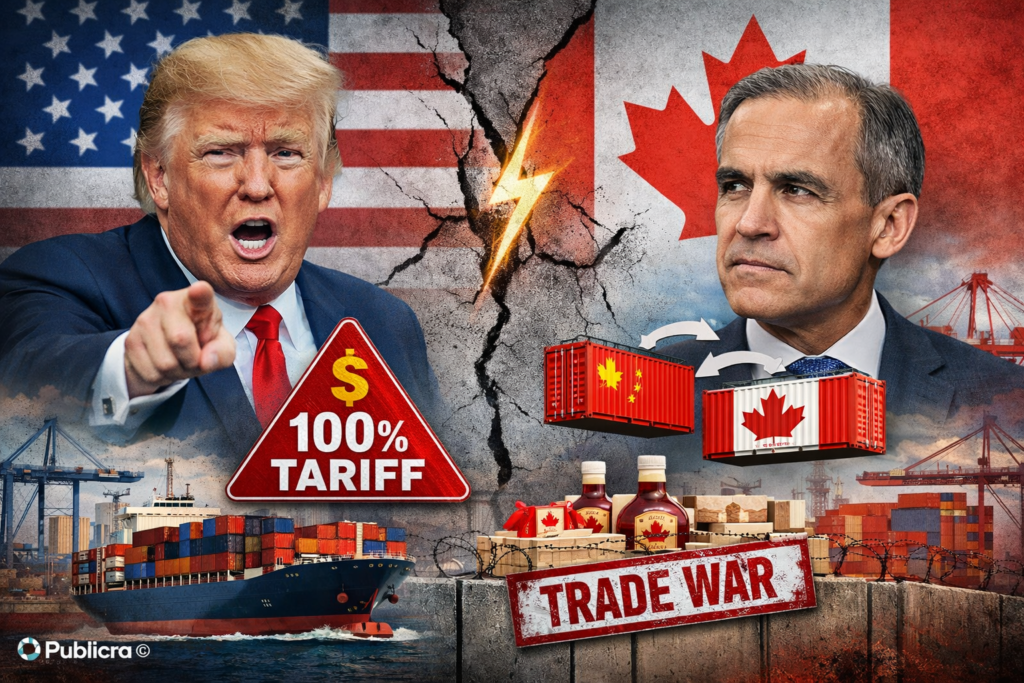
Escalating tensions between Washington and Ottawa highlight shifting global alliances, economic nationalism, and uncertainty in the US‑led world order
Relations between the United States and Canada, long considered one of the most stable and cooperative bilateral partnerships in the world, have entered a new phase of uncertainty. Former and current US President Donald Trump has threatened to impose sweeping 100% tariffs on all Canadian goods should Canada proceed with or expand a trade agreement with China. The warning, issued via Trump’s social media platform Truth Social, underscores rising geopolitical tensions, intensifying economic nationalism, and a rapidly shifting global trade landscape.
At the center of this dispute are Canada’s evolving trade relations with China, particularly around electric vehicles and agricultural products, and Washington’s concern that Canada could become a conduit for Chinese goods entering the US market. The standoff is emblematic of deeper issues reshaping international trade: strategic rivalry with China, erosion of multilateral norms, and the growing willingness of major powers to use tariffs as political leverage.
Trump’s Tariff Threat: What Was Said
In a strongly worded post, Trump warned that any finalized trade deal between Canada and China would trigger “an immediate 100% tariff against all Canadian goods and products coming into the U.S.A.” He accused Canadian Prime Minister Mark Carney of attempting to turn Canada into a “drop‑off port” for Chinese exports destined for the United States.
Trump once again referred to Carney as “Governor Carney,” reviving rhetoric from earlier disputes when he mockingly described Canada as America’s “51st state.” While no specific timeline or legal framework for the proposed tariffs was provided, the threat alone sent a strong political signal and reignited concerns among businesses, investors, and policymakers on both sides of the border.
Canada–China Trade Deal: The Core Issue
Canada’s recent engagement with China marks a notable shift in its foreign and trade policy. According to statements from Prime Minister Carney, the two countries reached a deal that would ease Canadian tariffs on Chinese electric vehicles while China would reduce levies on Canadian agricultural products.
For Canada, the agreement represents diversification. With US trade policy becoming increasingly unpredictable, Ottawa has sought to reduce over‑reliance on its southern neighbor. Carney has openly stated that Canada’s relationship with China has become “more predictable” than its relationship with the United States under the Trump administration.
For Washington, however, the deal raises red flags. US officials and Trump allies argue that Chinese manufacturers could exploit Canadian access to the US market, undercutting American industries and weakening efforts to counter China’s global economic influence.
A History of Trade Tensions Between the US and Canada
Despite close cultural and economic ties, US–Canada trade relations have experienced repeated strains in recent years. During Trump’s previous term, tariffs were imposed on Canadian steel, aluminum, and other goods, citing national security concerns. More recently, a 35% tariff was levied on Canadian products not covered under the existing free trade agreement, which is currently under mandatory review.
Although relations had shown signs of improvement, Trump’s renewed threats suggest that tariffs remain a central tool in his economic strategy. For Canada, this unpredictability complicates long‑term planning and reinforces the need to pursue alternative markets.
The Political Dimension: Rhetoric and Power
Beyond economics, the dispute has taken on a distinctly political tone. Trump’s language toward Canada — including suggestions that the country survives “because of the United States” — has been widely criticized in Ottawa and beyond. Carney firmly rejected this narrative, stating that “Canada doesn’t live because of the United States. Canada thrives because we are Canadians.”
The friction intensified following Carney’s speech at the World Economic Forum in Davos, where he warned of a “rupture” in the US‑led world order. Although Trump was not named directly, the message was clear. Trump responded angrily in his own remarks and later withdrew Canada’s invitation to join a newly proposed US‑led “Board of Peace.”
Global Context: China, Protectionism, and the New World Order
This confrontation cannot be viewed in isolation. It is part of a broader global realignment driven by US–China rivalry, weakening multilateral institutions, and the resurgence of protectionism.
Trump’s trade philosophy prioritizes bilateral deals, tariffs, and economic pressure to achieve strategic goals. Canada’s outreach to China, meanwhile, reflects a pragmatic response to uncertainty in US policy. As middle powers seek stability, diversification has become a survival strategy rather than a political statement.
Experts note that Canada’s policy shift toward China is not ideological but strategic — shaped by concerns that traditional alliances may no longer guarantee economic security.
Economic Impact: What 100% Tariffs Would Mean
If implemented, 100% tariffs on Canadian goods would have far‑reaching consequences:
- Supply Chains Disrupted: Industries such as automotive manufacturing, energy, agriculture, and consumer goods rely heavily on cross‑border trade.
- Higher Prices: US consumers would likely face increased prices on everyday goods, from food products to vehicles.
- Business Uncertainty: Canadian exporters and US importers would face sudden cost shocks, potentially leading to layoffs and reduced investment.
- Retaliation Risk: Canada could respond with counter‑tariffs, escalating the dispute into a full‑scale trade war.
Given that the US and Canada are each other’s largest trading partners, the economic fallout would extend well beyond national borders.
NATO, Greenland, and Expanding Disputes
Trade tensions have coincided with broader geopolitical disagreements. Trump’s renewed interest in acquiring Greenland and his criticism of NATO allies have strained relations with Canada and Europe alike. He has also criticized Canada for opposing the construction of the “Golden Dome” missile defense system over Greenland.
These overlapping disputes suggest a deeper ideological divide over security, sovereignty, and international cooperation — further complicating efforts to resolve trade disagreements diplomatically.
Uncertainty Ahead: Will the Tariffs Happen?
As of now, it remains unclear whether Trump’s tariff threat will materialize. No official action has been announced, and Canadian and US officials have yet to clarify whether the China trade deal has formally taken effect.
However, history suggests that even the threat of tariffs can influence markets and policy decisions. For Canada, the challenge lies in balancing economic diversification with the reality that the US remains its most important trading partner.
Conclusion
Trump’s warning of 100% tariffs on Canadian goods represents more than a bilateral trade dispute. It highlights the fragility of long‑standing alliances in an era defined by economic nationalism, strategic rivalry, and shifting global power structures.
For Canada, the message is clear: reliance on a single partner carries growing risks. For the United States, aggressive trade tactics may deliver short‑term leverage but risk long‑term instability. As the global order continues to evolve, the outcome of this standoff will serve as a key test of how middle powers navigate pressure from dominant neighbors while pursuing their own strategic interests.