
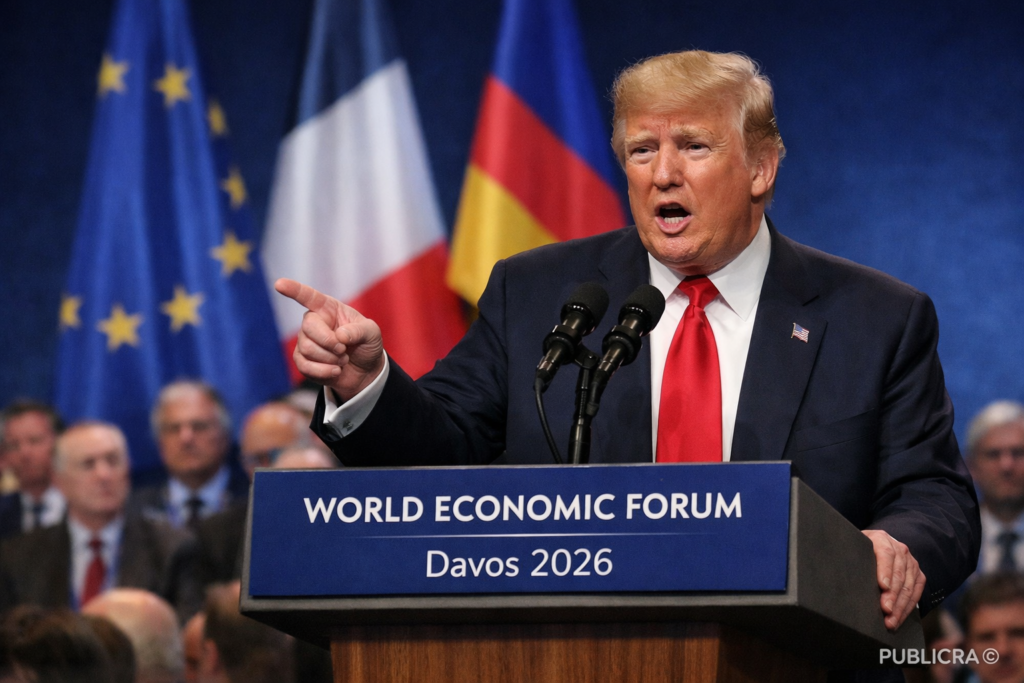
US President Donald Trump says European nations must urgently change course on trade, immigration, and energy policy or risk long-term decline
US President Donald Trump has issued a sharp warning to European nations, arguing that the continent is “destroying itself” through a decade of what he described as poor economic, migration, and energy decisions.
Speaking at the World Economic Forum (WEF) Annual Meeting in Davos, Trump said that while the United States wants Europe to succeed, current policies are weakening the region economically, socially, and strategically.
“We want strong allies, not seriously weakened ones,” Trump told global leaders and executives gathered in Switzerland.
His remarks come at a time when Europe is facing slow growth, rising bankruptcies, high energy costs, demographic decline, and political fragmentation, intensifying debate over the future direction of the European Union.
Europe’s Economic Slowdown Raises Alarm
Europe’s economic outlook has worsened over the past year, with several major economies struggling to regain momentum.
Germany, long considered Europe’s industrial engine, has recorded a surge in corporate bankruptcies, particularly among energy-intensive manufacturers and small businesses. High borrowing costs, weak global demand, and expensive electricity have weighed heavily on production.
Southern European countries continue to battle high public debt, while growth across the eurozone remains sluggish compared to the United States and parts of Asia.
Trump argued that restrictive regulations, excessive bureaucracy, and unfavorable trade policies have discouraged investment and innovation.
“Lower growth leads to lower living standards — and that’s exactly what we’re seeing,” he said.
Energy Policy and the Cost of the Green Transition
A central theme of Trump’s criticism was Europe’s approach to climate and energy policy.
He once again referred to green initiatives as a “green new scam,” claiming that an overreliance on wind and renewable energy has contributed to higher electricity prices for households and businesses.
Europe’s energy markets remain under pressure following the reduction of Russian gas supplies, forcing governments to rely more heavily on expensive imports and subsidies. While renewable energy capacity has expanded, storage limitations and grid constraints continue to create instability.
Critics argue that Europe’s transition has been too rapid, placing economic competitiveness at risk. Supporters counter that renewable investment is essential for long-term energy security and climate goals.
Migration and Social Strain Across the Continent
Trump also focused heavily on migration, claiming that uncontrolled and poorly managed immigration has created social disruption across Europe.
Several EU countries are currently grappling with:
- Overburdened asylum systems
- Housing shortages in major cities
- Pressure on healthcare and social services
- Rising political polarization
Recent elections have shown increased support for right-wing and populist parties, many of which campaign on stricter immigration controls and national sovereignty.
Trump warned that failing to address integration and border management could further weaken social cohesion.
“More socially disruptive migration makes countries vulnerable from within,” he said.
Demographic Decline and Falling Birth Rates
Europe’s demographic challenges have become increasingly severe. Many countries are experiencing record-low birth rates, shrinking workforces, and aging populations.
This trend places long-term strain on pension systems, healthcare funding, and economic productivity. Trump linked declining birth rates to cultural and economic uncertainty, arguing that societies lose confidence when growth stalls and living costs rise.
Demographers warn that without structural reforms, Europe may face labor shortages and slower innovation in the coming decades.
Security Concerns and Global Influence
The Trump administration’s National Security Strategy, released in December, echoed similar concerns, warning of what it described as Europe’s potential “civilizational erasure.”
The document criticized what it called restrictions on free speech, political dissent, and national decision-making within EU institutions, arguing that these trends undermine democratic resilience.
Meanwhile, geopolitical tensions — including the war in Ukraine, instability in the Middle East, and competition with China — have exposed Europe’s dependence on external security guarantees and energy suppliers.
Responses From Europe and Global Reactions
European leaders have pushed back against Trump’s remarks.
French President Emmanuel Macron recently urged Europe not to submit to external pressure, emphasizing strategic autonomy and European values. EU officials maintain that reforms are underway to strengthen energy independence, border control, and industrial competitiveness.
Russia has also weighed in on Europe’s decline. In December, President Vladimir Putin claimed that the West had lost its moral and civilizational foundation, echoing criticism from Moscow about EU governance and values.
A Crossroads for Europe
Trump’s comments have reignited a broader debate:
Is Europe reforming fast enough to remain competitive in a rapidly changing world?
While critics view his remarks as provocative, supporters argue that Europe must confront uncomfortable realities — rising costs, demographic decline, and strategic dependence — to secure its future.
As global economic power shifts and political uncertainty grows, Europe now faces critical decisions that could define its role in the world for decades to come.