
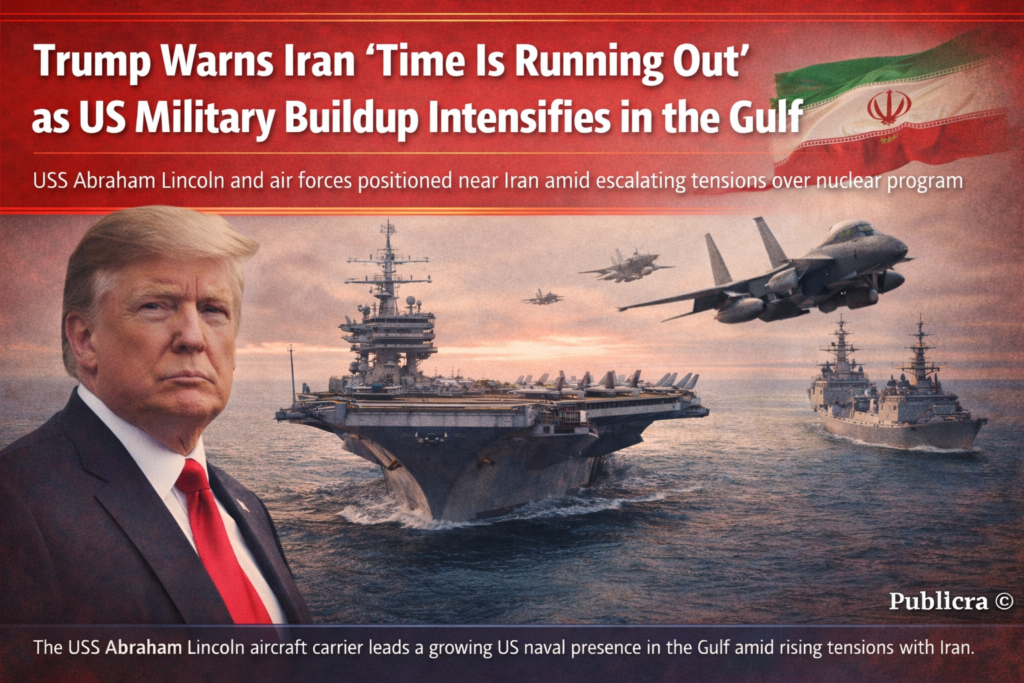
Washington escalates pressure on Tehran over its nuclear programme while deploying major naval and air assets, raising fears of another dangerous confrontation in the Middle East.
Diplomacy Under the Shadow of Force
Tensions between the United States and Iran are once again nearing a critical point. President Donald Trump has issued a stark warning to Tehran, declaring that “time is running out” for negotiations over Iran’s nuclear programme, even as a significant US military force continues to assemble in the Persian Gulf and surrounding regions.
The latest escalation comes amid renewed unrest inside Iran, heightened military activity across the Middle East, and growing international concern that diplomatic channels may soon give way to confrontation.
Trump’s Message: A Deal or Consequences
President Trump’s warning focused squarely on Iran’s nuclear ambitions. In a series of statements, he urged Tehran to return to negotiations and accept a deal that would permanently prevent it from developing nuclear weapons.
According to Trump, a “massive armada” of US forces is moving toward the region with what he described as “power, enthusiasm, and purpose.” While the president framed the deployment as a deterrent, his language suggested that military options remain firmly on the table if diplomacy fails.
Trump also referenced previous US strikes on Iranian nuclear facilities, warning that any future action would be “far worse” than past operations.
Iran’s Response: Dialogue — With a Warning
Iran has rejected claims that it is pursuing nuclear weapons, insisting its programme remains entirely peaceful. In response to Trump’s remarks, Iran’s mission to the United Nations said Tehran remains open to dialogue, provided talks are based on “mutual respect and interests.”
However, Iranian officials issued a strong counter-warning, stating that if Iran is attacked, it will defend itself and respond in unprecedented ways. Senior Iranian leaders have repeatedly argued that diplomacy cannot succeed under military threats, calling Washington’s approach counterproductive.
Protests Inside Iran Add to the Pressure
The geopolitical standoff is unfolding against the backdrop of significant unrest within Iran. Nationwide protests erupted late last year amid economic hardship, soaring inflation, power shortages, and a steep decline in the value of the Iranian rial.
Human rights groups report thousands of deaths since the unrest began, though figures vary widely and remain difficult to independently verify due to media restrictions and internet shutdowns inside the country.
President Trump initially voiced support for demonstrators, claiming that the United States would intervene to help. He later said he had received assurances that executions had stopped, though Iranian authorities dispute claims of mass executions.
Is the US Preparing for Military Action?
While the White House has not announced any imminent strikes, the scale and speed of US deployments suggest Washington is preparing for a wide range of contingencies.
Trump has emphasized that the military buildup is larger than previous deployments, including the one sent to Venezuela before US forces seized the country’s former leader. He described the current force as “ready, willing, and able” to act rapidly if required.
Defense analysts caution that such language, combined with visible military movements, increases the risk of miscalculation.
Tracking the US Military Buildup
Naval Forces
At the center of the deployment is the USS Abraham Lincoln aircraft carrier strike group, accompanied by guided missile destroyers and support vessels. The carrier can operate dozens of aircraft, including fighter jets and electronic warfare platforms.
US officials have confirmed that the fleet is operating near Oman, positioning it within striking distance of Iranian territory while maintaining access to key shipping routes.
Air Power and Logistics
Open-source intelligence and satellite imagery show a surge in US aircraft activity across the region. Fighter jets, cargo planes, refueling tankers, surveillance aircraft, and drones have been observed operating from bases in:
- Jordan
- Qatar
- Diego Garcia (Indian Ocean)
This infrastructure allows the US to sustain prolonged air operations if necessary.
Iran’s Military Posture
Iran has responded by increasing its own military readiness. Satellite imagery shows the deployment of the IRIS Shahid Bagheri, a drone carrier ship that entered service last year, operating near Iran’s coastline.
Tehran maintains a broad arsenal, including ballistic missiles, cruise missiles, armed drones, and proxy forces across the Middle East. Iranian officials have repeatedly warned that US bases and allied infrastructure would be targeted in the event of an attack.
Remembering the 2025 Strikes on Nuclear Sites
The last major confrontation occurred in June 2025, when US forces targeted Iranian nuclear facilities at Fordo, Natanz, and Isfahan during a brief but intense conflict involving Israel.
Washington said the strikes significantly delayed Iran’s nuclear progress. Iranian officials countered that key materials had already been removed, limiting the damage.
In retaliation, Iran launched missiles at a US military base in Qatar—an attack Trump later described as expected and limited.
The Nuclear Question at the Center
Despite years of sanctions, inspections, and negotiations, Iran’s nuclear programme remains the core issue driving tensions. The US and its allies argue that Iran’s uranium enrichment levels exceed civilian needs, while Tehran maintains that it has the sovereign right to peaceful nuclear development.
With trust low and rhetoric escalating, experts warn that the window for meaningful diplomacy is narrowing.
Regional and Global Implications
Any military confrontation between the US and Iran would have far-reaching consequences:
- Disruption to global energy markets
- Threats to shipping lanes in the Gulf
- Escalation involving regional allies and proxy forces
- Increased instability across the Middle East
Global powers, including European nations, Russia, and China, have urged restraint and renewed diplomatic engagement.
What Happens Next?
For now, both sides appear to be testing each other’s resolve—Washington through military pressure, and Tehran through defiance and warnings of retaliation.
Whether this standoff leads to renewed negotiations or another cycle of confrontation will depend on decisions made in the coming weeks. What is clear is that the growing military presence in the Gulf has raised the stakes dramatically.