
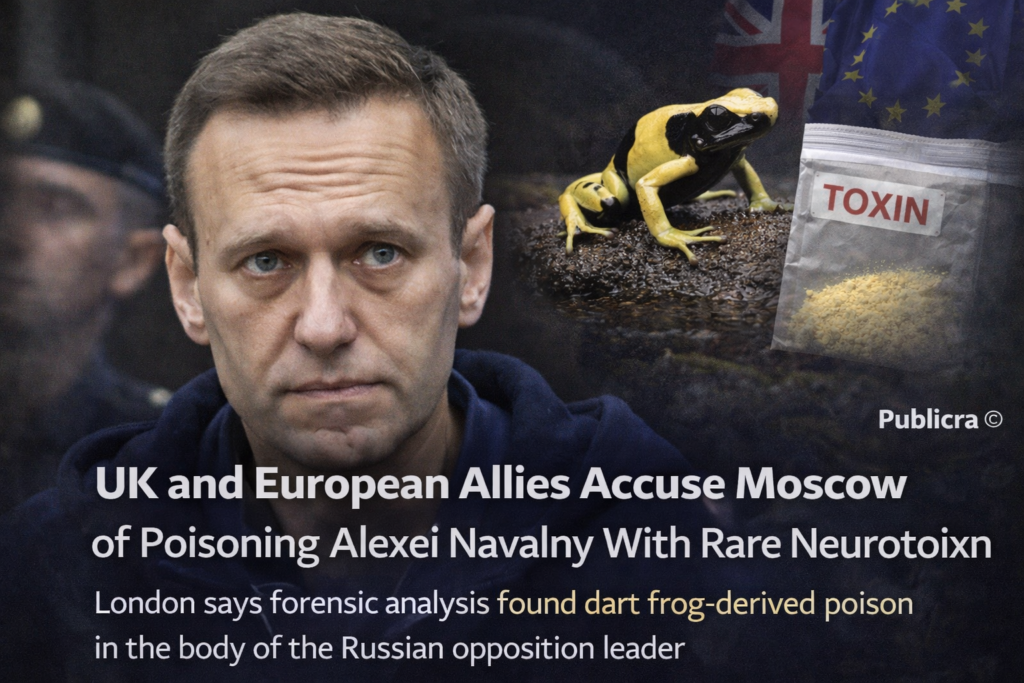
Two years after Navalny’s death in custody, Western governments cite forensic findings pointing to a dart frog–derived toxin, reigniting calls for accountability and tougher sanctions.
Two years after the sudden death of Russian opposition leader Alexei Navalny in a remote penal colony, the case has re-entered the global spotlight. The United Kingdom, joined by several European allies, has publicly accused Russian authorities of killing Navalny using a rare neurotoxin derived from dart frog poison. The allegation, based on forensic analysis of biological samples, has reignited international condemnation of the Kremlin, intensified calls for accountability, and reopened questions about the safety of political prisoners in Russia.
The accusation marks one of the most direct and specific claims made by Western governments regarding the cause of Navalny’s death. Officials say the toxin identified—epibatidine—has no innocent explanation for its presence and that only state-level actors would have the means and opportunity to deploy such a substance within the highly controlled environment of a Russian penal colony. Moscow has not publicly addressed the claims.
Who Was Alexei Navalny?
Alexei Navalny emerged over the past decade as the most prominent face of Russia’s opposition movement. Known for his anti-corruption investigations, online activism, and ability to mobilize mass protests, Navalny posed a unique challenge to the Kremlin’s political narrative. His campaigns targeted elite corruption and state-linked oligarchs, bringing unprecedented visibility to issues many Russians felt powerless to confront.
Navalny survived a near-fatal poisoning in 2020 and later returned to Russia, where he was arrested upon arrival. Over subsequent years, he faced multiple criminal convictions widely criticized by international observers as politically motivated. His imprisonment became a symbol of the risks faced by dissenters in an increasingly restrictive political environment.
When Navalny died suddenly in custody in February 2024, official accounts attributed his death to a sudden medical emergency. Supporters, family members, and human rights organizations disputed those claims, citing a pattern of prior poisoning attempts and harsh detention conditions.
The New Allegations: What Western Governments Say
According to statements from the UK and European partners, forensic analysis of samples taken from Navalny’s body identified traces of epibatidine, a powerful neurotoxin associated with certain South American dart frog species. Officials emphasized that the compound does not occur naturally in Russia and that dart frogs in captivity do not produce it, making accidental exposure implausible.
Western governments argue that the deployment of such a toxin within a secure penal colony environment strongly points to deliberate poisoning. The assertion is that only a state actor would possess the capability to source, handle, and administer such a substance in a tightly controlled detention facility.
Senior officials have framed the findings as evidence of a targeted killing rather than a natural death, calling the act a violation of international norms and conventions prohibiting chemical weapons and toxic substances.
Understanding Epibatidine: Why the Toxin Matters
Epibatidine is an extremely potent neurotoxin that acts on the central nervous system. Toxicology experts describe it as far more powerful than morphine in its effect on pain receptors, but also potentially lethal at very low doses. Its physiological effects can include muscle paralysis, seizures, slowed heart rate, respiratory failure, and death.
What makes epibatidine particularly notable in this case is its rarity. It is typically found only in minute quantities in specific wild frog species, and only under precise dietary conditions. The complexity of obtaining and preparing such a substance has fueled assertions that its use would require specialized knowledge and access—attributes associated with state-level operations rather than individual actors.
The allegation that such a toxin was used raises broader concerns about the potential misuse of rare or novel substances in political repression, complicating international efforts to monitor and prevent chemical weaponization.
The International Response: Sanctions, Accountability, and Law
The renewed accusations have triggered fresh calls for international accountability. European governments have emphasized the importance of upholding the Chemical Weapons Convention and have indicated that relevant international bodies have been notified of the findings.
Diplomatic pressure is expected to increase, with potential consequences including expanded sanctions, travel restrictions, asset freezes, and additional legal measures targeting individuals deemed responsible for political repression. Human rights groups have urged governments to go beyond symbolic condemnation and pursue concrete steps to protect political prisoners and activists.
For many Western leaders, the Navalny case has become emblematic of a broader pattern of repression in Russia. Officials argue that accountability in this case is not only about justice for Navalny but about deterring future abuses and reinforcing international norms against political violence.
Yulia Navalnaya and the Campaign for Justice
Navalny’s widow, Yulia Navalnaya, has been a persistent advocate for an independent investigation into her husband’s death. She has repeatedly rejected official explanations and has called on the international community to pursue accountability. Her public statements have framed the case not only as a personal tragedy but as a test of whether the world is willing to confront political violence against dissidents.
Navalnaya’s advocacy has helped sustain global attention on the case at a time when international crises often crowd out long-running human rights issues. Her message emphasizes continuity: the circumstances surrounding Navalny’s death, she argues, are inseparable from the broader conditions facing political prisoners and critics of the Russian government.
The Kremlin’s Silence and Russia’s Narrative
The Russian government has not publicly commented on the latest allegations. In past instances involving Navalny, officials denied wrongdoing and dismissed Western accusations as politically motivated. The Kremlin has consistently portrayed opposition figures as criminals rather than political prisoners, framing legal actions as matters of domestic law and order.
This narrative divide highlights a central challenge in international accountability efforts: without cooperation from Russian authorities, independent verification remains limited. The absence of transparent investigations fuels skepticism abroad and reinforces perceptions that political violence is being shielded from scrutiny.
Political Prisoners and Conditions in Detention
Navalny’s death has intensified scrutiny of Russia’s penal system, particularly with regard to the treatment of high-profile political detainees. Human rights organizations have long raised concerns about harsh conditions, restricted access to medical care, and punitive transfers to remote facilities.
The case underscores broader questions about the safety of political prisoners and the mechanisms available to protect them. Calls for international monitoring of detention conditions, humanitarian access, and stronger diplomatic pressure have grown louder since the announcement of the alleged poisoning method.
Chemical Weapons Norms and Global Security
The alleged use of a rare toxin in a political killing raises alarm beyond the immediate human rights implications. It touches on the integrity of global chemical weapons norms, which aim to prevent the development and use of toxic substances for hostile purposes.
If confirmed, the case would illustrate how novel or obscure compounds can be weaponized in ways that evade traditional monitoring frameworks. This possibility has prompted renewed discussion among security experts about strengthening international cooperation on toxicology, forensic analysis, and early warning mechanisms to prevent the misuse of emerging chemical agents.
The Broader Geopolitical Context
The Navalny case is unfolding against a backdrop of heightened tensions between Russia and Western countries. Sanctions, diplomatic disputes, and conflicting narratives about international order have created a polarized environment in which human rights issues are often interpreted through geopolitical lenses.
For Western governments, highlighting the Navalny case reinforces their stance on accountability and the defense of democratic values. For Moscow, rejecting the allegations aligns with a broader posture of resisting what it frames as external interference in domestic affairs. This dynamic complicates prospects for cooperation on investigations and underscores how individual human rights cases can become flashpoints in larger geopolitical rivalries.
Public Opinion and the Legacy of Navalny
Within Russia, public discourse about Navalny remains constrained by legal restrictions and media controls. Nonetheless, his legacy as an anti-corruption campaigner continues to resonate among segments of the population, particularly younger Russians and urban professionals.
Internationally, Navalny has become a symbol of resistance to authoritarianism and the personal risks faced by political dissidents. The renewed allegations surrounding his death have reinforced that symbolism, turning the case into a rallying point for activists and policymakers seeking to highlight the costs of political repression.
What Happens Next?
The immediate consequences of the allegations will likely include intensified diplomatic pressure and potential new rounds of sanctions. Legal avenues for accountability remain limited, but governments and international organizations may pursue investigations, documentation efforts, and coordinated responses aimed at preserving evidence and supporting victims of political repression.
Longer term, the Navalny case may influence how governments approach engagement with Russia on human rights issues. It could also shape international efforts to strengthen protections for political activists and to close gaps in chemical weapons monitoring regimes.
A Case That Reverberates Beyond One Life
The accusation that Alexei Navalny was killed using a rare neurotoxin has transformed his death from a contested tragedy into a renewed focal point of international confrontation over human rights, accountability, and the misuse of toxic substances. For supporters, the findings affirm long-held suspicions. For governments, they present a test of whether international norms can be enforced when allegations point to state involvement.
Beyond the immediate political ramifications, the case raises enduring questions about the safety of dissent in authoritarian systems and the responsibility of the international community to respond when political violence crosses into the realm of alleged chemical weaponization. Navalny’s legacy, forged through years of activism and sacrifice, continues to shape global debates about justice, repression, and the price of political courage.