
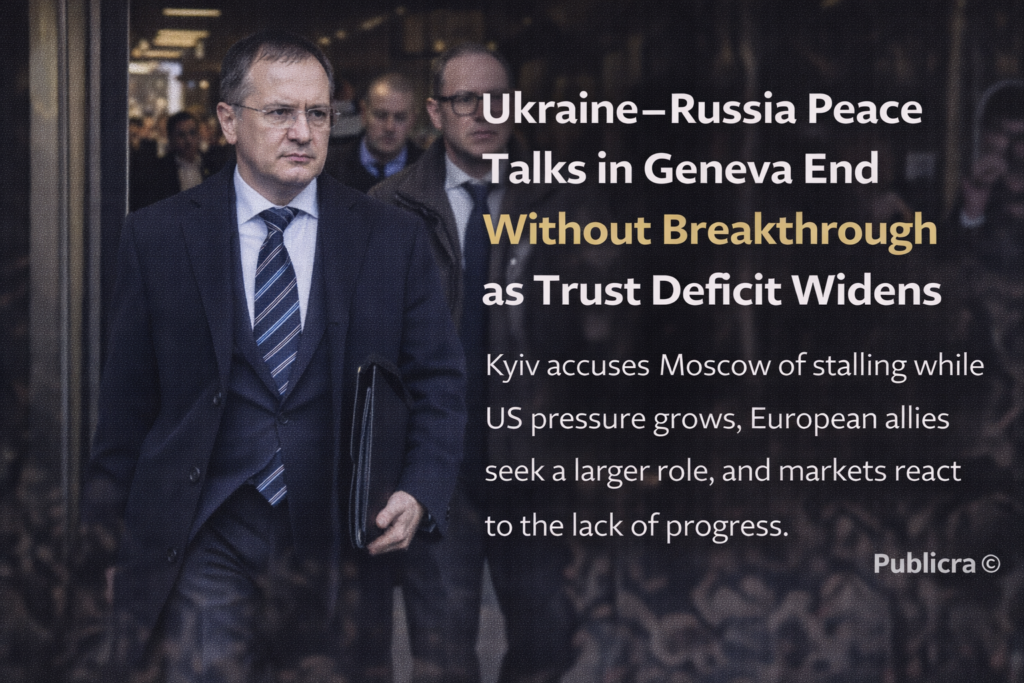
Kyiv accuses Moscow of stalling while US pressure grows, European allies seek a larger role, and markets react to the lack of progress.
Peace talks between Ukraine and Russia concluded in Geneva without a breakthrough, underscoring the widening trust deficit between the two sides as the war enters its fifth year. Ukrainian President Volodymyr Zelenskiy described the negotiations as “difficult,” accusing Moscow of deliberately stalling progress, while Russian officials signaled that further talks would be scheduled. The United States, acting as mediator, pressed both sides to accelerate compromise, adding to tensions within Kyiv over perceived pressure to concede territory.
The talks took place amid intensified fighting, sustained airstrikes on Ukraine’s energy infrastructure, and growing war fatigue across Europe. Financial markets reacted nervously to reports of stalled diplomacy, reflecting investor concerns that the conflict could persist well into the coming year. With millions displaced and critical infrastructure under strain, the failure to reach tangible agreements has amplified the urgency of finding a workable diplomatic path forward.
The Geneva Talks and Why They Matter
The Geneva meeting marked another attempt to bridge entrenched positions after previous rounds of US-brokered talks failed to yield substantial progress. The agenda focused on ceasefire parameters, humanitarian corridors, and the sequencing of confidence-building measures. While negotiators reported “substantive” exchanges, fundamental disagreements over territorial control and security guarantees remained unresolved.
The symbolism of Geneva as a neutral diplomatic venue contrasts sharply with the reality of hardened positions. Each round of talks raises hopes of de-escalation, only to confront the political and strategic realities that make compromise costly. The failure to advance beyond exploratory discussions reflects how deeply the conflict’s core issues are embedded in national narratives and security doctrines.
Zelenskiy’s Stance and Kyiv’s Red Lines
Kyiv has consistently rejected any framework that would formalize the loss of territory beyond areas currently occupied. Zelenskiy has emphasized that concessions perceived as rewarding aggression would be politically untenable at home. Ukrainian officials argue that negotiations conducted under continued military pressure undermine trust and incentivize delay tactics.
The Ukrainian leadership also seeks to ensure that any diplomatic outcome includes robust security guarantees and mechanisms to prevent renewed hostilities. For Kyiv, peace without credible deterrence risks becoming a pause rather than a settlement. These concerns shape Ukraine’s negotiating posture and limit the scope for rapid compromise.
Moscow’s Position and Strategic Calculations
Russia’s negotiating stance reflects a belief that time may favor its strategic objectives. By sustaining military pressure while engaging diplomatically, Moscow seeks to shape terms from a position of leverage. Russian officials maintain that negotiations will continue, but the lack of concrete proposals fuels accusations of bad faith.
From Moscow’s perspective, territorial realities on the ground and broader security considerations frame the talks. The Kremlin’s messaging emphasizes the need to address what it describes as root causes of the conflict, including regional security arrangements. These positions complicate efforts to reach interim agreements focused solely on de-escalation.
US Mediation and the Politics of Pressure
The United States has taken on a central mediating role, urging both parties to show flexibility. However, public messaging that appears to place greater pressure on Kyiv has sparked unease within Ukraine. Ukrainian officials worry that calls for rapid concessions risk legitimizing territorial changes achieved through force.
For Washington, the diplomatic push is shaped by broader strategic considerations, including alliance cohesion, regional stability, and the desire to avoid open-ended military commitments. Balancing these priorities while maintaining support for Ukraine’s sovereignty presents a delicate policy challenge.
The Case for Greater European Involvement
European leaders have called for a more prominent role in shaping the peace process, arguing that the conflict’s consequences are borne most heavily by the continent. Energy security, refugee flows, and economic disruptions have made the war a defining European security issue.
Greater European involvement could diversify diplomatic channels and provide additional guarantees for any eventual agreement. However, coordination among European capitals is itself complex, given differing threat perceptions and domestic political pressures. Building a cohesive European voice within the negotiation framework remains a work in progress.
The Human Cost and Humanitarian Imperatives
Beyond geopolitics, the humanitarian toll continues to mount. Sustained attacks on energy infrastructure have left communities without heating and power during harsh winter conditions. Displacement, trauma, and economic disruption compound the suffering of civilians on both sides of the front lines.
Humanitarian considerations are often sidelined in high-level negotiations, yet they provide potential entry points for incremental progress. Agreements on humanitarian corridors, prisoner exchanges, and infrastructure repair could build trust and alleviate suffering, even in the absence of a comprehensive peace deal.
Market Reactions and Economic Implications
Financial markets reacted to reports of stalled talks with declines in Ukrainian assets, reflecting investor concerns over prolonged conflict and fiscal strain. The war has reshaped economic expectations, with reconstruction costs mounting and growth prospects constrained by ongoing insecurity.
For Ukraine, sustained conflict complicates fiscal planning and investment, while for Europe, energy market volatility remains a persistent risk. The economic dimension underscores the broader stakes of diplomacy: peace is not only a political objective but an economic necessity.
Territorial Control and the Core Dispute
Territory remains the central obstacle to agreement. Russia’s occupation of significant portions of Ukraine’s territory has created facts on the ground that complicate negotiations. Any settlement must grapple with questions of sovereignty, security, and the rights of displaced populations.
Referendums, demilitarized zones, and phased withdrawals have been floated in various diplomatic circles, but none have garnered sufficient buy-in from both sides. The challenge lies in designing arrangements that uphold international norms while addressing security realities.
Energy Infrastructure and Winter Warfare
Targeting of energy infrastructure has emerged as a defining feature of the conflict, amplifying civilian hardship and strategic leverage. The winter campaign against power and heating systems has heightened urgency for ceasefire measures focused on protecting critical infrastructure.
Incorporating infrastructure protection into diplomatic frameworks could serve as a confidence-building step. Such measures would signal commitment to humanitarian norms and create practical benefits for civilian populations, potentially opening space for broader negotiations.
The Role of Public Opinion and War Fatigue
Public opinion in Ukraine remains resilient but strained by prolonged hardship. War fatigue is also evident across Europe, where economic pressures and political polarization influence support for continued engagement. Leaders must navigate domestic constituencies that demand both solidarity with Ukraine and tangible pathways toward peace.
In Russia, information controls shape public perception of the war, complicating assessments of domestic constraints on negotiating flexibility. Understanding these domestic contexts is essential for crafting proposals that can be politically sustained.
Possible Pathways Forward
Several incremental pathways could revive momentum: localized ceasefires around critical infrastructure, expanded humanitarian exchanges, and third-party monitoring mechanisms. While none address the conflict’s core disputes, they could reduce violence and build minimal trust.
A durable settlement will likely require a comprehensive framework encompassing security guarantees, territorial arrangements, and phased normalization. Achieving such a framework demands sustained diplomacy, patience, and coordination among international stakeholders.
Diplomacy at an Impasse, Stakes Unchanged
The end of the Geneva talks without a breakthrough highlights the entrenched nature of the Ukraine–Russia conflict. Accusations of stalling, external pressure, and unresolved territorial disputes underscore the challenges facing mediators. Yet the costs of failure—humanitarian, economic, and security-related—continue to rise.
As negotiations prepare to resume, the imperative is to convert dialogue into concrete steps that reduce violence and protect civilians. The path to peace remains narrow, but the alternative—a prolonged war with escalating risks—makes sustained diplomatic effort not just desirable, but necessary.