
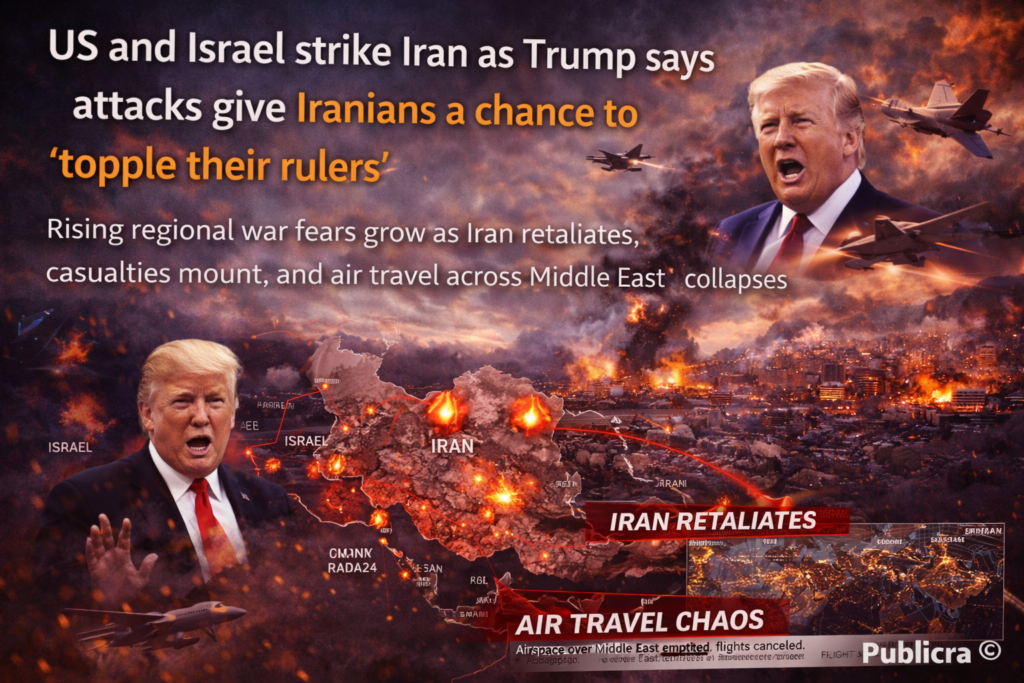
Us and israel strike iran as trump says attacks give iranians a chance to topple their rulers
A major new phase of conflict has erupted in the middle east after the united states and israel launched wide-ranging strikes on iran, with president donald trump publicly framing the action as an opportunity for iranians to “topple their rulers.” The operation, described by officials and sources as extensive and coordinated, has already triggered retaliatory attacks, casualties, panic-driven movement of civilians, and widespread disruption to global aviation routes that pass through the region.
Reports indicate that strikes hit multiple provinces across iran, with iranian media citing emergency services figures for significant numbers of dead and injured. Tehran, in turn, has retaliated with missile and drone attacks affecting israel and multiple gulf states, escalating fears that this confrontation could widen rapidly beyond a two-sided exchange.
As the situation develops, governments worldwide are urging restraint, the united nations is preparing emergency discussions, and markets are closely watching shipping and energy flows through key routes such as the strait of hormuz.
What happened and why it matters now
The core development is the opening of a large-scale us-israel military campaign inside iran, paired with unusually explicit political messaging from washington. Trump’s comments suggest a shift from limited deterrence toward a broader goal of pressuring or facilitating political change in tehran. That framing immediately raises the stakes because it affects not only military calculations but also internal iranian stability, regional alliances, and the likelihood of long-term escalation.
For israel, the strikes fit into an ongoing strategy of targeting iranian military capabilities and command structures it views as direct threats. For the united states, the strikes appear to mark a decisive pivot away from negotiation pathways and toward coercive pressure, even as external diplomatic efforts had been trying to keep talks alive.
The significance is not only the scale of the strikes but the combination of three things happening at once: military escalation, regime-change rhetoric, and immediate regional spillover.
Claims of targeted leadership and reported senior deaths
One of the most controversial elements of the reporting is the claim that iran’s top leadership was directly targeted. An israeli official has been cited as saying iran’s supreme leader ayatollah ali khamenei was targeted. Separate reports cite sources saying senior iranian defense and revolutionary guard leadership figures were killed.
These claims are difficult to independently verify in real time due to limited access, conflicting narratives, and rapid developments. However, even the suggestion of leadership targeting can be destabilizing, because it signals a move beyond infrastructure strikes into the realm of decapitation strategy—something that typically prompts intensified retaliation and hardened positions.
If confirmed, the loss of senior commanders could disrupt iran’s chain of command temporarily. But it can also produce rapid consolidation by harder-line factions, especially if succession planning favors security institutions.
Rising casualty figures and fears of wider civilian impact
Iranian media has reported rising casualty and injury figures, with emergency services cited for totals that suggest a large geographic footprint for the strikes. Reports also indicate that attacks affected multiple provinces.
At the same time, the humanitarian concern is growing across the region as retaliatory strikes expand the conflict’s footprint. Even when air defenses intercept incoming projectiles, the broader effects include mass fear, emergency disruptions, and secondary harms linked to sudden sheltering, evacuations, and strained medical services.
International bodies and human rights officials have warned that widening conflict could impose heavy costs on civilians and create long-term instability across the region.
Iran retaliates as attacks hit israel and gulf states
Following the initial strikes, iran launched missile and drone attacks that have affected israel and several gulf states. Reports indicate property damage in some locations, and authorities have issued public safety guidance, including sheltering instructions and movement restrictions in areas facing risk.
The gulf dimension is strategically important. If attacks continue across gulf states hosting major airbases, ports, and energy infrastructure, the conflict risks drawing more actors into active defense or retaliation. It also increases the risk of miscalculation, where an intercepted strike or misidentified launch could trigger broader involvement.
Iran has signaled it intends to continue action as long as it views the campaign against it as ongoing, framing its response under self-defense principles.
Civilian fear inside iran as people flee cities
Reports describe scenes of widespread fear inside iran, including movements out of major cities, crowded fuel stations, and families attempting to relocate quickly to perceived safer areas. In a fast-evolving conflict, civilian decisions are often shaped by uncertainty and rumors as much as confirmed information, which can intensify panic.
This is happening against a background of internal instability and recent unrest. When military escalation intersects with domestic political tension, the risks multiply: authorities may clamp down more tightly, information may become more restricted, and public anxiety may rise sharply.
Such conditions can create humanitarian strains—shortages, transport bottlenecks, and local service disruptions—even if fighting remains focused on military targets.
Airspace disruption becomes global as flights are cancelled
One of the most immediate international consequences has been the breakdown of normal air travel across major parts of the middle east. Airspace over multiple countries has reportedly become sparse, as airlines reroute flights away from conflict zones and airports face disruptions.
The middle east functions as a central east-west transit corridor connecting europe, asia, and africa. When this corridor tightens, it triggers knock-on effects globally: aircraft and crews get displaced, passenger connections break, cargo schedules shift, and costs rise. Airlines can face a cascading “network shock,” where disruptions in one region create shortages and delays across routes worldwide.
For businesses, disrupted cargo routes can affect supply chains quickly, particularly for time-sensitive shipments like medical supplies, electronics components, and specialized industrial parts.
Shipping and energy markets focus on the strait of hormuz
As missiles and drones fly, traders and governments closely monitor shipping lanes—especially the strait of hormuz, through which a major share of global oil consumption transits. Reports indicate some shipping and trading activity may pause or shift as risk rises.
Even a short-term slowdown can lift shipping insurance costs, raise freight rates, and increase uncertainty for energy markets. If ship operators perceive the threat of attack or seizure, they may delay sailing, reroute, or wait for escorts—each option raising costs and volatility.
This adds global economic stakes to what is already a high-risk security crisis.
Diplomacy scrambles as the un prepares emergency discussions
Diplomatic responses have accelerated as the conflict expands. An emergency united nations security council meeting has been planned, and multiple governments have issued statements calling for restraint, renewed negotiation, and an end to strikes that could widen the conflict.
However, the diplomatic environment is complicated by the fact that the military action is now underway and both sides have publicly drawn hard lines. When leaders frame conflict outcomes in maximalist terms—such as ending a nuclear program entirely or toppling a regime—compromise becomes politically harder.
Oman and other intermediaries may still attempt back-channel efforts, but the margin for de-escalation narrows with every retaliatory wave.
The internal iran question: does this increase or reduce regime stability
Trump’s public message to iranians—suggesting a “chance” to topple rulers—raises the central strategic debate: do external strikes weaken a regime’s grip or push society toward nationalist rallying?
Historically, external military pressure can cut both ways. It may intensify dissent if the state appears unable to protect the population. But it can also strengthen hardliners by shifting attention from internal grievances to external threats.
An additional reported dimension is intelligence assessments about leadership succession if khamenei were killed. Such scenarios matter because succession outcomes can influence whether the system becomes more pragmatic or more security-driven.
The us political challenge: war powers, authorization, and domestic debate
In the united states, major military action often triggers immediate legal and political debate about congressional authorization. Reports indicate calls from lawmakers for votes on war powers measures and concerns about the long-term consequences of escalation.
This domestic debate can influence how long an operation continues and what political constraints shape next steps. If the administration faces mounting pressure to define objectives clearly—limited strikes vs sustained campaign vs regime-change outcomes—policy could shift rapidly.
Political disagreement also affects allied coordination, because partners seek clarity on timelines, goals, and end-state planning.
Israel’s posture: civil defense, readiness, and multi-front risk
Israel has moved into emergency posture: restrictions on gatherings, school closures, and instructions to follow public safety guidance are consistent with expectations of sustained retaliation.
A key factor now is multi-front risk. If proxy forces or aligned groups open additional fronts, israel’s defense resources and response planning become more complex. Even if israel’s air defenses perform effectively, repeated waves can strain systems, impact daily life, and raise political pressure on decision-makers.
Israel’s leadership has framed its actions as necessary for national security, while emphasizing preparedness for several days or longer of confrontation.
What happens next: three high-impact scenarios
The next phase is likely to be shaped by one of these pathways, or a mix of them:
A sustained tit-for-tat campaign
Strikes and retaliations continue for days or weeks with periodic pauses. This keeps airspace disrupted, shipping risk elevated, and diplomatic channels strained.
A widened regional conflict
If strikes significantly affect gulf infrastructure, foreign bases, or strategic shipping, more states may become involved directly or indirectly, raising escalation risks.
A pressured return to negotiation
If costs rise sharply and neither side achieves decisive outcomes, mediators could push for a ceasefire-like pause to restart talks, though that may require face-saving mechanisms on both sides.
The us-israel strikes on iran, combined with trump’s regime-change signaling, have pushed the region into a highly volatile new chapter. Iran’s retaliation across israel and gulf states has widened the confrontation’s footprint, while rising casualty reports, civilian panic, and near-empty airspace underscore how quickly the crisis is spreading beyond battle maps into everyday life and global systems.
The coming hours and days will be critical. Decisions on further strikes, the scope of retaliation, and whether diplomatic channels can regain traction will determine whether this becomes a contained confrontation or a prolonged, region-wide conflict with global economic consequences.