
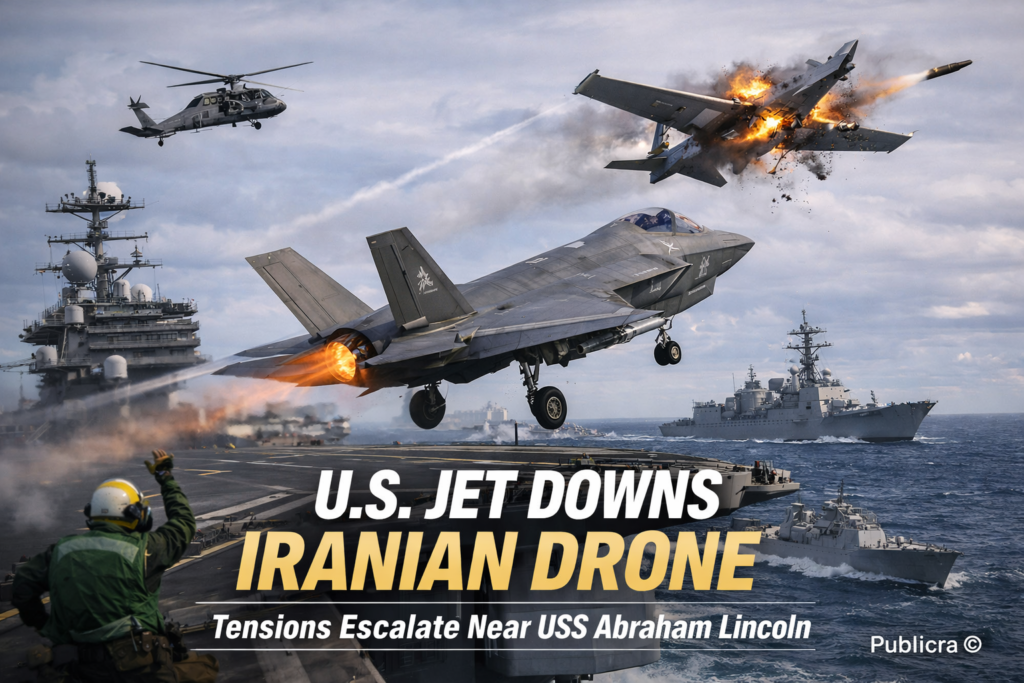
Washington cites self-defense as F-35 jet intercepts UAV near USS Abraham Lincoln while nuclear diplomacy hangs in the balance
The already fragile security environment in the Middle East witnessed a new flashpoint this week after the United States military confirmed it had shot down an Iranian drone over the Arabian Sea. According to Reuters, the unmanned aerial vehicle (UAV) was intercepted after it allegedly flew “aggressively” toward the US aircraft carrier USS Abraham Lincoln, a key component of Washington’s expanding naval presence in the region.
The incident comes at a particularly sensitive moment. Diplomatic efforts to revive nuclear talks between Washington and Tehran are underway, oil markets remain volatile, and global powers such as Russia and Turkey are reportedly working behind the scenes to prevent a wider military confrontation.
This article explores what happened, why it matters, and how it fits into the broader geopolitical chessboard involving Iran, the United States, and the wider Middle East.
What Happened in the Arabian Sea?
US officials told Reuters that an Iranian Shahed-139 drone approached the USS Abraham Lincoln with what they described as “unclear intent.” The carrier, operating in the Arabian Sea as part of a US carrier strike group, was conducting routine operations when the drone entered its vicinity.
A spokesperson for US Central Command said that an F-35C Lightning II fighter jet launched from the Abraham Lincoln intercepted and destroyed the UAV.
“An F-35C fighter jet from Abraham Lincoln shot down the Iranian drone in self-defense and to protect the aircraft carrier and personnel on board,” said Navy Captain Tim Hawkins, according to Reuters.
No US personnel were injured, and no damage to the carrier or its escorts was reported.
Why the USS Abraham Lincoln Matters
The USS Abraham Lincoln is not just another warship. As a nuclear-powered aircraft carrier, it serves as a floating airbase capable of projecting American military power across vast regions.
Its presence in the Arabian Sea sends a clear strategic signal:
- Deterrence: Demonstrating readiness to counter threats from Iran or allied armed groups
- Protection of shipping lanes: Safeguarding vital energy and trade routes
- Support for allies: Reassuring regional partners amid escalating tensions
The carrier’s deployment has been described by US media as part of a broader “armada” positioning itself near the Middle East, reflecting Washington’s concern over regional instability.
Iranian Drones and Regional Power Projection
Iran has invested heavily in drone technology over the past decade. UAVs such as the Shahed series are central to Tehran’s asymmetric warfare strategy, allowing it to:
- Monitor adversary movements
- Apply pressure without direct confrontation
- Support allied groups across the region
From the Persian Gulf to conflict zones beyond the Middle East, Iranian drones have become a recurring feature of modern geopolitical tensions.
While Tehran has not officially commented on this specific incident, previous encounters suggest Iran often frames such actions as defensive surveillance rather than provocation.
Oil Markets React Immediately
The geopolitical shockwaves were felt almost instantly in global energy markets. Oil futures reportedly rose by more than $1 per barrel following news of the drone shoot-down.
This reaction highlights how sensitive markets remain to:
- Military incidents involving Iran
- Threats to shipping routes
- Potential escalation between major powers
Even limited confrontations can drive up prices due to fears of wider disruption in one of the world’s most important energy corridors.
Diplomacy in the Background: Nuclear Talks at Stake
Perhaps the most critical context surrounding this incident is the ongoing effort to restart nuclear negotiations between Washington and Tehran.
According to Axios reporter Barak Ravid, talks were expected to take place this Friday. However, Iran has reportedly demanded changes to:
- Venue
- Format
- Scope of discussions
Tehran allegedly wants negotiations limited strictly to nuclear issues, resisting US and regional calls to also address Iran’s missile program and its support for proxy groups.
The Shadow of the 2015 Nuclear Deal
The current standoff cannot be understood without revisiting the Joint Comprehensive Plan of Action (JCPOA) signed in 2015.
Key points include:
- Iran agreed to limit uranium enrichment
- International sanctions were lifted
- Global inspections were introduced
However, the United States withdrew from the agreement in 2018 under President Donald Trump, reimposing harsh sanctions. In response, Iran gradually scaled back its compliance and began enriching uranium up to 60% purity, far beyond the limits set by the original deal.
Russia and Turkey: Quiet Mediators?
Reports from the Kuwaiti newspaper Al-Jarida suggest that Russia and Turkey have played behind-the-scenes roles in reducing the likelihood of a US military strike on Iran.
Moscow has repeatedly emphasized that Iran’s nuclear issue should be resolved diplomatically rather than through force. Analysts believe Russia sees:
- A regional war as destabilizing
- Energy market chaos as risky
- Diplomatic leverage as strategically valuable
These interventions may have helped create space for renewed negotiations, even as military incidents continue.
Trump’s Mixed Signals on Iran
Despite his history of hardline rhetoric, former President Donald Trump recently said he hopes the US and Iran can “make a deal.”
This apparent contradiction reflects a broader pattern:
- Strong military posture paired with
- Openness to negotiation when leverage is perceived
The drone incident underscores how fragile this balance remains.
Risk of Escalation or Managed Tension?
While the shoot-down did not lead to immediate retaliation, experts warn that repeated incidents increase the risk of miscalculation.
Key escalation risks include:
- Accidental casualties
- Rapid military responses
- Pressure from domestic politics on both sides
At the same time, the absence of immediate Iranian retaliation may indicate a desire to avoid derailing diplomatic efforts.
What Comes Next?
Several scenarios now appear possible:
- Controlled Diplomacy: Talks proceed despite tensions, focusing narrowly on nuclear issues
- Stalled Negotiations: Disagreements over format and scope delay progress
- Further Military Incidents: Additional encounters raise pressure on policymakers
Much will depend on whether both sides can compartmentalize military posturing from diplomatic engagement.
Global Implications Beyond the Middle East
This incident is not just a regional story. It has implications for:
- Global energy markets
- US-Russia relations
- Non-proliferation efforts
- Maritime security
As great-power competition intensifies, even localized confrontations can reverberate worldwide.
A Delicate Moment for Security and Diplomacy
The US shoot-down of an Iranian drone near the USS Abraham Lincoln highlights the razor-thin line separating deterrence from escalation in the Middle East. While Washington insists the action was purely defensive, the timing—amid sensitive nuclear diplomacy—adds layers of complexity.
For now, restraint on both sides suggests a mutual interest in avoiding open conflict. Whether diplomacy can outpace military tension remains the defining question in the weeks ahead.