
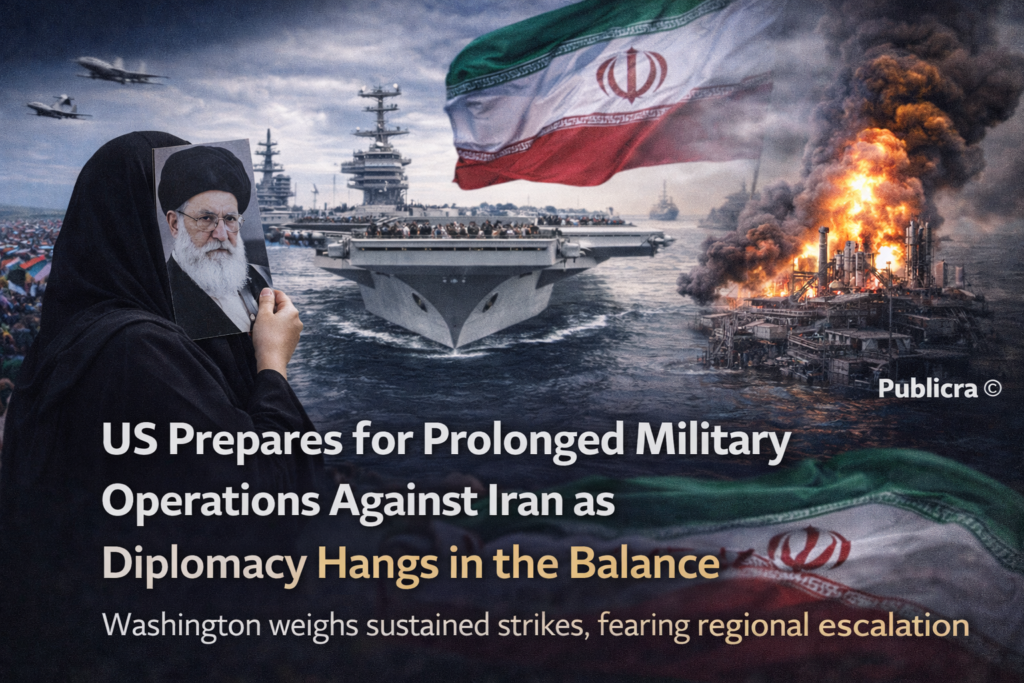
Pentagon planning signals a potential shift from one-off strikes to sustained campaigns, raising fears of regional escalation across the Middle East.
The United States military is preparing contingency plans for potentially weeks-long operations against Iran should diplomatic efforts fail, according to officials familiar with current planning. The development marks a significant escalation in posture from limited, one-off strikes toward a sustained campaign model, raising alarms about retaliation, regional destabilization, and the prospect of a broader Middle East conflict.
As negotiations proceed under the shadow of intensified force deployments, Washington is signaling that “all options remain on the table.” The build-up of naval, air, and missile-defense assets across the region underscores the gravity of the moment. For allies and adversaries alike, the question is no longer whether the United States has the capacity to strike Iran, but whether a prolonged confrontation could spiral beyond control.
From Limited Strikes to Sustained Campaigns: What’s Changed?
Previous episodes of U.S.–Iran confrontation were characterized by short, high-impact operations aimed at sending deterrent messages. The current planning reportedly contemplates something broader: a sustained campaign targeting not only nuclear infrastructure but also state and security facilities linked to Iran’s military posture.
This shift reflects a recalibration of deterrence. U.S. planners appear to be preparing for a scenario in which limited strikes fail to alter Iranian behavior, requiring follow-on operations to degrade capabilities over time. Such an approach would place U.S. forces in a protracted risk environment—one that increases exposure to missile, drone, and proxy attacks across multiple theaters.
Diplomacy Under Pressure: Talks Continue Amid Military Signals
Parallel to military preparations, diplomatic channels remain active. U.S. envoys are engaging in mediated talks with Iranian representatives, with regional intermediaries facilitating dialogue. Washington’s stated preference is to reach an agreement addressing nuclear activities and de-escalation pathways. Tehran has signaled willingness to discuss nuclear constraints in exchange for sanctions relief, while maintaining firm red lines on missile programs.
The coexistence of diplomacy and force posture is deliberate: the administration aims to strengthen negotiating leverage while preserving an off-ramp from conflict. Yet history suggests that the choreography of coercive diplomacy is perilous. Military signals can harden positions, empower hardliners, and narrow political space for compromise on both sides.
The Military Posture: Carriers, Air Power, and Missile Defense
The U.S. force posture across the Middle East has expanded in recent weeks. Additional aircraft carriers, guided-missile destroyers, fighter squadrons, and air-defense assets have been repositioned to enhance both offensive reach and defensive resilience. These deployments serve dual purposes:
- Deterrence: Demonstrating credible capability to strike and defend.
- Protection: Shielding U.S. bases and personnel from likely retaliation.
The architecture reflects a recognition that any sustained operation against Iran would provoke counterstrikes. The U.S. maintains bases and personnel across the Gulf and Levant, making force protection a paramount concern. Missile defense systems, early-warning capabilities, and hardened infrastructure are being emphasized to mitigate the risk of casualties and escalation.
Iran’s Likely Response: Retaliation and Asymmetric Warfare
Iran has long signaled that it would respond to attacks on its territory. Its strategy emphasizes layered deterrence: conventional missiles, drones, cyber capabilities, maritime disruption, and the mobilization of regional partners. In a prolonged confrontation, retaliation would likely unfold across multiple domains:
- Direct strikes: Ballistic and cruise missile attacks against U.S. bases and allied infrastructure.
- Maritime pressure: Disruption risks in key waterways, affecting global energy flows.
- Proxy actions: Heightened activity by aligned groups across regional theaters.
- Cyber operations: Targeting critical infrastructure and communications.
This multi-vector response framework complicates U.S. planning. Defending against one domain does not neutralize threats in others. The risk of miscalculation grows as the tempo of exchanges increases.
Regional Ripple Effects: Allies, Energy, and Global Trade
A sustained U.S.–Iran confrontation would reverberate far beyond the immediate belligerents. Regional allies would face heightened risks to their security and economic stability. Energy markets could experience volatility due to threats to shipping lanes and production infrastructure. Insurance premiums for maritime trade would rise, and supply chains could be disrupted.
For Gulf states pursuing economic diversification, prolonged instability threatens tourism, investment flows, and mega-project timelines. For Europe and Asia, disruptions to energy supplies and shipping routes could translate into inflationary pressures and political strain. The globalized nature of trade ensures that regional conflict carries worldwide consequences.
The Nuclear File: Deterrence, Thresholds, and Red Lines
At the heart of the confrontation lies the nuclear question. Washington seeks verifiable constraints on Iran’s nuclear activities; Tehran demands sanctions relief and security assurances. The challenge is managing thresholds: how far can each side go without crossing red lines that trigger broader war?
Prolonged operations risk entrenching worst-case assumptions. Military pressure could push Iran to accelerate hedging strategies, while U.S. strikes could harden resolve and complicate monitoring. Conversely, credible diplomacy could reduce incentives for escalation—if both sides perceive a viable path to security and economic normalization.
The Domestic Politics Factor
Decisions on war and peace are shaped not only by strategic calculations but by domestic politics. In Washington, policymakers face competing pressures: demonstrate resolve, protect U.S. personnel, and avoid another open-ended conflict. In Tehran, leadership must balance deterrence with the economic costs of confrontation and domestic expectations of sovereignty.
Domestic narratives can narrow policy options. Once leaders publicly frame confrontation in existential terms, compromise becomes politically costly. This dynamic underscores the importance of keeping diplomatic channels open even as military preparations proceed.
Risk Management: Can Escalation Be Contained?
Containment of escalation hinges on communication, clarity of objectives, and credible de-escalation pathways. Key risk-management tools include:
- Crisis hotlines and backchannels to prevent misinterpretation of military moves.
- Defined objectives to avoid mission creep.
- Proportionality in responses to limit escalation ladders.
- Regional diplomacy to manage spillover and reassure allies.
History suggests that prolonged campaigns increase the probability of accidents, miscalculations, and unintended escalation. The longer operations last, the more likely they are to generate political and humanitarian costs that reshape strategic aims.
International Law and Norms: The Legal Debate
Sustained military operations raise legal questions regarding authorization, proportionality, and civilian protection. International norms emphasize the necessity of exhausting diplomatic options and ensuring that any use of force adheres to humanitarian law. Scrutiny from global institutions and civil society would intensify as operations lengthen.
Allies will also weigh the legitimacy of prolonged action. Coalition cohesion depends on shared legal and political frameworks. Divergence among partners could complicate operational coordination and post-conflict diplomacy.
What Comes Next: Scenarios to Watch
Several plausible trajectories are emerging:
- Diplomatic breakthrough: Talks yield a framework for de-escalation and nuclear constraints, reducing the likelihood of sustained operations.
- Limited strikes with containment: The U.S. conducts targeted operations followed by restraint, with managed retaliation.
- Prolonged confrontation: Weeks-long exchanges lead to regional spillover, economic disruption, and heightened global risk.
- Escalation beyond the region: Maritime and cyber domains pull additional actors into the crisis.
Which path prevails will depend on decisions taken in the coming weeks—particularly whether leaders prioritize de-escalation alongside deterrence.
A Precarious Moment for Middle East Security
The prospect of prolonged U.S. military operations against Iran represents a watershed in regional security dynamics. While contingency planning is a hallmark of prudent defense policy, the move from limited strikes to sustained campaigns carries profound risks: retaliation, regional escalation, economic disruption, and long-term instability.
Diplomacy remains the least costly path to security, but it must contend with hardened positions and mutual distrust. The coming period will test whether coercive pressure can coexist with meaningful negotiation—or whether the Middle East edges closer to a conflict whose consequences would extend far beyond the region.