
Britain’s decision to transfer sovereignty to Mauritius has reignited global debate over military power, colonial legacies and U.S. strategy
The Chagos Islands, a remote archipelago in the Indian Ocean, have returned to the center of international attention after Britain agreed to transfer sovereignty of the territory to Mauritius — a move that carries major geopolitical and military implications because of the U.S.-British base on Diego Garcia.
The decision has drawn sharp criticism from U.S. President Donald Trump, who cited the handover as evidence that strategic territories should not be relinquished lightly. In a social media post this week, Trump called Britain’s move “an act of great stupidity,” warning that it endangered a critical military installation used by the United States and its allies.
A strategic outpost in the Indian Ocean
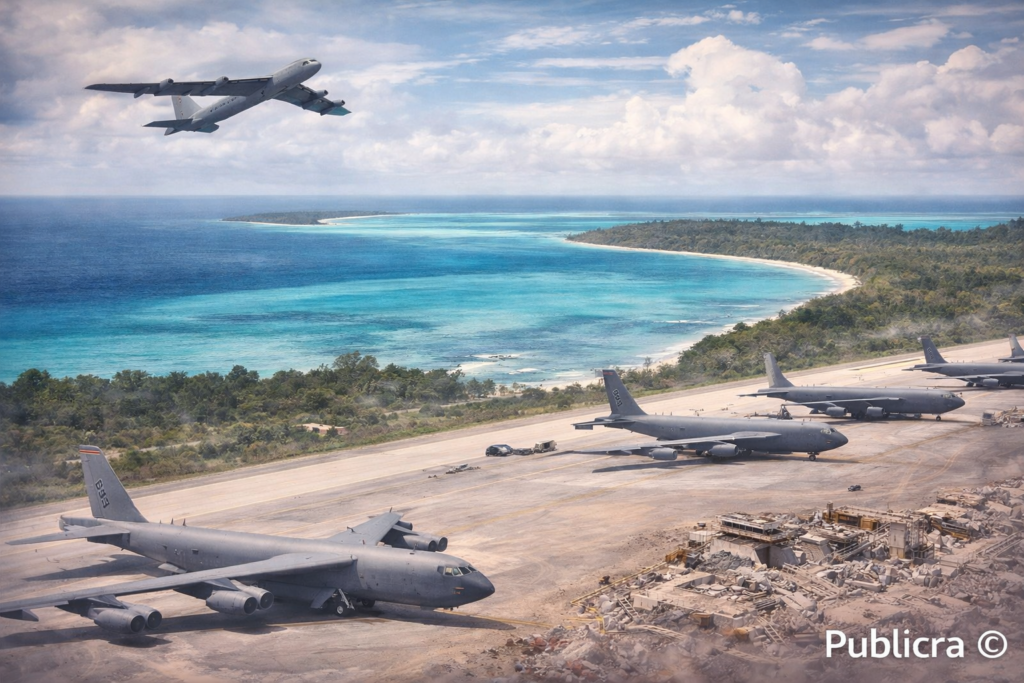
The Chagos Islands consist of more than 55 small islands located roughly midway between Africa and Southeast Asia. The largest of them, Diego Garcia, hosts one of the most important overseas military bases operated jointly by the United States and Britain.
The Diego Garcia base has played a key role in U.S. military operations for decades, serving as a logistics hub for naval forces and a refueling and staging point for long-range bombers. The base has supported operations in the Middle East, Afghanistan and the Indo-Pacific, and remains central to U.S. power projection across Asia and Africa.
Colonial history and forced displacement
Britain took control of the Chagos Islands during the colonial era. In the 1960s, as part of an agreement with Washington to establish the Diego Garcia base, British authorities forcibly removed the islands’ inhabitants, known as the Chagossians, relocating them primarily to Mauritius and the Seychelles.
The displacement, which affected thousands of people, has long been criticized by human rights organizations and international courts. Former residents have sought compensation, the right of return, and recognition of the injustice they suffered.
Mauritius’s claim and international pressure
Mauritius has claimed sovereignty over the Chagos Islands since gaining independence from Britain in 1968, arguing that the archipelago was unlawfully separated from its territory during decolonization.
In 2019, the International Court of Justice ruled that Britain’s continued administration of the islands was illegal and urged the U.K. to end its control “as rapidly as possible.” The United Nations General Assembly later backed the ruling, increasing diplomatic pressure on London.
After years of negotiations, Britain’s government agreed in 2024 to transfer sovereignty to Mauritius. The agreement, signed last year, still requires ratification by both countries but represents a significant shift in Britain’s position.
Military uncertainty and U.S. concerns
Although Britain and Mauritius have said the Diego Garcia base will continue operating under a long-term lease arrangement, the transition has raised concerns in Washington. U.S. officials worry about potential legal, political or diplomatic complications that could affect access to the base in the future.
Trump linked the Chagos decision to his argument that the United States should acquire strategically vital territories rather than risk losing control over key military assets — a reference to his renewed interest in Greenland, another strategically located island.
A symbol of larger global tensions
The Chagos handover reflects broader global debates over colonial legacies, international law, and military power in a rapidly changing world. As competition intensifies between major powers in the Indo-Pacific, control over remote but strategically positioned territories has become increasingly significant.
For now, Diego Garcia remains operational. But the political and legal changes surrounding the Chagos Islands highlight how historical disputes continue to shape modern geopolitics — with consequences far beyond the Indian Ocean.