
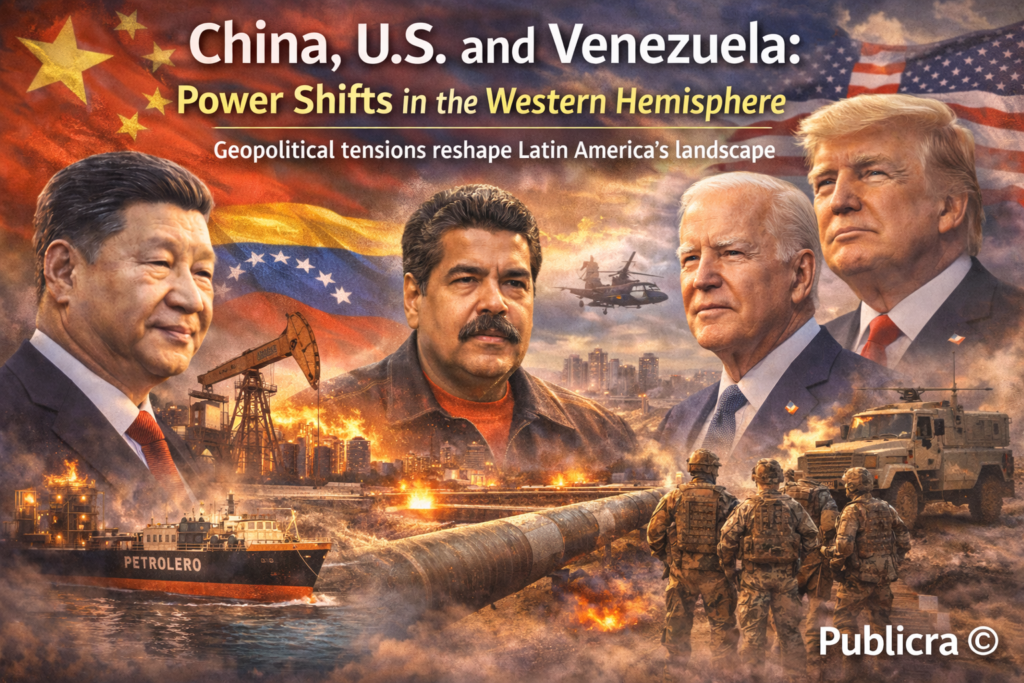
Beijing Reassesses Its Latin America Strategy as Washington Reasserts Power in the Western Hemisphere
A Shock to the Global South
The U.S. military intervention in Venezuela in early 2026 marked one of the most dramatic power moves in the Western Hemisphere in decades. The operation, which culminated in the capture of President Nicolás Maduro and the rapid reconfiguration of Venezuela’s oil export system, sent shockwaves far beyond Caracas. For Washington, it was a blunt demonstration of renewed resolve to shape outcomes in its near abroad. For Beijing, which had spent nearly two decades cultivating Venezuela as a flagship partner in Latin America, the intervention raised an uncomfortable question: why did China not step in to protect one of its closest allies in the region?
At first glance, China’s restraint appeared puzzling. Venezuela had long been a cornerstone of Beijing’s energy security strategy and a symbol of its expanding footprint in the Global South. Yet, despite strong rhetoric condemning U.S. actions, China avoided any form of direct confrontation. This decision was not an abandonment of Venezuela, nor a retreat from Latin America, but rather a calculated reassessment of power realities, strategic priorities, and the evolving nature of great-power competition in a multipolar world.
China’s Deep Stakes in Venezuela
Energy, Finance, and Strategic Ties
Over the past 20 years, Venezuela emerged as one of China’s most important partners in the Western Hemisphere. Chinese policy banks extended tens of billions of dollars in loans, much of it repaid through oil shipments. Chinese state-owned firms invested in upstream energy projects, infrastructure, telecommunications, and mining. At various points, Venezuela ranked among the top suppliers of crude oil to China in the Americas.
Beyond economics, the relationship was elevated to an “all-weather strategic partnership,” a rare designation signaling political trust and long-term cooperation. Beijing framed its engagement as development-oriented, offering financing and infrastructure without political conditions—an appealing alternative to Western institutions for governments facing sanctions or diplomatic isolation.
Security Cooperation Without Military Commitments
China also expanded limited security cooperation with Venezuela, supplying defense equipment and technology, including surveillance and satellite-related support. However, Beijing consistently stopped short of forming a formal military alliance or establishing a permanent military presence. This distinction proved crucial. While China was willing to support Venezuela economically and politically, it had no treaty obligation—or strategic incentive—to confront U.S. military power directly in the Americas.
Why China Chose Restraint Over Confrontation
The Reality of U.S. Military Dominance in the Hemisphere
The Western Hemisphere remains the United States’ most secure strategic domain. Despite China’s growing global reach, challenging U.S. military dominance so close to American territory would entail immense risks. Any attempt by China to intervene militarily in Venezuela could have triggered a severe escalation, potentially extending rivalry into open confrontation.
Beijing’s leaders are acutely aware of the asymmetry. While China can contest U.S. influence in Asia-Pacific waters, Latin America lies thousands of miles from Chinese shores. Power projection across such distances would strain Chinese capabilities and expose vulnerabilities in its global posture.
Avoiding a Dangerous Precedent
Intervening militarily on behalf of Venezuela could have set a precedent that undermines China’s long-standing principle of non-interference. Beijing has consistently promoted sovereignty and opposition to regime change as cornerstones of its foreign policy narrative. Yet, translating that rhetoric into direct military action abroad would contradict decades of diplomatic positioning and alarm many partners in the Global South who value China precisely because it avoids overt interventionism.
Energy Geopolitics After the Intervention
The Reordering of Venezuelan Oil Flows
Following the U.S. operation, Washington assumed de facto control over Venezuela’s oil export mechanisms. While China continues to purchase Venezuelan crude, the terms have shifted. Preferential arrangements embedded in earlier oil-backed loans have weakened, and transactions now occur under stricter market conditions.
This reconfiguration has implications for China’s energy security. Venezuelan heavy crude was never an ideal feedstock for Chinese refineries, but it served as a strategic hedge. Losing privileged access complicates Beijing’s broader strategy of diversifying supply sources and reducing exposure to chokepoints.
Debt, Leverage, and Strategic Losses
U.S. oversight of Venezuelan oil revenues also reshapes debt negotiations. Chinese lenders, once among Caracas’ most influential creditors, now face a diminished bargaining position. The episode underscores a hard lesson for Beijing: economic leverage alone cannot compensate for the absence of security guarantees in geopolitically contested regions.
The Monroe Doctrine Returns—In Modern Form
Washington’s Renewed Focus on the Western Hemisphere
Recent U.S. strategic documents emphasize the Western Hemisphere as a core priority. While not explicitly invoking the Monroe Doctrine, the logic is unmistakable: external powers should not establish military or strategic footholds in the Americas. The intervention in Venezuela sends a signal to China and other global actors that Washington is prepared to use force to enforce its perceived red lines.
Implications for China’s Latin America Strategy
For China, this does not mean abandoning Latin America. Instead, it suggests a recalibration. Beijing is likely to prioritize deeper economic ties with major regional powers such as Brazil and Mexico, where engagement can proceed without directly challenging U.S. security interests. Infrastructure investment, trade, and green energy cooperation remain central pillars of China’s approach.
Multipolarity and the Limits of Power Projection
A Test Case for Great-Power Competition
The Venezuelan episode illustrates a central feature of the emerging multipolar order: power is not evenly distributed across regions. The United States retains decisive advantages in its neighborhood, just as China seeks to assert primacy in parts of Asia. Rather than a universal contest for dominance, global politics increasingly resemble a patchwork of spheres of influence, negotiated implicitly through actions and restraint.
Strategic Restraint as a Form of Power
China’s decision not to intervene militarily can be interpreted not as weakness, but as strategic restraint. By avoiding escalation, Beijing preserves resources for contests closer to home, where its interests are more vital and its capabilities more relevant. This calculus reflects a long-term view of competition, prioritizing sustainability over symbolic gestures.
Regional Reactions in Latin America
Balancing Between Washington and Beijing
Latin American governments are watching closely. Many welcome Chinese investment and trade but remain cautious about becoming arenas for great-power rivalry. The Venezuelan intervention serves as a reminder that the U.S. retains unmatched coercive capacity in the region. As a result, countries may seek to balance economic ties with China against security relationships with Washington.
The Future of Non-Aligned Diplomacy
For smaller states, the episode reinforces the appeal of diversified partnerships. Rather than aligning exclusively with either the U.S. or China, many Latin American governments may pursue pragmatic engagement with both, extracting economic benefits while avoiding entanglement in geopolitical confrontations.
What This Means for the U.S.–China Rivalry
Competing Models of Influence
The contrast between U.S. and Chinese approaches to Venezuela highlights two competing models of influence. Washington emphasizes security dominance and the willingness to use force. Beijing prioritizes economic integration and diplomatic engagement. Each model has strengths and limitations, and their interaction will shape the trajectory of global politics in the coming decade.
From Globalization to Strategic Fragmentation
The intervention also reflects a broader trend: the gradual fragmentation of globalization into regional blocs and strategic zones. As great powers assert influence in their respective spheres, the promise of a universally open international system gives way to a more compartmentalized order, defined by negotiated boundaries and selective cooperation.
A Delicate Balance for Beijing
China’s response to the U.S. action in Venezuela reveals a sophisticated, if constrained, strategy. Beijing condemned the intervention, reaffirmed principles of sovereignty, and sought to protect its economic interests—without crossing a line that could trigger confrontation. This balancing act reflects the realities of power in a multipolar system, where influence is unevenly distributed and strategic patience often outweighs dramatic gestures.
For Venezuela, the future remains uncertain. For China, the lesson is clear: economic partnerships can deepen influence, but without security guarantees, they remain vulnerable in contested geopolitical spaces. For the world, the episode underscores a shifting global order—one where restraint, adaptation, and regional power dynamics increasingly define the rules of the game.
Key Takeaways
- China’s restraint in Venezuela reflects strategic realism, not retreat.
- The U.S. has reasserted dominance in the Western Hemisphere through decisive action.
- Energy geopolitics and debt leverage are central to the evolving rivalry.
- Multipolarity does not mean equal power everywhere; regional hierarchies persist.
- Latin America is becoming a critical testing ground for great-power competition.