
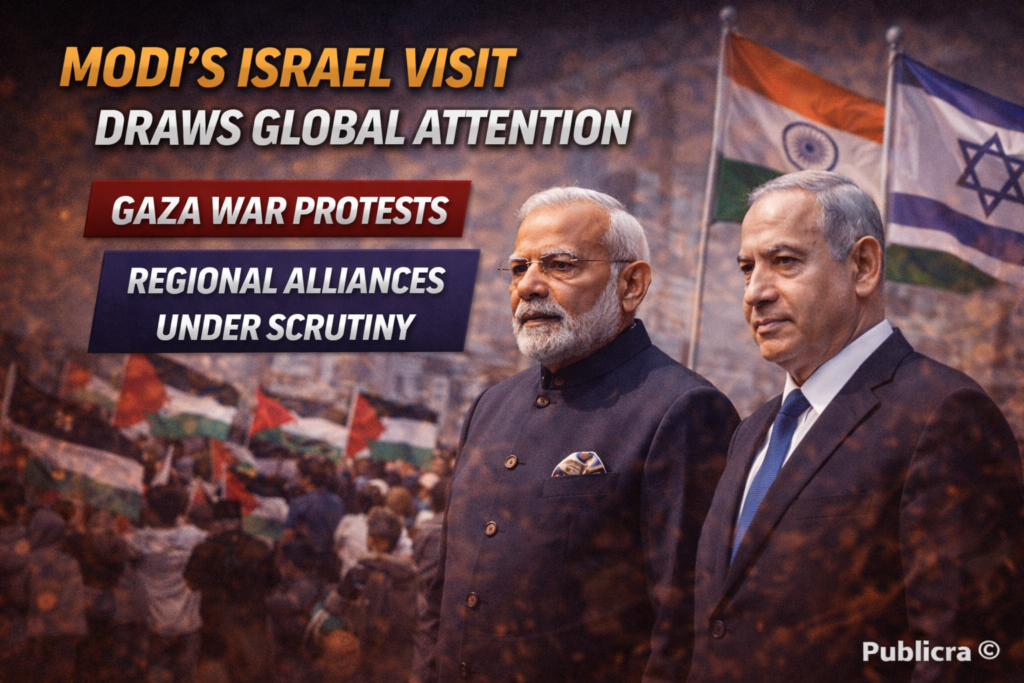
Diplomacy, Gaza protests, and shifting alliances put India’s Middle East strategy under global scrutiny
Indian Prime Minister Narendra Modi’s two-day state visit to Israel has ignited widespread debate across political, diplomatic, and civil society circles in India and the wider Middle East. The visit, which includes a rare address to Israel’s parliament, comes at a time when the war in Gaza continues to provoke global outrage and allegations of serious humanitarian violations.
For supporters of closer India–Israel ties, the visit underscores New Delhi’s pragmatic pursuit of security, technology, and trade cooperation with one of the Middle East’s most advanced economies. For critics, the timing raises ethical and geopolitical questions about India’s alignment in a region marked by intense conflict and suffering. The controversy surrounding Modi’s visit reflects deeper tensions within India’s foreign policy, which seeks to balance relationships with Israel, Arab partners, Iran, Russia, and Western powers.
The Timing of the Visit and the Gaza Factor
The Gaza conflict has become one of the most polarizing international issues of recent years, generating protests, diplomatic rifts, and calls for accountability. Modi’s arrival in Israel amid ongoing allegations of large-scale civilian harm has intensified scrutiny of India’s diplomatic posture.
For many observers, the visit risks being interpreted as tacit endorsement of Israel’s military actions, even if Indian officials emphasize that New Delhi supports humanitarian principles and a negotiated resolution. The optics of high-level engagement during an active conflict have fueled protests among segments of Indian civil society and political groups that traditionally support Palestinian rights.
India–Israel Relations: From Cautious Engagement to Strategic Partnership
India recognized Israel decades ago but maintained a cautious distance for much of the Cold War era, prioritizing solidarity with Arab states and the Palestinian cause. Over time, pragmatic considerations reshaped this stance. The establishment of full diplomatic relations marked the beginning of gradual engagement in trade, defense, and technology.
In recent years, the relationship has matured into a strategic partnership, driven by shared interests in counterterrorism, defense technology, agriculture, and innovation. Modi’s previous visit to Israel symbolized a turning point, normalizing high-level political engagement and expanding cooperation across multiple sectors.
Defense, Technology, and Economic Cooperation
A cornerstone of India–Israel relations is defense cooperation. Israel has emerged as a key supplier of military technology to India, ranging from surveillance systems to precision-guided munitions. This partnership aligns with India’s efforts to modernize its armed forces and diversify defense procurement sources.
Beyond defense, collaboration extends to water management, agricultural innovation, cybersecurity, and high-tech startups. Israeli expertise in arid-zone agriculture and water recycling has been particularly valuable for India’s development challenges. The economic dimension of the relationship reinforces the pragmatic rationale behind Modi’s outreach, even as political sensitivities persist.
The Balancing Act With Arab Partners
India’s engagement with Israel occurs alongside deep ties with Arab nations, particularly in the Gulf. Millions of Indian expatriates work in Gulf states, and the region remains a crucial source of energy supplies. Maintaining stable relations with Arab partners is therefore an economic and strategic imperative for New Delhi.
This balancing act requires careful diplomatic messaging. While India seeks to expand cooperation with Israel, it also emphasizes support for dialogue, humanitarian assistance, and regional stability. Critics argue that high-profile visits risk upsetting this balance, while officials contend that India can maintain parallel relationships without choosing sides.
Iran, Russia, and Strategic Autonomy
India’s foreign policy tradition emphasizes strategic autonomy, avoiding rigid alignment with any single bloc. Iran has long been an important partner for India, particularly in energy cooperation and regional connectivity initiatives. Russia remains a key defense and strategic partner.
Modi’s engagement with Israel must therefore be calibrated to avoid alienating these longstanding partners. The evolving geopolitical landscape, marked by tensions among major powers, complicates this balancing act. New Delhi’s challenge is to pursue national interests while navigating a web of regional rivalries and alliances.
Netanyahu’s Regional Vision and India’s Role
Israel’s leadership has articulated ambitious regional visions that seek to integrate select partners into broader security and economic frameworks. India’s inclusion in such initiatives reflects Israel’s view of New Delhi as an emerging global power with shared security concerns.
For India, however, participation in overtly security-focused blocs risks entanglement in regional conflicts that do not directly align with its core interests. Indian policymakers are therefore likely to prioritize bilateral cooperation over formal participation in regionally polarizing initiatives.
Domestic Political Reactions in India
The controversy over Modi’s visit is also shaped by domestic political dynamics. Political parties and civil society groups within India hold diverse views on the Israel–Palestine issue, often reflecting ideological traditions and electoral considerations.
Some opposition groups have criticized the visit as insensitive to humanitarian concerns in Gaza, while others have adopted a more cautious tone. Public opinion in India is not monolithic, with segments of the population supporting stronger ties with Israel for pragmatic reasons and others emphasizing solidarity with Palestinians.
The Symbolism of a Parliamentary Address
Modi’s scheduled address to Israel’s parliament carries significant symbolic weight. Such invitations are reserved for select foreign leaders and signal a high level of diplomatic warmth. For supporters, the speech highlights India’s growing global stature and deepening ties with Israel.
For critics, the symbolism raises questions about whether the visit inadvertently legitimizes controversial policies. The act of addressing a legislative body during an active conflict inevitably becomes part of the broader political narrative surrounding the visit.
Regional and Global Repercussions
The visit is being closely watched across the Middle East and beyond. Regional actors assess whether India’s engagement signals a shift in its traditional diplomatic posture. Global observers consider how emerging powers navigate complex conflicts while pursuing national interests.
India’s approach could influence how other non-Western powers engage with Middle Eastern conflicts, potentially shaping a multipolar diplomatic landscape where traditional alignments are less rigid.
The Role of Public Diplomacy and Perception Management
Public diplomacy plays a critical role in shaping perceptions of high-profile visits. Indian officials have sought to emphasize themes of peace, cooperation, and humanitarian concern, while Israeli leaders highlight strategic partnership and mutual interests.
Managing these narratives is essential to mitigate backlash and reassure partners across the region. The effectiveness of such efforts will depend on how tangible policy outcomes align with stated commitments to peace and stability.
Long-Term Implications for India’s Middle East Strategy
Modi’s visit to Israel is part of a broader recalibration of India’s Middle East policy, reflecting the region’s growing importance in global geopolitics. As India’s economic and strategic footprint expands, its diplomatic engagements are likely to become more visible and contested.
The long-term challenge for New Delhi is to craft a coherent Middle East strategy that integrates security cooperation, economic engagement, and principled diplomacy. Achieving this balance will require sustained dialogue with all regional stakeholders and careful management of domestic political sensitivities.
Diplomacy Under the Spotlight
The controversy surrounding Modi’s state visit to Israel illustrates the complexities of modern diplomacy in a deeply polarized world. As India navigates competing interests and moral considerations, its actions are scrutinized both at home and abroad.
Whether the visit ultimately strengthens India’s strategic partnerships without undermining its broader regional relationships will depend on how New Delhi translates high-level engagement into policies that promote stability, humanitarian concern, and constructive dialogue in the Middle East.