
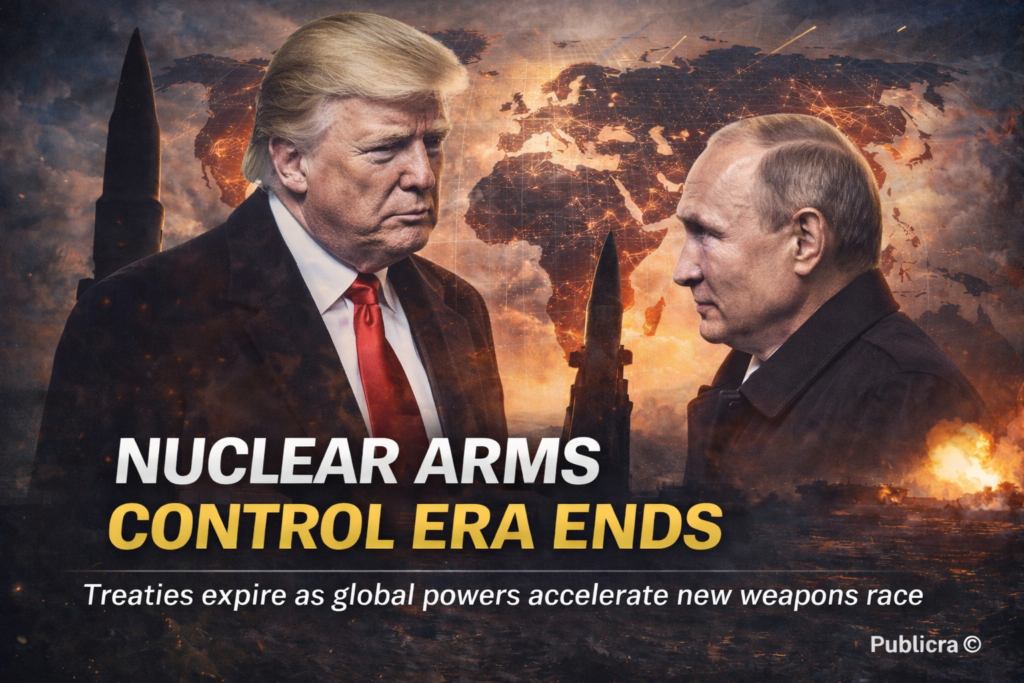
With treaty limits gone, the United States, Russia, China and their allies accelerate nuclear modernization amid rising global tensions
The End of a 50-Year Nuclear Framework
For more than half a century, nuclear arms control treaties acted as guardrails on the world’s most destructive weapons. From the Cold War through periods of détente and renewed rivalry, agreements between Washington and Moscow placed ceilings on warhead numbers, delivery systems, and verification mechanisms. That era has now come to a definitive close.
With the expiration of the last remaining US–Russia nuclear arms control treaty in early February 2026, the world has entered an unprecedented phase of strategic uncertainty. For the first time since the early 1970s, the two largest nuclear powers face no legally binding limits on the size, composition, or deployment of their arsenals. At the same time, China is rapidly expanding its nuclear forces, while European and Asian allies recalibrate their security postures in response to growing geopolitical risks.
The collapse of the arms control framework does not simply mark the end of a treaty. It represents a fundamental shift in how nuclear deterrence, competition, and diplomacy will shape international relations in the decades ahead.
From Cold War Restraint to Strategic Free-for-All
The modern arms control system began in 1972 with the signing of the Strategic Arms Limitation Talks (SALT) agreements between the United States and the Soviet Union. These early treaties acknowledged a dangerous truth: unlimited nuclear competition posed existential risks to both sides. Over the next five decades, successive accords—including the Intermediate-Range Nuclear Forces (INF) Treaty and the New Strategic Arms Reduction Treaty (New START)—sought to contain that competition through transparency, verification, and numerical limits.
These agreements helped:
- Reduce the overall number of deployed warheads
- Establish inspection regimes
- Prevent destabilizing weapons deployments
- Create communication channels during crises
Yet the geopolitical landscape that sustained arms control has steadily eroded. The war in Ukraine, rising US–China rivalry, and growing mistrust among major powers have frozen meaningful negotiations. With no extension or replacement treaty agreed upon, the framework that once restrained nuclear competition has effectively collapsed.
Why No New Treaty Emerged
Despite repeated diplomatic overtures in recent years, talks on extending or replacing existing arms control agreements stalled. Several factors contributed to the breakdown:
1. Geopolitical Confrontation
The ongoing war in Ukraine severely undermined US–Russia relations. Diplomatic channels narrowed, and arms control discussions became collateral damage in a broader strategic confrontation.
2. The China Factor
Washington has insisted that any future arms control framework must include China, whose nuclear arsenal is growing rapidly. Beijing, however, has repeatedly stated that its nuclear forces remain far smaller than those of the United States and Russia and has resisted joining trilateral negotiations.
3. Diverging Strategic Doctrines
The United States, Russia, and China now pursue different strategic visions:
- The US emphasizes modernization and extended deterrence for allies.
- Russia focuses on novel delivery systems and asymmetric capabilities.
- China seeks a survivable second-strike force to ensure deterrence credibility.
These divergent doctrines complicate the creation of a shared framework for limits and verification.
A New Nuclear Arms Race?
With treaty limits gone, all major nuclear powers are accelerating modernization programs. While leaders often stress that these efforts aim to maintain deterrence rather than seek superiority, the absence of constraints raises the risk of a renewed arms race.
United States: Modernization Across the Triad
The US is upgrading all three legs of its nuclear triad:
- Land-based missiles: Replacement of aging intercontinental ballistic missiles (ICBMs)
- Submarines: New ballistic missile submarines with enhanced stealth
- Bombers: Next-generation strategic bombers and cruise missiles
These programs are designed to ensure deterrence credibility well into the mid-21st century. However, critics argue that modernization could drive reciprocal expansion by rivals.
Russia: New Delivery Systems
Russia is testing and deploying new nuclear delivery systems, including hypersonic glide vehicles and advanced cruise missiles. Moscow frames these developments as responses to NATO expansion and US missile defense systems.
China: Rapid Arsenal Expansion
China’s nuclear buildup has drawn particular attention. Satellite imagery and defense assessments suggest Beijing is constructing new missile silos and expanding its submarine-based deterrent. While China maintains a policy of “no first use,” its growing capabilities are reshaping global strategic calculations.
Allies Reassess Their Security Posture
The end of arms control has profound implications for US allies in Europe and Asia. NATO members are debating how to adapt deterrence strategies in a more volatile nuclear environment. Some countries are increasing defense spending, hosting rotational deployments of allied forces, or investing in missile defense systems.
In East Asia, concerns over China’s nuclear expansion and North Korea’s weapons programs are prompting deeper security coordination among the United States, Japan, South Korea, and Australia. Discussions around extended deterrence—Washington’s commitment to defend allies under its nuclear umbrella—have taken on renewed urgency.
Global Non-Proliferation at a Crossroads
The collapse of bilateral arms control raises broader questions about the future of global non-proliferation efforts. The Nuclear Non-Proliferation Treaty (NPT) rests on a bargain: non-nuclear states agree not to acquire nuclear weapons, while nuclear-armed states commit to disarmament efforts.
As nuclear powers expand and modernize their arsenals, critics argue that the disarmament pillar of the NPT is weakening. This perception risks encouraging proliferation pressures in regions with unresolved security disputes.
Countries without nuclear weapons may increasingly question whether existing frameworks adequately protect their security interests in a world where nuclear competition is intensifying.
Technological Change and the Risk of Miscalculation
The emerging nuclear landscape is shaped not only by warhead numbers but also by technological innovation. New capabilities—such as hypersonic weapons, cyber interference, and artificial intelligence-enabled decision systems—introduce fresh risks.
Key concerns include:
- Compressed decision times: Hypersonic weapons reduce warning time, increasing the risk of accidental escalation.
- Cyber vulnerabilities: Interference with early-warning systems could lead to misinterpretation of signals.
- Command and control risks: Greater automation in military systems raises concerns about unintended escalation pathways.
Without arms control frameworks to regulate these technologies, the margin for error in crisis situations may narrow significantly.
Can Arms Control Be Rebuilt?
Despite the current impasse, many analysts argue that arms control is not dead—only dormant. History suggests that periods of intense rivalry can eventually give way to renewed efforts at restraint when leaders recognize shared risks.
Potential pathways forward include:
- Informal confidence-building measures
- Hotlines and crisis communication mechanisms
- Transparency initiatives on exercises and deployments
- Multilateral dialogues involving emerging nuclear powers
Even limited agreements on transparency or risk reduction could help stabilize relations in the absence of formal treaties.
Public Debate and Democratic Oversight
The end of arms control also raises questions about democratic oversight of nuclear policy. Modernization programs involve trillions of dollars in long-term spending commitments, yet public debate over nuclear strategy remains limited in many countries.
Civil society groups and arms control advocates are calling for greater transparency in:
- Nuclear budgeting
- Strategic doctrine formulation
- Risk assessments and contingency planning
They argue that nuclear policy should not remain confined to closed-door negotiations among security elites, especially given the catastrophic stakes involved.
Final Perspective: A Defining Moment for Global Security
The end of the nuclear arms control era marks one of the most consequential shifts in global security since the Cold War. With treaties gone, trust eroded, and new technologies reshaping warfare, the risks of miscalculation and escalation are rising. Whether the world can find new ways to manage nuclear competition—or whether it will slide into a destabilizing arms race—will define international security for a generation.
The challenge for policymakers is not simply to build more weapons, but to rebuild the norms, channels, and frameworks that once prevented catastrophe. In a world bristling with new warheads and faster delivery systems, restraint may once again become the most strategic choice of all.