
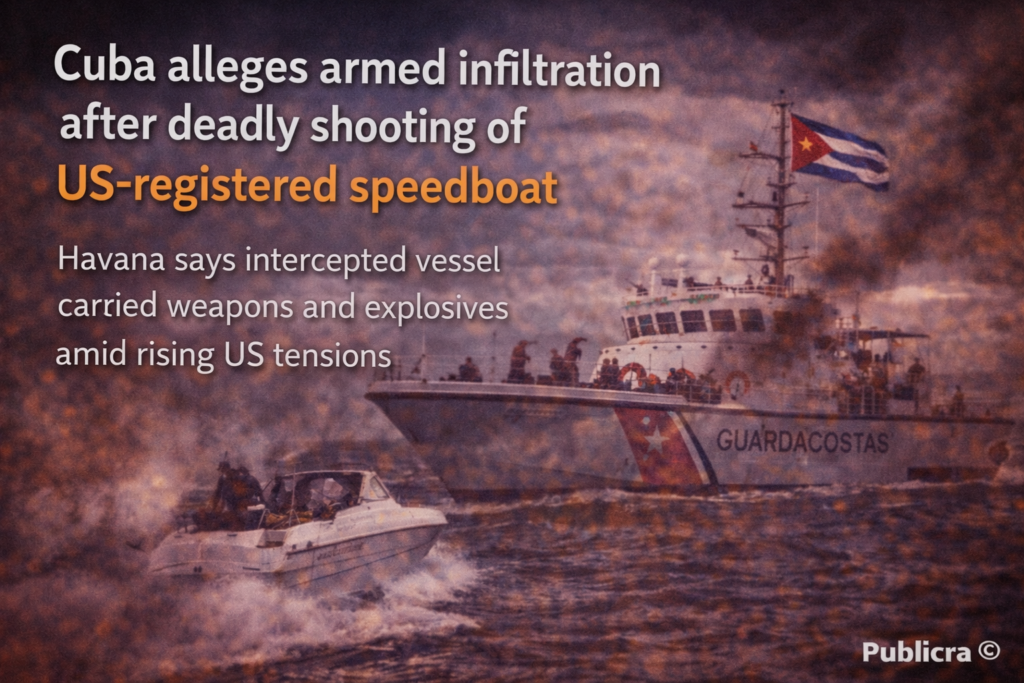
Havana says intercepted vessel carried weapons and explosives amid rising US tensions
Cuba has accused a group traveling aboard a US-registered speedboat of attempting an armed infiltration into its territorial waters, following a deadly maritime confrontation that has further strained relations between Havana and Washington.
According to Cuba’s Interior Ministry, border guards intercepted a Florida-registered vessel approximately one nautical mile off the northern coast near Cayo Falcones. Officials say a firefight erupted after those on board allegedly opened fire on Cuban forces. Four people were killed and six others were injured in the exchange, while a Cuban officer was also reported wounded.
The incident unfolds during a period of heightened geopolitical tension between the two nations, raising serious diplomatic and security questions across the Caribbean region.
Details Of The Maritime Confrontation
Cuban authorities state that the intercepted speedboat entered territorial waters illegally and was engaged by Cuban border forces. Officials allege that the group on board possessed firearms, assault rifles, improvised explosive devices, and tactical gear, suggesting preparation for a coordinated operation rather than a spontaneous maritime crossing.
According to Havana, the individuals were Cuban nationals residing in the United States. Authorities claim an additional suspect linked to the alleged plot has been detained separately.
While Cuba asserts that its forces acted in self-defense, the United States has indicated it will independently verify the facts surrounding the incident.
Washington’s Response And Ongoing Investigation
US Secretary of State Marco Rubio described the incident as “highly unusual” and confirmed that US authorities are investigating the circumstances. He clarified that no US government personnel were aboard the vessel and emphasized that Washington would not rely solely on Cuban accounts.
The US government has not publicly confirmed the identities of those killed or the ownership details of the vessel. The boat’s Florida registration number has not yielded publicly available ownership information.
Rubio, who has long been critical of Cuba’s government, stated that the broader situation between the two countries remains tense and that Washington is evaluating the implications of the maritime confrontation.
Historical Context Of Maritime Incidents
This is not the first time maritime confrontations between Cuba and US-linked vessels have escalated into diplomatic crises. In previous decades, disputes over airspace and territorial waters have led to international fallout.
The Caribbean remains a sensitive geopolitical zone due to migration flows, smuggling networks, and longstanding political friction between Havana and Washington. Cuba has previously accused privately owned US boats of engaging in illegal migrant transport or smuggling operations.
The latest shooting revives memories of past maritime tragedies and reinforces how quickly incidents at sea can escalate into broader diplomatic disputes.
Rising US-Cuba Political Tensions
The deadly encounter comes amid already elevated tensions between the United States and Cuba. Recent developments in the region have contributed to deteriorating relations, particularly following US actions involving Cuba’s allies and energy supply disruptions.
Fuel shortages and economic pressure have intensified internal challenges within Cuba. At the same time, Washington has increased rhetorical pressure on Havana, urging economic and political reforms.
This latest confrontation adds another volatile element to an already fragile relationship.
Sovereignty, Security And Territorial Waters
Cuba has framed the incident as a matter of national sovereignty and territorial defense. President Miguel Díaz-Canel stated that Cuba would respond firmly to any threat against its stability and territorial integrity.
Under international maritime law, countries maintain sovereign rights over territorial waters extending 12 nautical miles from their coastline. Havana asserts that the speedboat was well within this zone when intercepted.
If proven accurate, Cuba’s claim would reinforce its legal justification for engaging the vessel. However, the key question remains whether the use of lethal force was proportionate to the threat posed.
Arms Allegations And Security Implications
Cuban officials claim that firearms, explosives, and tactical equipment were recovered from the boat. If verified, such discoveries could lend credibility to Havana’s assertion that the group intended an armed infiltration rather than migration or smuggling.
However, without independent verification, questions remain about the scale and intent of the alleged operation. Washington has stated that it will conduct its own assessment before drawing conclusions.
The presence of weapons, if confirmed, would represent a serious escalation compared to typical migration-related incidents.
The Role Of Regional Geopolitics
The Caribbean has increasingly become a focal point in broader geopolitical competition. Economic alliances, energy dependencies, and shifting political alignments contribute to heightened sensitivity around security incidents.
Cuba’s relationship with regional partners, combined with US policy shifts, has created a complex diplomatic environment. Maritime security incidents now carry amplified consequences because they intersect with energy policy, migration management, and international sanctions.
In this context, even a single confrontation can ripple across diplomatic channels.
Migration, Smuggling And Political Narratives
For decades, maritime routes between Cuba and Florida have been used by migrants seeking to reach the United States. Smuggling operations have occasionally exploited these routes.
Cuba has previously accused foreign-based actors of using migration flows to destabilize the country. Conversely, US policymakers have raised concerns about Cuba’s internal governance and economic conditions contributing to migration pressures.
The speedboat shooting will inevitably be interpreted through these competing narratives, with both sides seeking to shape public perception.
Economic Pressure And Energy Shortages
Cuba has faced ongoing fuel shortages and economic constraints, exacerbated by shifting regional alliances and sanctions enforcement. Washington has signaled targeted economic measures while also indicating selective humanitarian exceptions.
The maritime incident occurs against this backdrop of economic fragility. Escalating tensions could complicate trade flows, humanitarian shipments, and diplomatic engagement in the region.
International Law And Diplomatic Fallout
International maritime law provides guidelines for engagement within territorial waters, but disputes often arise over enforcement methods and proportionality.
If the United States challenges Cuba’s account, the matter could escalate into a broader diplomatic dispute involving international observers.
Given historical sensitivities, both governments may seek to avoid prolonged escalation while defending their respective positions publicly.
What Happens Next
The immediate priority for both governments will be fact verification. Washington has stated it will independently assess the incident, while Cuba maintains its version of events.
Diplomatic channels may engage quietly behind the scenes to prevent further escalation. However, public rhetoric on both sides could complicate de-escalation efforts.
The broader trajectory of US-Cuba relations may hinge on whether this incident is treated as an isolated confrontation or as part of a larger pattern of hostility.
A Flashpoint In Fragile Relations
The deadly shooting of a US-registered speedboat near Cuban waters represents a serious flashpoint in already strained relations. With allegations of armed infiltration, disputed narratives, and rising regional tensions, the incident underscores how fragile stability remains in the Caribbean.
Whether this episode deepens diplomatic rifts or is resolved through investigation and dialogue will shape the next chapter of US-Cuba relations.