
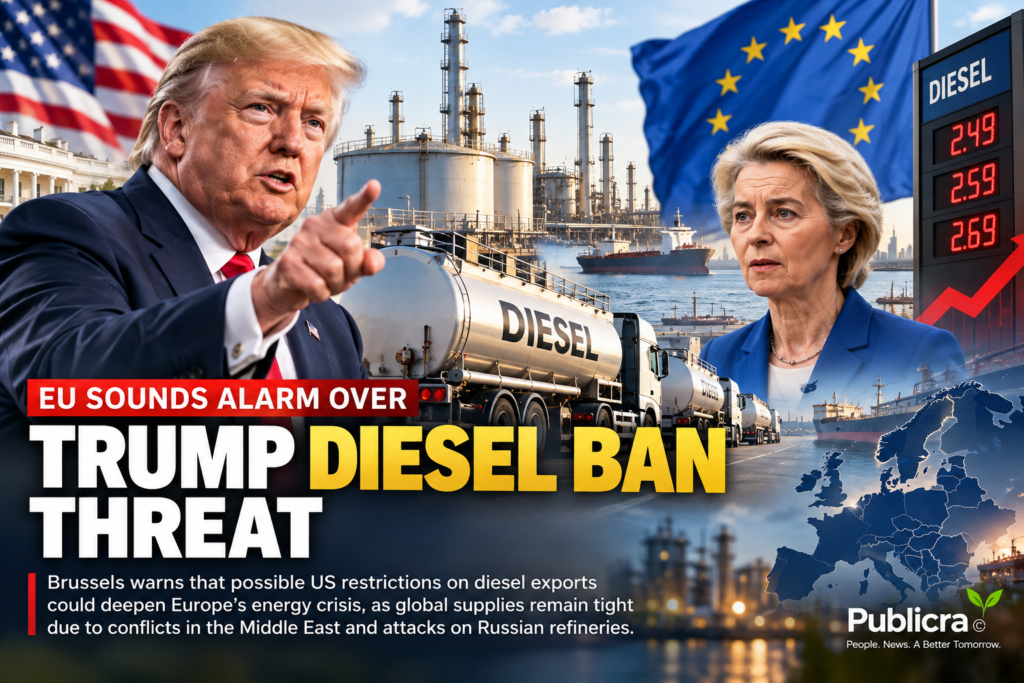
Brussels warns that possible US diesel export restrictions could tighten European supplies as record fuel prices, Middle East disruptions and attacks on Russian refineries strain the global diesel market.
The European Union has warned that possible restrictions on US diesel exports could place additional pressure on Europe’s already strained energy market, opening a new transatlantic dispute at a time when diesel supplies around the world are unusually tight.
European Commission officials said Brussels was concerned by reports that US President Donald Trump’s administration could restrict diesel exports in an effort to ease record fuel prices at home. The concern is particularly significant for Europe because the United States has become one of its most important alternative energy suppliers as the EU has reduced its dependence on Russian energy since 2022.
However, reports describing the proposal as an agreed 90-day US diesel export ban require an important qualification. The White House has denied that it is preparing a flat temporary ban, while US Energy Secretary Chris Wright has said such a measure would not work. Reuters reported on September 24 that Wright had instead contacted executives at several American refiners to explore whether they would support voluntary restrictions on diesel exports.
EU says disruption to US diesel supplies could hurt both sides
European Commission spokesman Olof Gill confirmed that Brussels was concerned about the possibility of Washington restricting diesel exports. He said high-level contacts between the European Union and the Trump administration were continuing and stressed the importance of consultation before either side takes measures affecting shared energy markets.
Gill said disruption to the energy trade could have negative consequences for both Europe and the United States. The Commission’s position reflects Europe’s growing dependence on American energy supplies following its effort to diversify away from Russia after the escalation of the Ukraine conflict in 2022.
European Commission spokeswoman Anna-Kaisa Itkonen said the bloc was monitoring fuel markets and security of supply closely. She also stressed that there was no concrete diesel shortage in the EU at the time of her remarks, an important distinction from the broader global market tightness. According to the Commission, the United States accounted for around 50% of EU diesel imports in August, making any substantial disruption to American exports particularly important for European buyers.
Trump looks for ways to bring down record US diesel prices
The controversy emerged as diesel prices in the United States climbed to unprecedented levels. Average US retail diesel prices reached approximately $6.52 a gallon this week, according to figures cited by Reuters, placing increasing pressure on farmers, transport companies, manufacturers and other sectors heavily dependent on diesel fuel.
Trump publicly indicated that he wanted his administration to examine ways of keeping more diesel inside the United States rather than exporting it. Reports subsequently emerged that officials were considering a temporary 90-day export ban, creating immediate concern among international fuel traders and European policymakers.
But the administration has sent mixed signals about exactly what action may be taken. A White House official denied that a flat temporary export ban was being prepared, while Wright said the administration was considering ways of increasing domestic diesel availability without disrupting production of other fuels. Reuters later reported that Wright had contacted American refiners to gauge support for voluntary restrictions instead.
Trump’s own energy secretary warns a ban could backfire
One of the strongest warnings about a diesel export ban has come from inside the Trump administration itself. Energy Secretary Chris Wright said a blanket ban would be a “blunt tool” and argued that preventing refiners from exporting diesel could ultimately create new problems for American consumers.
US refineries produce a mixture of fuels rather than diesel alone. If refiners could no longer export surplus diesel and storage capacity became constrained, Wright argued, some facilities could be forced to reduce overall refinery operations. That could decrease production of gasoline and jet fuel at the same time, potentially putting upward pressure on prices for those products.
The argument demonstrates why fuel markets are difficult to manage through a single trade restriction. An export ban might theoretically retain more diesel within the United States, but its effect would depend on refinery economics, storage capacity, transportation infrastructure and how producers respond. The administration is therefore examining alternatives as it faces growing domestic pressure to bring fuel prices down.
Why Europe is particularly vulnerable
Europe’s concern is partly a consequence of the transformation of its energy system since 2022. For decades, Russia was one of the EU’s largest suppliers of oil, natural gas and refined petroleum products. European governments sharply reduced many of those purchases following Russia’s invasion of Ukraine, while sanctions and trade restrictions accelerated the shift towards alternative suppliers.
The United States subsequently became an increasingly important source of both liquefied natural gas and petroleum products. That diversification reduced Europe’s direct exposure to Russian energy but also made stable transatlantic supplies increasingly important.
The diesel market is particularly sensitive because Europe has historically depended on imports to satisfy consumption. Diesel is widely used by road freight, agriculture, construction and industry, meaning sustained price increases can spread through the wider economy by raising transportation and production costs.
The problem is much bigger than US-EU trade
The dispute is unfolding against the backdrop of an unusually severe global diesel shortage. Reuters reported this week that diesel supplies have been heavily affected by the conflicts involving Iran and Ukraine, while inventories in several major markets have fallen to historically low levels.
US distillate inventories fell to exceptionally low seasonal levels in September, while stocks in Europe’s Amsterdam-Rotterdam-Antwerp trading and refining hub were also significantly below their five-year average. Industry participants expect the tight market to persist into 2027 if major supply disruptions continue.
Diesel futures in Europe have also reached record levels, having more than doubled from their level at the beginning of 2026. The International Energy Agency has warned that many refineries around the world are already operating close to their limits, leaving relatively few easy options for rapidly increasing supply.
Middle East disruption has removed huge volumes from the market
One of the biggest pressures comes from the Middle East. The continuing conflict involving the United States, Israel and Iran has severely disrupted normal energy flows through the Gulf and the Strait of Hormuz, one of the world’s most strategically important oil transportation routes.
The International Energy Agency estimated that net diesel and gasoil exports from Gulf countries averaged only around 390,000 barrels per day in August, slightly more than one-quarter of their pre-war level. The IEA said refined-product and LPG exports remained about 60% below February levels, while total Gulf oil exports were running at roughly half their pre-war level.
The consequences extend far beyond the Gulf itself. Europe historically obtains substantial volumes of diesel from the Middle East, while Asian and African markets also depend heavily on Gulf refineries. When those barrels disappear from international markets, buyers compete more aggressively for supplies from the United States, China and other exporting regions.
Ukrainian attacks have added pressure on Russian refining
Russia represents another important part of the global diesel equation. Intensified Ukrainian attacks on Russian refining infrastructure have disrupted production and exports, further reducing the volume of fuel available internationally.
The IEA estimates that the combined reduction in net diesel and gasoil exports from the Gulf and Russia reached around 1.6 million barrels per day in August compared with February. Before those disruptions, the two regions together accounted for almost 45% of global seaborne diesel and gasoil trade.
Trump has urged Ukrainian President Volodymyr Zelensky to halt attacks on Russian refineries, linking the strikes to pressure on global diesel supplies. Russia has similarly argued that attacks on its energy infrastructure contribute to instability in international energy markets. Those are political claims by the respective governments, but independent market data confirms that reduced Russian refinery output and exports are one factor tightening global diesel availability.
Refineries elsewhere are struggling to replace lost supply
Normally, high prices encourage refiners elsewhere to increase production. That process is already happening, but the scope for a rapid response is limited because many facilities are operating at high utilisation rates.
The IEA reported that refining margins have risen to exceptional levels as companies attempt to capture profits created by scarce supplies. US refineries were operating at their highest rate in eight years in late August, according to IEA figures cited by Reuters. Even so, the agency warned that the global refining system has limited spare capacity available to compensate for major losses from Russia and the Middle East.
China could provide some additional relief by increasing exports, while exceptionally high refining margins may encourage maximum production in other regions. But analysts warn that another refinery outage, escalation in the Middle East or additional disruption to Russian production could quickly send prices higher again.
Why an American export restriction could affect European prices
If Washington substantially restricts diesel exports, European traders would have to compete for alternative supplies at precisely the moment when those alternatives are already limited. Buyers could seek additional cargoes from Asia, the Middle East or other refining centres, but longer transportation distances and intense competition could increase costs.
The effect would not necessarily be confined to diesel stations. Higher diesel prices can increase the operating costs of trucks, farms, construction equipment and industrial machinery. Those costs can eventually feed into the price of food and consumer goods because diesel remains central to moving products through modern supply chains.
This explains why Brussels is reacting before any final American policy has been announced. The EU’s concern is not that supplies have already been cut but that a major source of replacement fuel could become less reliable during an already severe global shortage.
Could restricting exports actually lower US diesel prices?
That remains uncertain. Keeping more diesel within the United States could theoretically increase domestic availability and place downward pressure on prices, particularly in regions well connected to major refineries.
However, the refining industry argues that the market is more complicated. US refineries are designed to serve both domestic and international customers, and some facilities are geographically positioned to export significant volumes. Preventing those exports could create storage and logistical problems rather than automatically redirecting every barrel to American consumers.
Wright’s warning is that if refiners respond by reducing refinery runs, the United States could ultimately produce less gasoline and jet fuel as well as diesel. That possibility helps explain why officials are discussing voluntary measures rather than relying solely on an outright prohibition.
Europe faces another test of its post-2022 energy strategy
The situation also raises a broader question about Europe’s energy security. Since 2022, EU governments have worked to diversify away from Russian supplies, increasing imports from the United States and other producers.
Diversification can reduce dependence on one supplier, but it does not eliminate exposure to global disruptions. The Middle East conflict, damage to Russian refining capacity and the possibility of US export restrictions demonstrate how several geopolitical events can affect the same market simultaneously.
For Brussels, the challenge is therefore no longer simply replacing Russian energy. It is building a supply system resilient enough to withstand disruptions across several producing regions at the same time.
A global diesel shortage with no quick solution
The International Energy Agency’s September assessment illustrates the scale of the problem. It said diesel and gasoil prices had risen much more sharply than crude oil prices, reflecting acute shortages in refined products. Gulf diesel exports remained dramatically below normal levels, Russian refinery disruptions had compounded the shortage and refineries elsewhere were being pushed hard to compensate.
Reuters reported that the global shortage may continue into 2027, with inventories already depleted across several major markets. Although increased Chinese exports and high refinery margins could provide some relief, the market remains vulnerable to further geopolitical escalation or unexpected refinery outages.
That makes the US debate particularly important internationally. America is attempting to reduce fuel costs for its own consumers, while Europe fears that restricting American exports could transfer some of the pressure across the Atlantic. At the same time, US officials themselves are debating whether export restrictions would actually achieve the intended result.
What happens next
For now, there is no confirmed blanket 90-day US diesel export ban. The White House has disputed reports that such a measure is being prepared, and Energy Secretary Chris Wright has publicly argued against a flat prohibition. Discussions about other measures, including voluntary restrictions by refiners, are continuing.
The European Commission is maintaining high-level contact with Washington and monitoring fuel supplies across member states. Brussels has made clear that it considers disruption to established US-EU energy trade undesirable, particularly after American supplies became an important part of Europe’s diversification strategy.
The larger problem will remain even if Washington decides against restrictions. Diesel markets are confronting reduced Gulf exports, disruptions to Russian refining, depleted inventories and limited spare refinery capacity elsewhere. In that environment, any major change in American exports could have consequences far beyond US borders.
What began as an attempt to address record fuel prices for American consumers has therefore become part of a much larger international energy question: when global diesel supplies are already stretched, can one major exporter protect its domestic market without increasing pressure somewhere else?