
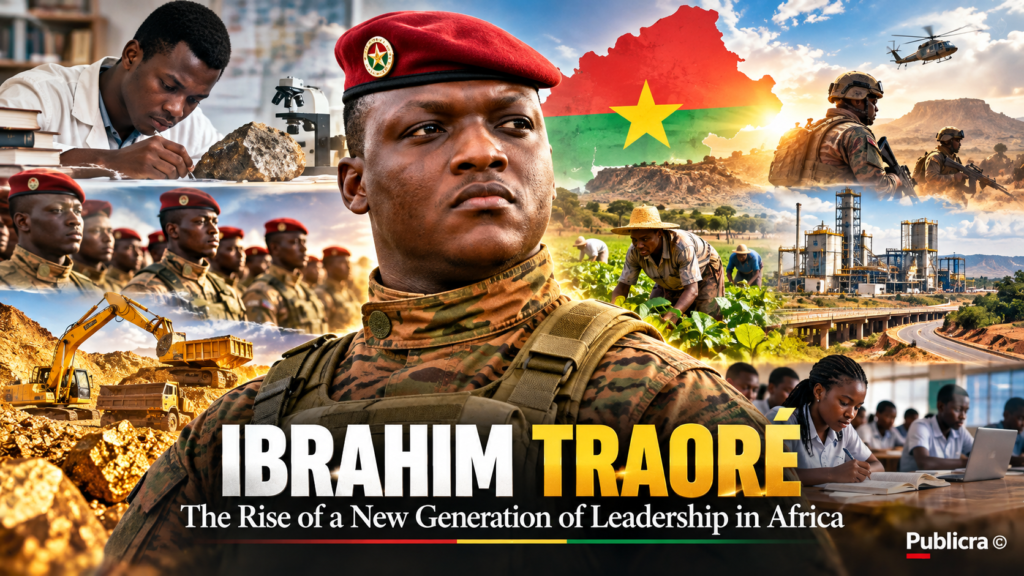
From a geology student and frontline army officer to Burkina Faso’s transitional president, Ibrahim Traoré has become one of Africa’s most recognisable political figures — championed by supporters for his message of sovereignty and economic independence, while facing continuing questions over security, political freedoms and the future of civilian rule
Few contemporary African leaders have attracted international attention as rapidly as Captain Ibrahim Traoré, the transitional president of Burkina Faso. Young, military-trained and outspoken about sovereignty, Traoré has developed a political image extending far beyond the borders of his landlocked West African country.
To supporters, his rise represents a new generation demanding greater African control over natural resources, security and economic development. His speeches about national sovereignty, domestic production and reducing dependence on foreign powers have helped make him particularly visible among younger audiences across Africa.
Yet the complete story is considerably more complicated. Burkina Faso continues to confront a severe armed insurgency, humanitarian pressures and political restrictions. Independent observers and rights organisations have also raised concerns about the treatment of critics and alleged abuses during the counter-insurgency campaign.
Understanding Ibrahim Traoré therefore requires looking beyond the social-media image surrounding him. His story stretches from a childhood in Burkina Faso through university studies in geology, military training and frontline service, two coups in 2022, a major reorientation of foreign policy, efforts to strengthen domestic agriculture and industry, and an unresolved struggle to restore security.
EARLY LIFE: FROM KÉRA TO THE NATIONAL STAGE
Ibrahim Traoré was born on 14 March 1988 in Kéra, in the Bondokuy area of Burkina Faso. His official presidential biography says he attended the public primary school in Bondokuy before continuing his secondary education at Lycée Mixte d’Accart in Bobo-Dioulasso.
He completed his Baccalaureate in 2006. At that stage, nothing publicly suggested that less than two decades later he would become the country’s head of state.
Traoré’s generation grew up during an important period in Burkina Faso’s political history. The country had experienced repeated political upheaval since independence, while the legacy of revolutionary leader Thomas Sankara remained an influential part of national political memory.
Traoré would later become associated by supporters with themes also linked to Sankara — sovereignty, domestic production, national mobilisation and resistance to external dependence. Comparisons between the two men have consequently become common, although they governed in different periods and under substantially different circumstances.
EDUCATION: A GEOLOGY STUDENT BEFORE THE MILITARY
Before becoming a professional soldier, Traoré pursued scientific studies.
From 2006 to 2010, he studied at the University of Ouagadougou, now known as Joseph Ki-Zerbo University. His studies were within the sciences, including chemistry, biochemistry, biology and geology.
According to his official biography, he obtained a master’s degree in geology in 2010.
That educational background is noteworthy because Burkina Faso is an important gold-producing country and the management of mineral resources has subsequently become an important part of the economic and sovereignty agenda pursued during his presidency.
His university education, however, did not lead him into a conventional civilian career in geology. After completing university, Traoré entered military training.
ENTERING THE ARMED FORCES
Traoré was admitted to the Georges Namoano Military Academy in Pô, one of Burkina Faso’s principal officer-training institutions.
After two years at the academy, he graduated as a second lieutenant. His official biography says he finished as vice-major of his class, indicating a high academic or training position within his cohort.
His military career subsequently progressed through the officer ranks.
He became a lieutenant in 2014 and was promoted to captain in 2020.
During his military service, Traoré was deployed to areas that became some of the most dangerous parts of Burkina Faso as jihadist violence expanded across the Sahel.
His official biography records service in the Sahel, North, Centre-North and East regions. It also states that he participated in international military operations, including United Nations peacekeeping activities, and undertook training and professional development abroad.
By March 2022, Traoré had been appointed commander of an artillery regiment based in Kaya.
His experience in conflict-affected regions would become central to the political events that soon propelled him to power.
THE SECURITY CRISIS THAT CHANGED BURKINA FASO
To understand Traoré’s rise, it is necessary to understand Burkina Faso’s security crisis.
The country has faced attacks from armed Islamist groups since around 2015. Violence expanded dramatically over subsequent years, killing civilians and security personnel, displacing communities and forcing schools, health facilities and businesses to close in affected areas.
Public anger grew over the inability of successive governments to contain the insurgency.
In January 2022, President Roch Marc Christian Kaboré was overthrown in a military coup led by Lieutenant Colonel Paul-Henri Sandaogo Damiba.
Damiba’s government promised to improve security.
But dissatisfaction inside the armed forces continued as attacks persisted.
Only eight months later, Burkina Faso experienced another military takeover.
THE SEPTEMBER 2022 COUP THAT BROUGHT TRAORÉ TO POWER
On 30 September 2022, soldiers led by Traoré overthrew Damiba.
Traoré emerged as head of the Patriotic Movement for Safeguard and Restoration, commonly known by its French initials MPSR.
The central justification presented for the takeover was the continuing deterioration in security and dissatisfaction with the existing leadership’s handling of the insurgency.
At only 34, Traoré suddenly became one of the world’s youngest national leaders.
On 21 October 2022, he was formally sworn in as Burkina Faso’s transitional president, head of state and supreme commander of the armed forces.
The political transition has since been extended. Under changes adopted in May 2024, the transition was extended for five years beginning on 2 July 2024, meaning military-led transitional rule could continue substantially longer than initially anticipated.
WHY TRAORÉ BECAME SO VISIBLE ACROSS AFRICA
Traoré’s international prominence cannot be explained solely by Burkina Faso’s size or economic power.
Much of it comes from the political message surrounding his leadership.
His speeches repeatedly emphasise sovereignty, self-reliance, domestic production, control of natural resources and reducing dependence on external powers.
These themes have resonated with sections of African public opinion frustrated by colonial history, economic inequality, foreign military involvement and perceptions that the continent’s enormous natural wealth has not sufficiently improved living standards.
Social media has amplified this image dramatically.
Traoré has consequently developed a following well beyond Burkina Faso. At the same time, his online popularity has created a major misinformation problem: fabricated speeches, false photographs, invented development projects and exaggerated economic statistics have repeatedly circulated under his name.
His actual record therefore needs to be separated carefully from the much larger digital mythology surrounding him.
BREAKING WITH FRANCE AND REORIENTING FOREIGN POLICY
One of the most consequential changes under Traoré has been Burkina Faso’s foreign-policy realignment.
Relations with France, the country’s former colonial power and a longstanding security partner, deteriorated sharply.
French troops left Burkina Faso after the transitional authorities requested their departure, reflecting Traoré’s argument that Burkina Faso needed greater control over its own security strategy.
This formed part of a broader transformation occurring across the central Sahel, where military governments in Burkina Faso, Mali and Niger increasingly rejected traditional Western security partnerships.
At the same time, the three governments developed closer cooperation with one another.
THE ALLIANCE OF SAHEL STATES
In September 2023, Burkina Faso, Mali and Niger created the Alliance of Sahel States, or AES.
Initially focused heavily on collective security, the alliance developed into a broader political and strategic partnership.
The three countries subsequently announced their withdrawal from the Economic Community of West African States, or ECOWAS.
Their governments argued that existing regional institutions had not provided sufficient support in confronting terrorism and had become overly influenced by outside interests.
The creation of the AES represents one of the most significant geopolitical developments in the Sahel in recent years.
For Traoré, it also fits his broader argument that African states facing similar security and economic problems should cooperate more closely and develop greater strategic autonomy.
RELATIONS WITH RUSSIA AND OTHER INTERNATIONAL PARTNERS
As Burkina Faso reduced military cooperation with France, its government strengthened relations with Russia.
Security cooperation has become particularly significant.
This shift mirrors developments in neighbouring Mali and Niger, whose military-led governments have also expanded relations with Moscow while reducing Western military partnerships.
Traoré’s foreign policy, however, should not simply be described as replacing one country with another. His government’s stated objective is broader diversification and sovereignty — developing partnerships that authorities believe offer Burkina Faso greater freedom of action.
The effectiveness and long-term consequences of this strategy remain subjects of international debate.
BUILDING A LARGER NATIONAL SECURITY FORCE
Security has remained the defining challenge of Traoré’s presidency.
His government has substantially expanded mobilisation against armed groups.
A major element has been the recruitment of Volunteers for the Defence of the Homeland, commonly known as VDPs. These civilian auxiliaries support Burkina Faso’s armed forces in areas affected by insurgent activity.
Tens of thousands of volunteers have been mobilised.
The strategy reflects Traoré’s concept of involving the wider population in national defence rather than relying exclusively on the professional armed forces.
Burkina Faso has also sought additional military equipment and strengthened defence cooperation with new international partners.
THE SECURITY RECORD REMAINS CONTESTED
The expansion of the military effort has not produced an uncontested victory.
Armed groups linked to al-Qaeda and the Islamic State have continued carrying out major attacks. Independent security analysts have reported that militants retain influence across substantial areas of Burkina Faso.
This is one of the largest challenges to Traoré’s original justification for taking power: restoring national security.
Government authorities have reported the recovery of communities and the return of displaced residents to some previously insecure areas. The World Bank notes that, according to government figures, more than one million internally displaced people had been resettled in roughly 700 localities by March 2025.
But serious attacks have continued, demonstrating that the conflict remains unresolved.
HUMAN RIGHTS AND POLITICAL FREEDOMS
Traoré’s presidency has also faced substantial criticism over civil liberties.
Journalists, activists and political critics have reported pressure, detention or compulsory mobilisation. Reuters documented cases in which critics said they were conscripted for military service after criticising the authorities.
Rights organisations have also accused security forces and pro-government auxiliaries of abuses during counter-insurgency operations. Burkina Faso’s authorities have rejected or disputed a number of such allegations.
Armed Islamist organisations have themselves committed extensive atrocities against civilians, including massacres and attacks against communities perceived to support the government.
Burkina Faso’s security crisis therefore involves both the challenge of defeating armed groups and the question of how counter-terrorism operations are conducted.
ECONOMIC SOVEREIGNTY BECOMES A CENTRAL MESSAGE
Alongside security, Traoré has made economic sovereignty one of the defining themes of his government.
His administration argues that Burkina Faso should process more of its resources domestically, strengthen agriculture, encourage local manufacturing and reduce unnecessary dependence on imports.
The philosophy is straightforward: producing raw materials without developing industries to process them leaves too much economic value outside the country.
For a country rich in gold but facing widespread poverty, that argument carries significant political appeal.
GOLD AND BURKINA FASO’S MINING STRATEGY
Gold is one of Burkina Faso’s most important economic resources.
Traoré’s administration has sought greater national participation in the mining sector and increased domestic value creation.
Changes to mining policy have coincided with efforts to formalise artisanal and semi-mechanised mining.
World Bank figures show a significant increase in reported gold production. Production reached approximately 94 tonnes in 2025, compared with about 61 tonnes in 2024, with the Bank attributing the increase largely to formalisation of artisanal and semi-mechanised production and the recovery of industrial mining.
Gold therefore remains both an economic opportunity and a central test of the government’s sovereignty strategy.
INDUSTRIALISATION AND LOCAL PROCESSING
Traoré’s economic message extends beyond mining.
His government has promoted the idea that agricultural and mineral products should increasingly be processed inside Burkina Faso instead of exported primarily as raw materials.
Domestic processing can potentially create jobs, develop technical skills, increase tax revenues and retain more value within the national economy.
Industrialisation is consequently presented not merely as an economic objective but as part of the broader sovereignty agenda.
The long-term test will be whether new processing capacity can operate competitively, attract sustainable investment and create large numbers of productive jobs.
AGRICULTURE AND FOOD SELF-SUFFICIENCY
Agriculture is another major pillar of the government’s development strategy.
The authorities have promoted an agropastoral and fisheries offensive designed to increase domestic production and improve food security.
This includes support for agricultural production and efforts to improve productivity.
Independent economic data show that agriculture contributed significantly to recent growth.
According to the World Bank, cereal production increased by approximately 17.6 percent in the 2025 season compared with the previous year, supported by favourable rainfall as well as government agricultural programmes.
This distinction matters: improved production cannot be attributed exclusively to government policy because weather conditions also played an important role.
WHAT HAS HAPPENED TO THE ECONOMY?
Burkina Faso’s recent macroeconomic figures show notable resilience despite continuing insecurity.
The World Bank estimated real GDP growth of 4.8 percent in 2024 and 5.3 percent in 2025.
Real GDP per person also increased.
Agriculture, services, construction and mining contributed to the expansion.
Inflation, which had been 4.2 percent in 2024, was estimated at negative 0.5 percent in 2025, helped by strong agricultural production and lower energy prices.
The World Bank also estimated a substantial reduction in extreme poverty during 2025.
These figures represent genuine economic improvements, but they should not be interpreted as proof that Burkina Faso’s structural economic problems have disappeared.
The World Bank continues to identify major challenges involving productive employment, insecurity, inequality and the vulnerability of affected communities.
EDUCATION AND THE CHALLENGE OF INSECURITY
Education presents another complicated part of Traoré’s record.
The government has emphasised human-capital development and national capacity, but years of insecurity have severely disrupted schooling in conflict-affected regions.
When armed groups threaten communities, schools can close, teachers can leave and families can become displaced.
Restoring education therefore depends partly on restoring territorial security.
The broader development challenge is not simply constructing educational facilities. Burkina Faso needs functioning schools, trained teachers, reliable access, vocational skills and education connected to the country’s agricultural, industrial and technological ambitions.
INFRASTRUCTURE AND NATIONAL DEVELOPMENT
Traoré’s government has also presented infrastructure development as an essential part of national transformation.
Roads, transport links, electricity, water systems and productive infrastructure are particularly important for a landlocked country.
Better infrastructure can reduce transportation costs, connect agricultural areas with markets and make domestic industrial production more competitive.
However, large infrastructure ambitions require sustained financing and security. Projects located in conflict-affected areas can become difficult and expensive to complete.
For this reason, economic development and security remain closely connected.
A DIFFERENT MODEL OF AFRICAN DEVELOPMENT
The broader philosophy associated with Traoré can be summarised around several recurring ideas: sovereignty, security, domestic production, resource control, regional cooperation and reduced external dependence.
Supporters see this as an attempt to create a more independent development model.
Critics argue that political centralisation and military government create risks of their own and that sovereignty rhetoric cannot substitute for accountable institutions, security and long-term economic reforms.
Both dimensions are important for understanding why Traoré has become such a polarising international figure.
THE QUESTION OF DEMOCRACY AND CIVILIAN RULE
One of the biggest unanswered questions concerns Burkina Faso’s political future.
Traoré did not come to power through a national election. He became head of state following the September 2022 military takeover.
The transitional period was subsequently extended for five years from July 2024.
Supporters of the military authorities argue that restoring security and rebuilding the state must come before a conventional electoral transition.
Critics counter that repeated extensions risk turning temporary military government into prolonged rule without an electoral mandate.
How and when Burkina Faso eventually returns to constitutional civilian government will therefore be one of the defining tests of Traoré’s legacy.
TRAORÉ’S FUTURE DEVELOPMENT AGENDA
Traoré’s stated direction points toward continued emphasis on security, agricultural production, domestic industrialisation, mining reform and national control over strategic resources.
Regional cooperation through the AES is also likely to remain central.
The underlying ambition is to build a country capable of producing more of what it consumes, processing more of what it extracts and defending more of its territory with national and regional capabilities.
Whether that ambition can be fully realised will depend on several factors that no government can control through rhetoric alone.
Burkina Faso needs sustained security improvements, investment, technical skills, functioning institutions, reliable infrastructure and sufficient employment for a rapidly growing population.
THE ECONOMIC OUTLOOK
The World Bank’s latest outlook provides reasons for both optimism and caution.
It estimated growth at 5.3 percent in 2025 and projected stronger growth in 2026 if security continues improving, rainfall remains favourable and political conditions remain stable.
Those qualifications are important.
Burkina Faso’s future economic performance remains closely linked to security. A major deterioration in the conflict could damage agriculture, mining, trade, education and investment simultaneously.
Conversely, sustained improvements in security could allow currently disrupted regions to participate much more fully in the national economy.
A LEADER SURROUNDED BY AN ONLINE MYTHOLOGY
Few African political leaders currently generate as much social-media material as Ibrahim Traoré.
Videos portray him as everything from a revolutionary successor to Thomas Sankara to the architect of enormous projects.
Some claims are genuine.
Others are misleading, exaggerated or entirely fabricated.
AI-generated photographs and videos have made verification even more important.
A credible assessment of Traoré should therefore distinguish between documented government programmes, independently measured economic outcomes, official claims that remain to be verified, and completely fabricated social-media stories.
Doing so does not diminish genuine achievements. Instead, it makes those achievements easier to identify.
IBRAHIM TRAORÉ AND THE SYMBOLISM OF A NEW AFRICAN GENERATION
Whatever the eventual outcome of his presidency, Traoré has already become an important figure in a wider African political debate.
That debate concerns who controls natural resources, how African states should respond to insecurity, whether traditional relationships with former colonial powers remain appropriate, and how much economic independence is realistically possible in an interconnected global economy.
His age has amplified that symbolism.
Born in 1988 and reaching the presidency at only 34, Traoré represents a generation born decades after the independence struggles that created modern African states.
For supporters, this makes him a representative of a generation prepared to challenge established relationships.
For critics, generational change does not eliminate the need for political accountability, civil liberties and measurable improvements in people’s daily lives.
THE ROAD AHEAD
Ibrahim Traoré’s story remains unfinished.
He rose from a scientific education and military career to become Burkina Faso’s leader during one of the most difficult periods in the country’s modern history.
Under his leadership, Burkina Faso has pursued a more assertive sovereignty agenda, strengthened its partnership with Mali and Niger, distanced itself from France, developed closer security ties with Russia, expanded national mobilisation against armed groups and promoted domestic agriculture, mining and industrial processing.
At the same time, the country continues to face serious insurgent violence. Questions remain about political freedoms, alleged abuses, the treatment of critics and the eventual restoration of civilian constitutional government.
Recent economic indicators have improved, including GDP growth, agricultural output and gold production. Yet Burkina Faso still faces major structural challenges involving poverty, jobs, insecurity and human development.
That contrast explains much of the intense debate surrounding Ibrahim Traoré.
His supporters see the possibility of a more sovereign and economically independent Burkina Faso. His critics focus on the risks of prolonged military government and the unresolved security crisis.
The ultimate measure of his presidency will therefore not be the number of viral speeches, online admirers or comparisons with previous African revolutionaries.
It will be determined by more concrete outcomes: whether Burkina Faso becomes safer, whether living standards improve, whether productive industries and jobs expand, whether children can attend school safely, whether national resources produce broader prosperity, and how the country eventually resolves the question of representative civilian government.
Those outcomes will determine how the rise of Ibrahim Traoré is ultimately written into Burkina Faso’s history.