
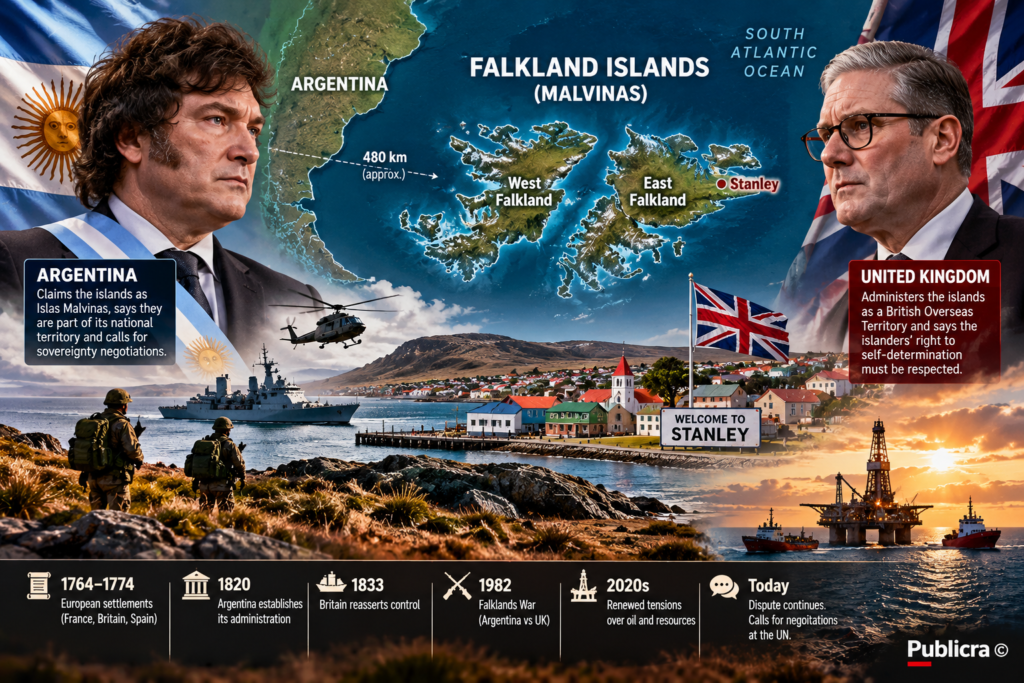
From early European settlements and competing British-Spanish claims to Argentina’s 1820 possession, Britain’s return in 1833, the 1982 Falklands War and Javier Milei’s renewed campaign over sovereignty and oil, the South Atlantic islands remain one of the world’s longest-running territorial disputes
The Falkland Islands, known in Argentina as the Islas Malvinas, are at the centre of one of the world’s longest-running territorial disputes. Located in the South Atlantic Ocean, the islands are geographically much closer to South America than to Britain, lying roughly 480 kilometres east of the Argentine coast. Today they are administered as a British Overseas Territory, with substantial internal self-government while the United Kingdom retains responsibility for defence and foreign affairs. Argentina rejects British sovereignty and maintains that the Malvinas form an integral part of Argentine national territory. Nearly two centuries after Britain reasserted control in 1833 and more than four decades after Argentina and Britain fought a war over the islands, neither side has abandoned its position. The disagreement now involves not only history and sovereignty but also self-determination, regional politics, fisheries, military security and potentially valuable offshore oil resources.
WHERE ARE THE FALKLAND ISLANDS?
The Falkland Islands are an archipelago consisting principally of East Falkland and West Falkland, surrounded by hundreds of smaller islands in the South Atlantic. Stanley, situated on East Falkland, is the capital and largest settlement. The islands are approximately 480 kilometres from the Argentine coast but around 12,000 kilometres from the United Kingdom. Their geographical position is therefore central to Argentina’s argument that the Malvinas belong naturally within its territorial sphere. Britain does not accept geographical proximity as determining sovereignty and instead emphasises its historical claim, long administration and the political wishes of the people who live there. The surrounding ocean is also economically significant because of productive fisheries and offshore hydrocarbon resources, making the islands far more strategically and economically important than their relatively small population might suggest.
WHO FIRST CONTROLLED THE ISLANDS?
Determining who originally “owned” the Falklands is difficult because the islands had no established Indigenous population when European powers began exploring the South Atlantic. France established a settlement on East Falkland in 1764, while Britain established a settlement at Port Egmont on West Falkland shortly afterwards. Spain objected to both presences because it regarded the islands as falling within its colonial domain. France eventually transferred its settlement to Spain, which administered the islands from Buenos Aires. Britain withdrew from Port Egmont in 1774, largely for economic reasons, but maintained that its sovereignty claim had not been surrendered. Spain continued administering the islands until the political collapse of Spanish colonial authority across South America during the early nineteenth century. These overlapping French, Spanish and British activities created competing historical claims that later became central to the disagreement between Argentina and Britain.
ARGENTINA ENTERS THE HISTORY OF THE MALVINAS
Following independence from Spain, the United Provinces of the Río de la Plata, the political predecessor of modern Argentina, argued that it inherited Spain’s territorial rights in the region. In 1820, authorities representing the new South American state formally asserted possession of the islands. Buenos Aires subsequently attempted to develop administration, settlement and economic activity there. One of the most important figures during this period was Luis Vernet, who established commercial activities and received authority from Buenos Aires to administer the islands. Argentina considers this period important evidence that it exercised sovereignty before Britain’s return. From the Argentine perspective, the Malvinas were therefore not abandoned territory waiting for Britain to occupy them. Britain disputes the legal conclusion Argentina draws from these events and maintains that its own earlier sovereignty claim had never been relinquished. These competing interpretations came into direct confrontation in 1833.
WHY 1833 REMAINS THE HEART OF ARGENTINA’S CLAIM
In January 1833, Britain returned to the islands and reasserted its authority. Argentine governmental and military authority was displaced, after which British administration gradually became firmly established. Argentina regards this event as the central historical injustice underlying the modern dispute, arguing that Britain used force to remove legitimate Argentine authorities from territory over which Argentina had already exercised sovereignty. Britain disputes that interpretation and maintains that it was reasserting an older British claim rather than conquering internationally recognised Argentine territory. Britain also disputes descriptions suggesting that the entire civilian population was forcibly expelled, maintaining that civilians were able to remain. The disagreement over 1833 therefore remains fundamental: Argentina views it as an illegal interruption of Argentine sovereignty, while Britain considers it the restoration of British authority based on a pre-existing claim.
HOW BRITISH RULE DEVELOPED
Following 1833, Britain consolidated its administration and a permanent population developed on the islands. Agriculture, particularly sheep farming, became important to the economy, while fisheries later transformed the territory’s financial position. Generations of families were born and raised on the islands, producing a community that today identifies overwhelmingly with the Falkland Islands and Britain rather than Argentina. This population has become central to Britain’s modern legal and political argument. London maintains that the dispute cannot be resolved purely by examining nineteenth-century territorial claims because people have lived on the islands for generations and possess the right to determine their political future. Argentina rejects applying self-determination in this way, arguing that the present population developed under British administration after the events of 1833 and cannot independently decide the underlying territorial sovereignty question.
THE UNITED NATIONS AND THE SOVEREIGNTY DISPUTE
The dispute gained greater international importance during the global decolonisation movement after the Second World War. In 1965, United Nations General Assembly Resolution 2065 recognised the existence of a sovereignty dispute between Argentina and the United Kingdom concerning the Falkland Islands/Malvinas and invited the two governments to seek a peaceful negotiated solution. Argentina considers this an important diplomatic foundation because the United Nations has not treated the sovereignty question as though no dispute exists. The UN Special Committee on Decolonization continues to consider the Malvinas question and has repeatedly encouraged Argentina and Britain to resume negotiations. However, these UN resolutions have not transferred sovereignty to Argentina or declared Argentina the legal owner of the islands. They recognise that a dispute exists and encourage negotiations, leaving the fundamental disagreement unresolved.
WHY ARGENTINA BELIEVES THE MALVINAS SHOULD BE ARGENTINE
Argentina’s sovereignty case combines geography, succession from Spain, administration before 1833, territorial integrity and decolonisation. Buenos Aires argues that it inherited Spain’s rights after independence and subsequently exercised governmental authority over the islands before Britain displaced Argentine officials. Argentina therefore considers British administration to be the continuation of a colonial situation rather than the legitimate exercise of sovereignty. Geography strengthens the political force of this argument because the islands are located only several hundred kilometres from Argentina and thousands of kilometres from Britain. Argentina also emphasises that the United Nations recognises the existence of a sovereignty dispute. Its position is therefore that Britain and Argentina should negotiate sovereignty directly and that the dispute cannot be resolved solely by asking the present island population whether it wishes to remain British.
BRITAIN’S ARGUMENT IS BASED ON SELF-DETERMINATION
Britain’s contemporary case places the right of the Falkland Islanders to self-determination at its centre. London argues that the islanders form a permanent population whose families in many cases have lived there for generations and that they cannot legitimately be transferred to another country’s sovereignty against their wishes. This position was demonstrated through the 2013 referendum, when 99.8% of participating voters supported retaining the islands’ existing status as a British Overseas Territory, with turnout above 90%. Britain regards this result as overwhelming evidence of what the population wants. Argentina does not accept the referendum as resolving sovereignty because it argues that the present population developed after British occupation and therefore cannot use self-determination to legitimise what Buenos Aires considers an earlier violation of Argentine territorial integrity. This conflict between territorial integrity and self-determination remains perhaps the most difficult issue preventing a settlement.
NEGOTIATIONS BEFORE THE 1982 WAR
Argentina and Britain held discussions over sovereignty during the twentieth century, particularly after the United Nations became involved. Different arrangements were considered at various stages, including proposals that could potentially have transferred sovereignty while protecting the islanders’ lifestyle and connections with Britain. None produced a final agreement. By the late 1970s and early 1980s, Argentina was governed by a military dictatorship facing serious political, economic and social problems at home. On 2 April 1982, Argentine forces invaded the islands. Argentina’s military government presented the operation as the recovery of national territory, while Britain regarded it as an armed invasion of British-administered islands whose inhabitants did not want Argentine rule. The diplomatic dispute had suddenly become a war.
THE 1982 FALKLANDS WAR
British Prime Minister Margaret Thatcher responded to the Argentine invasion by sending a large naval task force thousands of kilometres into the South Atlantic. Britain faced the enormous logistical challenge of fighting far from its home territory, while Argentina possessed the geographical advantage of operating much closer to its mainland. The conflict involved naval warfare, air attacks and ground combat. One of its deadliest incidents occurred when the British nuclear-powered submarine HMS Conqueror sank the Argentine cruiser ARA General Belgrano, killing 323 Argentine sailors. Argentine aircraft subsequently inflicted significant losses on the British fleet, including the destruction of HMS Sheffield after it was struck by an Exocet missile. British forces eventually established positions on East Falkland and advanced towards Stanley through battles including Goose Green, Mount Longdon, Two Sisters and Mount Tumbledown. On 14 June 1982, Argentine forces on the islands surrendered. Approximately 649 Argentine military personnel and 255 British service personnel were killed, together with three Falkland Island civilians. Britain restored its administration, but the military victory did not end the sovereignty dispute.
ARGENTINA LOST THE WAR BUT DID NOT ABANDON THE MALVINAS
The defeat contributed to the collapse of Argentina’s military dictatorship, and the country subsequently returned to democratic government. However, democratic Argentina did not abandon the sovereignty claim. Governments from different political traditions have continued asserting that the Malvinas belong to Argentina while pursuing the objective through peaceful diplomatic means. Argentina’s Constitution identifies recovery of sovereignty over the Malvinas, South Georgia and South Sandwich Islands as a permanent national objective, while calling for this to be achieved consistently with international law and respect for the islanders’ way of life. The distinction between the military strategy of 1982 and Argentina’s modern diplomatic approach is important. Contemporary Argentine governments officially seek negotiations rather than another invasion.
WHO GOVERNS THE FALKLAND ISLANDS TODAY?
Today the islands remain a British Overseas Territory, although day-to-day government is not simply directed from London. The Falkland Islands have their own elected Legislative Assembly and substantial responsibility for domestic affairs, public services and economic management. The United Kingdom remains responsible particularly for defence and international relations. Britain also maintains a permanent military presence to prevent another attempt to seize the territory by force. The islands are therefore effectively controlled and administered within the British constitutional system, even though Argentina continues to dispute British sovereignty. This difference between effective administration and disputed sovereignty is important when understanding the current situation.
WHY THE ISLANDS ARE ECONOMICALLY IMPORTANT
The economic significance of the Falklands has increased considerably since the 1982 war. Fisheries became an important source of income, with licensing of commercial fishing in surrounding waters helping transform the islands’ economy. More recently, attention has increasingly focused on offshore petroleum resources. The Sea Lion oil development, located north of the islands, has the potential to introduce a major new source of economic activity. Britain and the Falkland Islands Government maintain that the islanders possess the right to develop their natural resources. Argentina rejects hydrocarbon exploration and production conducted without its authorisation in waters it regards as part of the sovereignty dispute. Natural resources have therefore added a significant twenty-first-century economic dimension to a conflict historically dominated by territory, identity and colonial history.
JAVIER MILEI AND ARGENTINA’S RENEWED MALVINAS CAMPAIGN
President Javier Milei has maintained Argentina’s sovereignty claim while emphasising that the objective should be pursued peacefully. His position demonstrates the unusual political durability of the Malvinas issue because governments with very different economic and ideological programmes have continued supporting the claim. Milei has raised the issue internationally and argued that Argentina should eventually recover sovereignty through diplomacy and sustained negotiation rather than repeat the military approach of 1982. Recent disagreements over offshore oil development have increased tensions because Argentina views unilateral exploitation of resources as undermining its sovereignty position. Milei’s government has consequently sought to increase diplomatic and economic pressure surrounding companies participating in resource development authorised by the Falkland Islands authorities.
BRITAIN’S POSITION UNDER KEIR STARMER
The British government under Prime Minister Keir Starmer has maintained the longstanding UK position that the future of the islands must be determined by the Falkland Islanders themselves. London continues to cite the 2013 referendum as clear evidence that the population wishes to remain a British Overseas Territory. Britain therefore rejects sovereignty negotiations that would disregard the islanders’ wishes. The UK also supports the islands’ right to develop their natural resources and rejects Argentine attempts to penalise companies operating under Falkland Islands authority. Although British and Argentine governments can cooperate in other areas, the fundamental sovereignty positions remain incompatible.
THE NEW DISPUTE OVER OFFSHORE OIL
Oil could make the Falklands–Malvinas dispute considerably more economically important. Argentina argues that Britain and the Falkland Islands authorities should not unilaterally exploit hydrocarbons from maritime areas whose sovereignty remains contested. Buenos Aires has used legal, diplomatic and economic measures against companies involved in activities it considers unauthorised. Britain and the Falkland Islands Government reject Argentina’s authority over those operations and maintain that the islanders are entitled to develop their economy. If Sea Lion becomes a significant producing field, the financial stakes could rise considerably. Argentina could view successful production as further consolidation of British control over resources it claims, while the islanders could gain substantial additional revenue and economic independence. The resource question may therefore make compromise more difficult even as it creates stronger incentives for some form of practical cooperation.
WHY LATIN AMERICA MATTERS TO ARGENTINA’S CLAIM
Argentina has historically received substantial diplomatic sympathy for its Malvinas position across Latin America. For many countries in the region, the dispute is viewed through the wider historical experience of European colonialism in the Americas. The fact that a European state continues administering islands located close to the South American mainland gives Argentina’s argument considerable political resonance. Regional support does not itself determine sovereignty, but it strengthens Argentina’s ability to keep the issue alive internationally. Britain responds that regional political solidarity cannot override the rights of the people who actually live on the islands. The dispute therefore extends beyond bilateral relations and touches broader debates about colonial history, territorial integrity and self-determination.
COULD ARGENTINA ATTACK THE FALKLANDS AGAIN?
A repeat of the 1982 invasion currently appears unlikely. Argentina’s present policy emphasises diplomatic and peaceful recovery, and there is no clear evidence of preparations for another attempt to seize the islands militarily. Britain also maintains considerably stronger permanent defences than it did before the 1982 war. Modern surveillance, aircraft, military infrastructure and other defensive capabilities would make an attempted invasion extraordinarily risky and costly. Another conflict would also impose severe human, diplomatic and economic consequences. The modern struggle is therefore much more likely to occur through international diplomacy, legal measures, economic pressure, resource disputes and negotiations than through conventional warfare.
DOES ARGENTINA HAVE A REALISTIC PATH TO SOVEREIGNTY?
Argentina possesses an enduring sovereignty claim, constitutional commitment and considerable regional diplomatic support, while the United Nations continues to recognise that a dispute exists and encourages negotiations. These factors mean Argentina’s claim cannot simply be treated as having disappeared after its defeat in 1982. However, they also do not mean that sovereignty is about to change. Britain exercises effective administration, maintains military control and insists that no change can occur against the wishes of the islanders. The overwhelming result of the 2013 referendum therefore represents a major practical obstacle to Argentina’s objective. For Argentina to move substantially closer to sovereignty through peaceful means, there would probably need to be a significant change in British policy, international diplomacy, the preferences of the island population or the structure of a negotiated settlement.
COULD ARGENTINA AND BRITAIN FIND A COMPROMISE?
Territorial disputes sometimes produce creative diplomatic arrangements, and various ideas concerning the Falklands have been discussed historically, including forms of leaseback, shared arrangements, cooperation over natural resources and phased sovereignty settlements. However, any compromise would have to reconcile positions that currently appear fundamentally incompatible. Argentina wants recognition that the Malvinas form part of its national territory. The islanders overwhelmingly want to retain their relationship with Britain. Britain says it will not transfer sovereignty against their wishes, while Argentina argues that the existing population cannot possess a permanent veto over restoration of what it considers Argentine territorial integrity. Practical agreements involving fisheries, transport, humanitarian issues or natural resources may therefore be easier to imagine than a comprehensive sovereignty settlement.
WHAT IS LIKELY TO HAPPEN NEXT?
The continuation of the present dispute is more plausible in the near term than either an immediate Argentine takeover or another war. Argentina can continue pressing Britain through the United Nations, regional organisations and bilateral diplomacy while increasing political and legal pressure over offshore resource development. Britain is likely to continue relying on self-determination, supporting the Falkland Islands Government and maintaining sufficient military forces to deter an attempt to change the situation by force. Offshore oil could become an increasingly important source of disagreement, particularly if commercial production expands. Diplomatic relations between London and Buenos Aires may improve or deteriorate depending on their governments, but the sovereignty question is unlikely to disappear because both sides regard their core positions as matters of principle.
A DISPUTE THAT REMAINS UNFINISHED
The Falkland Islands–Malvinas dispute remains unresolved more than 190 years after the events of 1833 and more than four decades after the 1982 war. Argentina bases its case on succession from Spain, its administration before 1833, territorial integrity and the continuing international recognition that a sovereignty dispute exists. Britain bases its modern position heavily on longstanding administration and the right of the Falkland Islanders to determine their political future. Argentina’s defeat in 1982 confirmed British military control but did not extinguish the Argentine claim, while United Nations calls for negotiations have not transferred sovereignty to Argentina. The growing importance of offshore oil may make the dispute even more economically significant in the years ahead. For now, Britain continues to administer and defend the islands, the islanders overwhelmingly support maintaining their British status, and Argentina continues to claim the territory as the Islas Malvinas. The eventual future of the islands will depend on whether these competing principles—Argentina’s territorial claim, Britain’s administration and the islanders’ demand for self-determination—can ever be reconciled through peaceful diplomacy.