
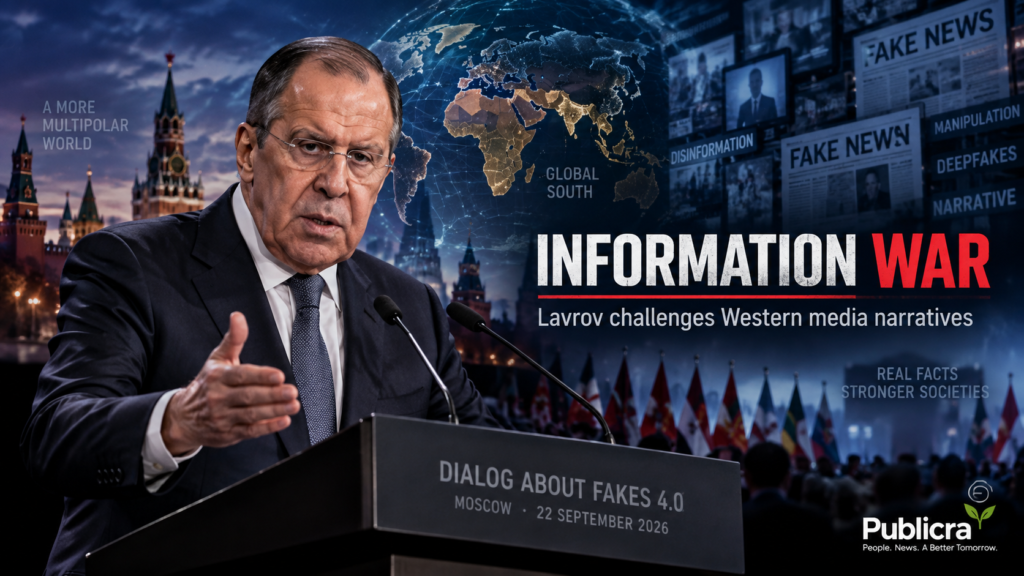
Russian foreign minister says Western powers use media narratives, sanctions and political pressure to protect their influence, as disputes over disinformation, AI and the emerging multipolar order deepen
Russian Foreign Minister Sergey Lavrov has accused Western governments and media organisations of using disinformation and selective narratives to undermine Russia, China and countries across the Global South, bringing the increasingly contentious issue of information warfare back into the international spotlight.
Speaking in Moscow on September 22, 2026, at the opening of the international “Dialog about Fakes 4.0” forum, Lavrov argued that technological changes have made it possible for inaccurate or deliberately misleading information to reach enormous audiences within minutes. The forum brought together government representatives, journalists, fact-checking specialists, technology experts and members of the business community, with organisers saying more than 2,000 participants from around 80 countries were expected.
Lavrov used his appearance to advance a broader Russian argument: that disputes over information are increasingly connected to economic power, sanctions, international institutions and the emergence of a more multipolar international system. His remarks come as governments around the world confront a rapidly evolving challenge — distinguishing reliable information from manipulated material in an era of generative artificial intelligence, social-media algorithms, deepfakes and intense geopolitical competition.
Lavrov says information has become a geopolitical battleground
One of Lavrov’s central arguments was that modern technology has dramatically increased the speed and scale at which information can spread. Digital platforms can distribute a claim across continents almost instantaneously, and the same infrastructure that allows governments, journalists and ordinary citizens to communicate quickly can also amplify inaccurate or deliberately misleading material.
Lavrov argued that Western governments exploit this information environment to protect their geopolitical interests. He connected what he described as Western disinformation with sanctions, tariffs, diplomatic pressure and disputes involving international organisations, presenting them as different parts of a broader competition over the future international order.
That interpretation reflects Moscow’s longstanding argument that global power is shifting away from a predominantly Western-led system towards a more dispersed order involving countries including China, India, Russia and Brazil. Western governments strongly dispute Russia’s account and have repeatedly accused Moscow itself of conducting influence operations and spreading disinformation abroad. As a result, information — and accusations of manipulating information — has itself become part of geopolitical competition.
Why the Global South matters in the information battle
Lavrov placed particular emphasis on the Global South, a broad term commonly applied to developing and emerging economies across Africa, Asia, Latin America and other regions. These countries account for a growing share of the world’s population and economic activity, and many have sought to avoid aligning completely with either Western governments or Russia and China in major international disputes.
That makes them increasingly important in the competition for diplomatic influence. Russia has worked to strengthen political, economic and security relationships across Africa, Asia, Latin America and the Middle East, while China has dramatically expanded its trade and infrastructure relationships across many of the same regions. Western countries, meanwhile, retain extensive diplomatic, commercial and security partnerships throughout the Global South.
The competition is therefore no longer limited to investment, energy, defence or trade. It increasingly includes a struggle over narratives — who defines international rules, which institutions are considered legitimate, whose media organisations audiences trust and which interpretation of wars, sanctions and political crises dominates international discussion.
Artificial intelligence is transforming the disinformation problem
The challenge extends far beyond the confrontation between Russia and the West. Generative artificial intelligence has dramatically reduced the technical skills and resources required to produce convincing false material. Realistic images can be created within seconds, artificial voices can imitate public figures, videos can be manipulated and entire articles or social-media campaigns can be generated automatically.
For ordinary readers, this creates a much more difficult information environment. A professionally produced photograph or video can no longer automatically be regarded as proof that an event occurred exactly as depicted. The same caution increasingly applies to audio recordings, screenshots and viral social-media posts, particularly during wars, elections, disasters and diplomatic crises when information moves rapidly and audiences may react before verification is possible.
Artificial intelligence can also be used defensively. Researchers, journalists and technology companies can employ AI to identify manipulated media, analyse suspicious networks and support fact-checking. The technology therefore presents both a major threat to information integrity and a potentially powerful tool for protecting it.
Lavrov accuses Western media of shaping perceptions of Russia
Lavrov also accused Western media organisations of creating an environment in which audiences are predisposed to accept negative information about Russia before evidence has been fully examined. According to his argument, an accusation can dominate international coverage during its first few days while later corrections, qualifications or competing interpretations receive far less attention.
The broader problem of speed versus verification is not unique to international politics. Journalists and researchers have long examined how modern news cycles and social-media platforms can allow breaking information to spread faster than it can be independently confirmed. Lavrov, however, specifically attributes the pattern to Western political and media strategies directed against Russia.
Western governments and many independent media organisations reject that characterisation. They argue that extensive negative coverage of Russia reflects events including Moscow’s invasion of Ukraine and related security disputes rather than a coordinated campaign to manufacture anti-Russian narratives. These competing interpretations illustrate one of the central difficulties of modern information warfare: governments increasingly disagree not only about events themselves but also about who is producing propaganda and who is correcting it.
Bucha remains one of the most serious disputes over evidence
Lavrov returned to one of the most sensitive episodes of the Russia-Ukraine war: the civilian killings discovered in Bucha, near Kyiv, after Russian forces withdrew from the area in 2022. Moscow has repeatedly rejected accusations that Russian forces were responsible and has challenged evidence presented by Ukraine and Western governments.
During his September 2026 remarks, Lavrov referred to Russian research examining information associated with victims and questioned aspects of the established account. Those claims remain disputed and should not be presented as independently established facts. United Nations investigators documented extensive evidence concerning civilian deaths in Bucha and reported that the town was under Russian military control from March 5 to March 30, 2022.
By October 31, 2022, the Office of the UN High Commissioner for Human Rights had documented the killings of 73 civilians in Bucha and was working to corroborate another 105 alleged killings. UN investigations into Russian-occupied areas of northern Ukraine also documented cases of summary execution and other civilian deaths using evidence including witness testimony, photographs, video and forensic findings. Those findings conflict directly with Moscow’s claim that the Bucha killings were fabricated, while Russia continues to reject accusations of responsibility.
Bucha demonstrates why independent verification matters
The continuing dispute over Bucha illustrates how wartime events can become part of a much larger information struggle. Ukraine and its supporters cite the killings as evidence of abuses committed during Russia’s invasion, while Moscow presents accusations surrounding Bucha as an example of what it describes as anti-Russian information manipulation.
Both narratives reach global audiences through governments, international organisations, television networks, online publications and social-media platforms. Once information becomes part of a geopolitical confrontation, audiences may encounter radically different explanations of the same event depending on which source they follow.
That is why independently verifiable evidence becomes particularly important. Satellite imagery, authenticated photographs and videos, forensic analysis, eyewitness testimony and transparent investigative methodology generally provide a stronger basis for assessing events than political statements issued by governments directly involved in a conflict.
Sanctions and economic pressure are also part of Lavrov’s argument
Lavrov extended his criticism beyond journalism and information policy to economic measures. He attacked unilateral sanctions, tariffs and Western complaints about Chinese industrial overcapacity, arguing that such policies demonstrate an unwillingness to compete on equal terms.
Western governments dispute that interpretation. The United States and European countries generally describe sanctions against Russia as responses to Moscow’s actions in Ukraine and other security concerns. They have also defended trade restrictions involving China on grounds including state subsidies, market access, economic security and concerns about excess industrial capacity.
China and Russia reject many of those arguments and frequently characterise Western restrictions as protectionist or politically motivated. The disagreement demonstrates how trade, sanctions, technology restrictions, energy policy and control of supply chains have become increasingly interconnected with the wider geopolitical competition over influence and international rules.
Russia and the West remain deeply divided
Lavrov argued that Western pressure on Russia intensified after Moscow began pursuing a more independent foreign policy in the early 2000s. Russian officials frequently describe the deterioration in relations that followed as evidence of an effort by Western powers to contain Russia.
Western governments present a different account. Relations deteriorated through a series of major disputes including NATO enlargement, the 2008 Russia-Georgia war, Russia’s annexation of Crimea in 2014, allegations of political interference and cyber operations, sanctions and ultimately Russia’s full-scale invasion of Ukraine in February 2022.
By 2026, relations remain severely strained. Sanctions continue to be a major source of confrontation, European governments remain concerned about Russian military and hybrid activity, and the Kremlin continues to demand the removal of Western restrictions while arguing that NATO and European policies threaten Russian security interests.
AI could make the next information battle much harder to detect
The rapid development of artificial intelligence means future disinformation campaigns may become substantially more difficult to identify. Convincing propaganda once required professional editing equipment, significant funding or access to broadcasting infrastructure. Today, a single person with relatively inexpensive technology can potentially create realistic photographs, imitate voices, translate content into multiple languages and generate large volumes of social-media material.
Deepfake technology can make political leaders appear to say things they never said, synthetic photographs can depict events that never happened and artificial audio can imitate politicians, military commanders or journalists. During a fast-moving international crisis, such content could circulate widely before experts have enough time to verify it.
This also creates a challenge for genuine evidence. As fabricated media becomes more realistic, authentic photographs, videos and recordings can themselves be dismissed as fake. The problem therefore involves not only convincing people to believe false material but potentially making audiences distrust real evidence as well.
Why the phrase “fake news” needs to be treated carefully
The expression “fake news” presents another problem because governments, politicians and organisations can use the label against legitimate journalism simply because they dislike what is being reported. Calling a report fake does not itself establish that the information is false.
There are also important differences between misinformation, disinformation, mistakes and propaganda. Incorrect reporting can result from an honest error, while misinformation may involve false material shared without an intention to deceive. Disinformation generally describes false or manipulated information deliberately distributed to mislead, while propaganda can contain true, false or selectively presented information intended to influence attitudes.
These distinctions matter for readers trying to assess competing claims. Publication by a large international media organisation does not automatically guarantee that every detail is correct, just as a government describing a report as fake does not prove that it is wrong. Evidence, transparency, corrections and independent verification remain more useful standards.
Media literacy is becoming an essential skill
Lavrov’s speech highlights a practical challenge extending far beyond governments and international diplomacy. Ordinary news consumers increasingly need basic verification skills because the information they encounter may originate from governments, media organisations, anonymous social-media accounts, political activists or artificial-intelligence systems.
Before sharing a dramatic claim, readers can consider who originally published it, whether that source is directly involved in the dispute and whether independent organisations have reported the same facts. It is also useful to examine whether evidence such as documents, photographs or data is provided and whether the headline makes a stronger claim than the underlying information supports.
Images can be checked to determine whether they previously appeared in another context, while developing stories should be revisited for corrections and updates. Perhaps most importantly, readers should distinguish between verified facts, allegations, interpretations and opinions instead of treating them as equivalent.
Global South audiences are increasingly important
The competition over information described by Lavrov is unlikely to disappear. Countries across Asia, Africa and Latin America are becoming more influential economically and diplomatically, while their populations now have access to a far broader information ecosystem than existed during earlier periods of geopolitical rivalry.
Western outlets such as BBC, CNN, The New York Times and Reuters compete for international audiences alongside Russia’s RT, Chinese international broadcasters, regional television networks and thousands of independent digital publications. Social media has further transformed this environment because a speech delivered in Moscow can be clipped, translated, reposted and debated around the world within minutes.
This creates a much more fragmented information landscape. Audiences can encounter perspectives from London, New York, Moscow, Beijing, Doha, New Delhi and elsewhere almost simultaneously. That diversity can expose readers to viewpoints they might otherwise never encounter, but it can also create confusion when sources present fundamentally different accounts of the same event.
A multipolar world could create a more fragmented media system
Lavrov’s broader argument reflects Russia’s vision of an international order in which Western governments no longer dominate political and economic institutions. Whether the international system develops in precisely the way Moscow predicts remains contested, but global information is already becoming increasingly decentralised.
The challenge for journalism is therefore not simply to produce more information. It is to provide reporting that audiences can verify and understand in context. As governments, political organisations and private actors become more sophisticated at shaping online narratives, transparency about evidence and sourcing becomes increasingly valuable.
For readers, this means relying less on whether a claim supports an existing political viewpoint and more on whether the available evidence withstands independent scrutiny.
What comes next in the global information battle
The September 22 forum comes as governments, media organisations and technology companies face growing pressure to respond to AI-generated misinformation and deepfakes. Political disagreements involving Russia, Ukraine, China, the United States and European governments mean accusations of propaganda and information manipulation are likely to remain a prominent part of international diplomacy.
Lavrov’s remarks present Moscow’s interpretation of that struggle: Western powers, he argues, use information narratives and economic pressure to preserve their influence as the international system becomes more multipolar. Western governments reject that interpretation and themselves accuse Russia of disinformation and influence operations.
Those competing accusations are unlikely to be resolved by speeches or political statements alone. For audiences attempting to understand international events, a more reliable standard remains evidence: Who made the claim? What supports it? Can independent sources verify it? What evidence contradicts it? In an era when convincing photographs, voices, videos and even entire news reports can be artificially generated within seconds, those questions are becoming more important than ever. remains evidence: Who made the claim? What evidence supports it? Can independent sources verify it? And what evidence contradicts it?
In an age when a convincing image, voice recording or news report can be artificially generated in seconds, those questions are becoming increasingly important.