
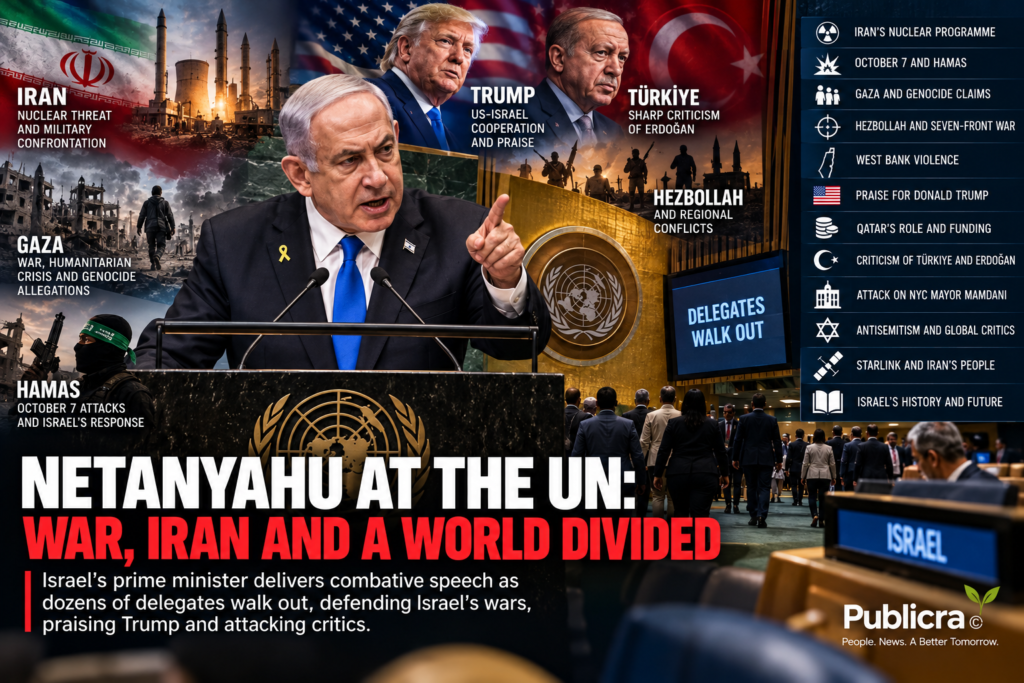
In a wide-ranging address to the UN General Assembly, Benjamin Netanyahu defended Israel’s military campaigns, praised Donald Trump, attacked Iran, Hamas, Qatar and Türkiye, rejected genocide allegations and confronted critics as dozens of delegates walked out
Israeli Prime Minister Benjamin Netanyahu delivered a combative address to the United Nations General Assembly in New York on Thursday, using one of the world’s most prominent diplomatic stages to defend Israel’s military record and confront governments, political leaders and international critics he accused of misrepresenting his country.
The speech on 24 September 2026 ranged across decades of Israeli history but concentrated heavily on the conflicts of the past three years. Netanyahu discussed Iran’s nuclear programme and the US-Israeli campaign against Tehran, the Hamas-led October 7 attacks, fighting involving Hezbollah and other Iran-aligned groups, violence in the occupied West Bank, allegations concerning Israel’s conduct in Gaza and what he described as an international information campaign against the Jewish state.
His appearance was itself contentious. Dozens of delegates left the General Assembly hall as Netanyahu approached the podium, while supporters in the gallery chanted in Hebrew. Netanyahu immediately addressed those leaving, calling them “moral cowards” and accusing governments of privately benefiting from Israeli military action while publicly condemning his government. Reuters reported that the walkout came as Israel faces mounting diplomatic pressure over its military policies.
Iran dominated the opening of Netanyahu’s speech
Netanyahu began by recalling his famous appearance at the UN 14 years earlier, when he used a diagram and a red line to warn about Iran’s nuclear programme. He told delegates that he had vowed then to prevent Tehran from acquiring nuclear weapons and argued that Israel had now fulfilled that promise.
Referring to attacks on Iranian nuclear facilities, Netanyahu said the military operation itself had been extremely difficult but described the decision to undertake it as “one of the easiest decisions” he had made as prime minister. His reasoning, he said, was that Israel faced an existential threat if Iran acquired nuclear weapons. He also claimed that some leaders whose representatives walked out of his speech had privately thanked Israel for acting against Iran.
Netanyahu portrayed Israel’s campaign against Iran as benefiting countries beyond Israel itself. That is the Israeli prime minister’s account of the conflict; Iran has long disputed Israeli and Western characterisations of its nuclear ambitions and has maintained that its nuclear programme has peaceful purposes.
Netanyahu turned to 1967 and rejected accusations of colonialism
From Iran, Netanyahu moved backwards in history to the period immediately before the Six-Day War of June 1967. He argued that Israel faced threats to its existence even before it controlled the West Bank, Gaza and the Golan Heights, using this history to challenge the argument that the Israeli-Palestinian conflict is fundamentally caused by occupation of those territories.
Netanyahu said Israel was a tiny country compared with the combined territory of the Arab world and rejected descriptions of Israel as a colonial project. He specifically criticised Britain and France over such accusations, invoking their own histories of colonialism.
He also addressed Syria’s leadership while discussing the Golan Heights, invoking ancient Jewish history and the Bible to assert a longstanding Jewish connection to the territory. These are political and historical claims central to Netanyahu’s argument; sovereignty over the Golan Heights remains internationally contested, with most of the international community regarding the territory as occupied Syrian land.
His brother Yoni became a central theme of the speech
Netanyahu then made the speech deeply personal, recalling the period immediately before the 1967 war when, as a high-school student in Philadelphia, he returned to Israel and found the country preparing for conflict.
He described travelling to see his older brother, Yonatan “Yoni” Netanyahu, who was serving as a young paratroop officer. Netanyahu recalled asking his brother what would happen if war came. His brother’s answer became the central refrain of Thursday’s UN address: “We’re going to win. We have no other choice.”
Netanyahu then moved to the 1976 Entebbe hostage rescue in Uganda, which Yoni Netanyahu commanded. Israeli forces rescued more than 100 hostages after an aircraft was hijacked and taken to Entebbe. Yoni Netanyahu was killed during the operation. The prime minister thanked Uganda for recently erecting a statue honouring his brother and repeatedly returned to Yoni’s words as a metaphor for what he described as Israel’s continuing struggle for survival.
October 7 and Israel’s “seven-front war”
Netanyahu described the Hamas-led attacks of 7 October 2023 as the darkest day in Israel’s history. He recounted killings, kidnappings and sexual violence during the assault and said approximately 1,200 Israelis were killed.
He argued that the attacks demonstrated that Israel’s enemies were not primarily motivated by territorial disputes. Netanyahu noted that Israel had withdrawn its permanent military and civilian presence from inside Gaza years earlier and argued that October 7 nevertheless occurred, supporting his contention that Hamas sought Israel’s destruction rather than simply an Israeli withdrawal from territory.
The prime minister then characterised the years that followed as a “seven-front war.” He named Hamas in Gaza, Hezbollah in Lebanon, the Houthis in Yemen, Iran itself, armed groups in Iraq and Syria, and Palestinian militants in the West Bank. Netanyahu said Israel had responded by inflicting severe damage on those adversaries and portrayed Israel’s ability to fight simultaneously across several theatres as evidence of national resilience.
Netanyahu claimed Israel had severely weakened Hamas and Hezbollah
Netanyahu said Israeli forces had dealt major blows to Hamas and Hezbollah and also highlighted US-Israeli military operations against Iran. He claimed that much of Hezbollah’s missile and rocket arsenal had been destroyed and pointed to the deaths of senior figures in organisations fighting Israel.
He also held up a pager while speaking, an apparent reference to the explosive-device operation against Hezbollah members in Lebanon. The episode became one of the visual moments of his address, continuing Netanyahu’s long-running practice of bringing props and visual material to speeches at the UN. Reuters reported that he also displayed a Starlink terminal later in his address.
Many of Netanyahu’s descriptions of military effectiveness were assertions by Israel’s prime minister rather than independently established assessments presented by the UN. His speech framed the campaigns as defensive victories against organisations and governments seeking Israel’s destruction.
West Bank violence and Netanyahu’s criticism of international coverage
Netanyahu then turned to the occupied West Bank, which he repeatedly called Judea and Samaria, the terminology commonly used by the Israeli government and many Israelis.
He accused international news organisations and social media platforms of concentrating disproportionately on violence committed by Israeli settlers while giving insufficient attention to Palestinian attacks against Israelis. Netanyahu condemned vigilantism by Israelis, saying Israel was governed by law, but argued that the number of offenders involved was relatively small.
Reuters reported that Netanyahu described the perpetrators of settler violence as a relatively small group of young offenders who had thrown stones, cut down olive trees and sometimes started fires. His characterisation came against international concern over settler violence and Israeli policies in the occupied West Bank.
Netanyahu cited recent attacks on Israelis to illustrate his argument, including the killing of Netanel Shukrun and an attack that seriously injured reserve soldier Neria Leiter. He connected those individual cases to his wider message that Israel continued to face persistent attacks and would continue defending its citizens.
Trump received some of Netanyahu’s strongest praise
Netanyahu reserved extensive praise for US President Donald Trump, describing him as Israel’s most important partner in what the prime minister portrayed as a broader struggle against extremist forces.
He credited Trump with recognising the danger posed by Iran and said American and Israeli forces had worked together against Tehran. Netanyahu also said cooperation between the two countries had contributed to efforts to return Israeli hostages.
Reuters reported Netanyahu thanking Trump for his “bold leadership” and describing him as Israel’s greatest partner in the current struggle. The praise was notable because Netanyahu’s visit to New York did not include a planned meeting with the US president, an unusual feature of the trip.
Netanyahu called information and social media an “eighth front”
After describing Israel’s military conflicts as seven fronts, Netanyahu said Israel was fighting an eighth front — a battle over information and truth.
He accused foreign governments of spending large amounts of money to influence public attitudes towards Israel, particularly among younger people and university students. Netanyahu singled out Qatar, accusing it of financing American universities and media organisations, including Al Jazeera, in ways he said encouraged hostility towards Israel, the United States and the West.
He also criticised Qatar for hosting Hamas officials. These were allegations made by Netanyahu; Qatar has repeatedly presented itself as a mediator in regional conflicts and has disputed Israeli accusations concerning its role.
Netanyahu launched a direct attack on Türkiye and Erdoğan
Netanyahu then directed some of his harshest language towards Türkiye and President Recep Tayyip Erdoğan, accusing Ankara of spreading what he described as anti-Israel and antisemitic narratives.
He criticised Erdoğan’s government over its relationship with Hamas, treatment of Kurdish populations, policies towards journalists and opposition politicians, its position on the Armenian genocide and Türkiye’s control of northern Cyprus. Netanyahu also accused Erdoğan of harbouring ambitions involving Syria and Jerusalem.
Türkiye disputes many Israeli characterisations of its regional policies and has itself sharply criticised Netanyahu’s government and Israel’s conduct in Gaza. Netanyahu’s remarks therefore represented one side of an increasingly hostile political relationship between the two governments.
Netanyahu rejected genocide allegations over Gaza
One of the central parts of the speech was Netanyahu’s rejection of accusations that Israel has committed genocide against Palestinians in Gaza.
He said Hamas had deliberately operated among civilians and used hospitals, schools and mosques for military purposes. Netanyahu argued that Hamas had attempted to keep Palestinian civilians in danger while Israel had tried to move them away from combat zones by sending text messages, making telephone calls and distributing warning leaflets.
He also pointed to vaccinations and food aid entering Gaza as evidence, in his view, that Israel was not pursuing genocidal policies. Netanyahu called the genocide allegation an enormous falsehood and cited military analyst John Spencer in support of his argument that Israel had taken extensive measures to reduce civilian casualties.
These claims remain intensely contested internationally. Israel denies committing genocide and says its military operations target Hamas and other armed groups. Critics, Palestinian representatives and human-rights organisations have accused Israel of grave violations, while the International Criminal Court issued an arrest warrant for Netanyahu in 2024 alleging war crimes and crimes against humanity. Reuters noted that the warrant continues to restrict Netanyahu’s ability to travel to a number of countries.
New York Mayor Zohran Mamdani became a major target
Netanyahu devoted an unusually substantial part of an international diplomatic speech to New York City Mayor Zohran Mamdani, who has been one of his prominent critics.
Mamdani has described Netanyahu as a war criminal and has accused his government of genocide against Palestinians. Netanyahu rejected those allegations and accused the mayor of contributing to hostility towards Israel and Jewish communities.
He told Mamdani that attempts to silence him would fail and declared that Israel had prevented, rather than committed, genocide. Reuters subsequently reported Mamdani rejecting Netanyahu’s allegations and accusing the Israeli prime minister of using false claims to defend his record. Reuters also noted that one allegation Netanyahu made about Mamdani supporting Hamas was false.
Antisemitism and Netanyahu’s message to Jews worldwide
Netanyahu broadened the dispute with Mamdani into a discussion of antisemitism internationally. He cited attacks against Jewish people and Jewish institutions in cities around the world and argued that misinformation about Israel could have consequences for Jewish communities far beyond the Middle East.
His message to Jewish communities was one of defiance. Netanyahu said the era in which Jewish people were unable to defend themselves had ended because they now had a state and an army.
He urged Jews around the world not to be intimidated and to remain confident in their identity. Netanyahu connected this appeal to his wider argument that Israel sees its military strength not simply as national defence but as protection against the historical vulnerability of Jewish communities.
Western European governments faced sharp criticism
Netanyahu also criticised several governments in Western Europe, accusing their leaders of responding to domestic political pressure rather than defending Israel.
He said some European governments had chosen what he described as weakness and appeasement. Reuters reported that he accused Western European leaders of yielding to “antisemitic mobs”. The remarks came amid deteriorating relations between Israel and several traditional Western allies.
Earlier in September, Britain, France and Canada announced measures targeting Israeli settlements in the occupied West Bank. Netanyahu’s UN remarks placed those diplomatic disputes within his broader argument that some Western democracies were failing to recognise threats from militant Islamist movements.
Netanyahu displayed Starlink while addressing Iran
Another striking visual moment came when Netanyahu held up a Starlink satellite internet terminal.
He said the Iranian government feared its own citizens and argued that uncensored access to information could help Iranians challenge state authority. Netanyahu said he would leave the Starlink device with the president of the General Assembly so it could be given to the Iranian delegation.
He then predicted that Iran’s current political system would eventually fall and that Iranian citizens would become free. This was a political prediction and aspiration expressed by Netanyahu, not an established assessment of when or whether Iran’s government will change. Reuters confirmed that he displayed the Starlink equipment and said Iranian authorities would eventually be toppled by their own people.
He challenged protesters over Iran and Christians in the Middle East
Netanyahu also addressed demonstrators protesting against him outside the United Nations and delegates who had left the General Assembly hall.
He accused them of applying selective standards to human rights, asking why similar demonstrations had not been organised over Iranian government repression. He also raised the situation of Christian communities across the Middle East, arguing that Christians had declined in number in many places while Israel’s Christian population had grown.
Netanyahu specifically invoked Bethlehem, contrasting its religious demographics under previous Israeli control with the period under Palestinian Authority administration. His interpretation of demographic change and its causes is politically contested and should be understood as part of the argument he presented in the speech rather than an uncontested explanation.
Netanyahu said Israel remained technologically and militarily strong
Despite diplomatic criticism, Netanyahu presented Israel as stronger rather than weaker after years of conflict.
He highlighted Israeli developments in health, agriculture and artificial intelligence and argued that the country continued contributing technological innovation internationally even while fighting multiple enemies.
The message formed an important counterpoint to the walkout at the beginning of his address. Where critics see increasing diplomatic isolation, Netanyahu sought to present Israel as militarily capable, technologically advanced and unwilling to alter its security policies simply to obtain international approval.
Jewish history framed Netanyahu’s conclusion
Netanyahu concluded by moving away from immediate military events and towards the long history of the Jewish people.
He spoke of a history stretching back more than 3,000 years and invoked biblical figures including David, Solomon, Isaiah and Jeremiah. He described the connection between Jewish identity and the land of Israel as continuous across millennia and linked that history to values including the sanctity of life, law, peace and justice.
He also invoked American writer Mark Twain, who wrote about the endurance of the Jewish people despite the disappearance of ancient empires. Rather than ending with a new diplomatic proposal, Netanyahu returned to the phrase he had attributed to his brother Yoni earlier in the speech.
His closing argument was essentially the same as his opening historical narrative: Israel, he said, has repeatedly faced enemies seeking its destruction and survived by refusing to surrender. He ended by returning to the words that ran through the address — “We have no other choice.”
What Netanyahu did not focus on
The speech was notable not only for what Netanyahu discussed but also for what he largely left out.
Despite previous Israeli emphasis on expanding the Abraham Accords, Netanyahu did not make Saudi normalisation or expansion of those agreements a major theme. He also did not unveil significant new evidence about Iran’s nuclear programme, despite expectations before the speech that Iran would dominate his presentation. Contemporary reporting noted that the address instead concentrated on Iran’s leadership, Israel’s military record, antisemitism, Trump, Mamdani and criticism of Western governments.
Nor did the address present a detailed new political roadmap for Gaza or a comprehensive proposal for resolving the Israeli-Palestinian conflict. Netanyahu’s focus was overwhelmingly defensive and historical: explaining why he believes Israel’s recent military campaigns were necessary and challenging the legitimacy of criticism directed at his government.
A speech aimed beyond the United Nations
Although delivered to diplomats in New York, Netanyahu’s audience extended well beyond the General Assembly chamber.
The speech was broadcast live during Israeli prime time, and Reuters noted that Israel is approaching a general election. Netanyahu used much of the address to emphasise military achievements, his relationship with Trump and his claim that Israel had successfully confronted enemies on multiple fronts.
Internationally, the address was designed to contest the narrative of a diplomatically isolated Israel accused of excessive force. Netanyahu instead presented Israel as a country fighting for survival against a network of adversaries while simultaneously battling what he considers an international campaign of misinformation.
The competing interpretations remain stark. Netanyahu says Israel’s military operations have protected the country from existential threats and prevented genocide against Israelis. Palestinian representatives, international critics and human-rights advocates argue that Israel’s conduct has inflicted catastrophic harm on Palestinians and violated international law. Those disputes were not resolved by Thursday’s address, but they defined both Netanyahu’s message and the reaction to it.
A walkout that captured the divisions surrounding Israel
The image likely to define the beginning of the speech was not one of Netanyahu’s props but the sight of diplomats leaving the General Assembly chamber.
Dozens of delegates walked out when Netanyahu began speaking. His supporters responded with chants, and the prime minister immediately confronted those departing.
The episode encapsulated the extraordinary international divisions surrounding Israel in 2026. Netanyahu arrived at the UN determined to argue that international condemnation reflected misunderstanding, misinformation and double standards. Many of those who walked out clearly viewed the situation very differently.
For Netanyahu, however, the central message remained unchanged from the story he told about his brother more than half a century ago: Israel would continue defending itself regardless of international pressure because, in his formulation, “we have no other choice.”