
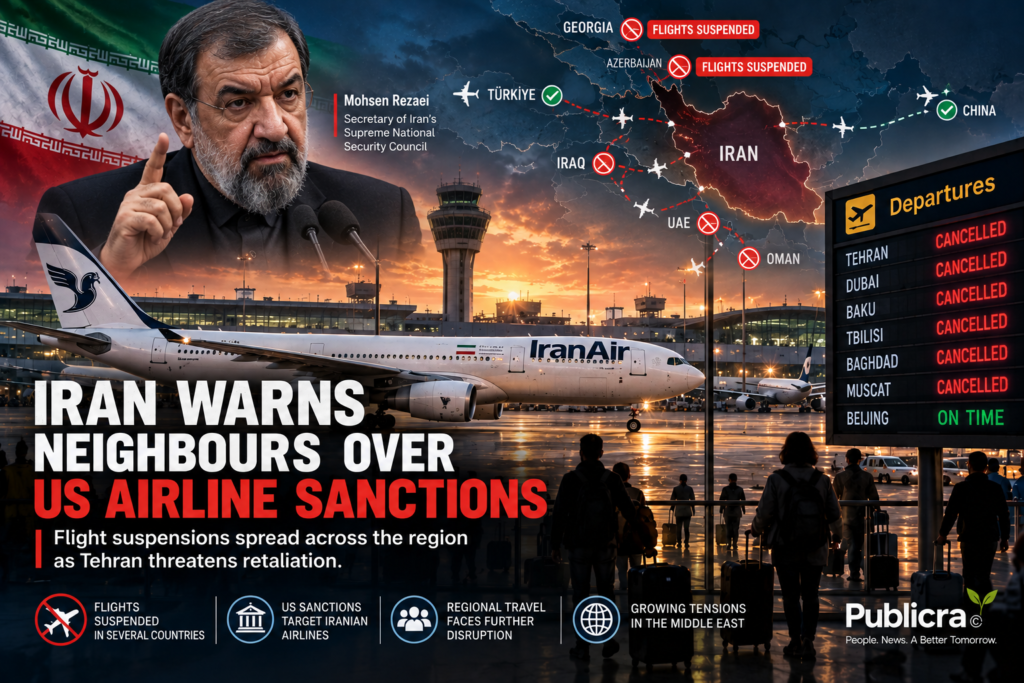
Tehran has threatened unspecified retaliation against countries restricting Iranian carriers, adding fresh uncertainty for passengers and major aviation hubs already dealing with months of conflict and disruption
Iran has warned neighbouring countries against enforcing sweeping new United States sanctions targeting its airlines, raising concerns that an escalating confrontation over aviation could cause further disruption to air travel across the Middle East and surrounding regions.
The warning came from Mohsen Rezaei, secretary of Iran’s Supreme National Security Council, after several countries began restricting Iranian-operated flights. Rezaei said countries cooperating with Washington’s measures could face consequences affecting their own airports, although he did not publicly explain exactly what action Tehran might take or whether the threatened response would be diplomatic, economic or military.
The dispute is already affecting travellers. Azerbaijan and Georgia have confirmed restrictions on Iranian flights, while services involving destinations including Baghdad and Muscat have also been disrupted. Iranian carriers have cancelled additional international flights, including services involving the United Arab Emirates, while some connections with countries such as Türkiye and China have continued.
The confrontation comes at an especially difficult time for regional aviation. Months of conflict have already forced airlines to alter routes, cancel services and reassess operations across parts of the Middle East. The latest sanctions could now make international travel considerably more difficult for Iranian passengers while creating another source of uncertainty for neighbouring airports and aviation companies.
What exactly has Iran threatened?
Rezaei warned neighbouring governments that Tehran would not regard participation in the US aviation restrictions as a purely commercial decision. His comments suggested that Iran could impose reciprocal costs on countries that prevent Iranian carriers from using their airports, although the precise meaning of that warning remains unclear.
That ambiguity is important. Iran cannot legally determine whether another sovereign country permits Iranian aircraft to use its airports, just as Washington cannot directly order another country’s airspace to close. The United States can, however, use its economic influence to make dealing with sanctioned Iranian airlines financially risky for airports, fuel suppliers, ticketing businesses, ground-handling companies and other service providers.
Iran’s warning appears designed to counter that pressure by presenting governments with a different calculation: complying with US sanctions may reduce exposure to American financial penalties, but Tehran is signalling that cooperation could also carry consequences. Analysts quoted in the original reporting described this as a form of coercive deterrence, although Iran has not publicly detailed how any retaliation against airports would be carried out.
Why has the US targeted Iranian airlines?
The immediate backdrop is a major expansion of US sanctions against Iran’s aviation sector. On September 8, the US Treasury’s Office of Foreign Assets Control announced measures targeting Iran’s remaining airlines along with foreign intermediaries and companies accused of supporting the country’s aviation network. The Treasury described the package as part of “Operation Economic Outcast” and said it targeted 36 entities and individuals connected with Iranian aviation.
Washington says Iranian aviation networks have been used to transport weapons, personnel and other cargo and has long accused Mahan Air of supporting Iran’s Islamic Revolutionary Guard Corps. The latest measures widened the pressure significantly by targeting additional Iranian carriers and restricting transactions that previously supported certain civil aviation activities.
The consequences extend beyond the airlines themselves. Airports and private companies providing sanctioned carriers with fuel, landing services, ticketing or other support could face secondary US sanctions, potentially jeopardising their access to the American financial system. That creates a powerful incentive for businesses and governments to avoid servicing Iranian aircraft even when their own governments have not imposed equivalent national sanctions.
Flights are already disappearing from Iranian schedules
The impact has quickly become visible. Azerbaijan Airlines said Iranian carriers’ services to Azerbaijan were being suspended from September 22 because of the new US sanctions package. Georgia has also restricted Iranian flights, while disruptions have affected routes involving Oman, Iraq, Türkiye and the United Arab Emirates.
Not every international connection has disappeared. Some Iranian flights have continued to destinations including China, and reporting indicates that Iran may retain links with countries less willing to enforce Washington’s restrictions. That means the sanctions do not necessarily amount to a complete international aviation blockade.
Nevertheless, the network available to Iranian passengers has become substantially smaller. Aviation analytics company Cirium estimated that Iran’s international flight capacity in August 2026 was already 49% lower than in August 2025, before the latest restrictions took full effect. The new measures therefore strike an aviation system already weakened by conflict, sanctions and the reluctance of many foreign airlines to operate services to Iran.
Could Iran actually disrupt neighbouring airports?
Rezaei’s warning has attracted attention partly because he did not explain how Iran would prevent airports in neighbouring countries from functioning. Without that detail, it is impossible to conclude whether Tehran was referring to diplomatic retaliation, commercial restrictions, cyber measures or something more serious.
The regional security environment makes the language particularly sensitive. Earlier phases of the conflict caused extensive disruption to Gulf aviation, with airspace closures and flight suspensions affecting several countries. That history means airlines and governments are likely to take any suggestion of renewed aviation disruption seriously even when the mechanism behind the threat is unspecified.
At the same time, analysts have cautioned against automatically interpreting Rezaei’s remarks as an announcement of imminent attacks on civilian airports. Security analyst Wolfgang Pusztai told Al Jazeera that he considered an Iranian attack on the airports in question “extremely unlikely”. The more immediate issue may therefore be political and psychological pressure rather than direct military action.
Why Gulf aviation is particularly vulnerable to another crisis
Few regions depend on international aviation as heavily as the Gulf. Dubai, Doha and Abu Dhabi have developed into major connecting hubs linking Asia, Europe, Africa and the Americas. Their business models rely on predictable airspace access, passenger confidence and enormous numbers of connecting travellers.
When regional conflict forces airlines to avoid particular airspace, the effects can spread far beyond the countries directly involved. Flights may require longer routes, increasing fuel consumption and operating costs. Crews can reach working-hour limits sooner, schedules become more difficult to maintain and passengers may face cancellations or longer journeys.
The economic consequences can also be substantial. According to figures cited in the source material, the International Air Transport Association estimated Middle Eastern airlines were on track for a collective $4.3bn loss in 2026, while the World Travel & Tourism Council estimated earlier in the year that conflict was costing the region around $600m per day in international visitor spending. These estimates reflect the broader conflict environment rather than the latest sanctions alone, but they illustrate how vulnerable aviation and tourism have become to further instability.
Ordinary Iranian travellers could feel the biggest impact
Although the dispute is between governments, some of the most immediate consequences fall on ordinary passengers. When direct flights disappear, travellers may have to reach neighbouring countries by road before continuing their journeys by air, turning what was once a straightforward international flight into a much longer and more expensive trip.
Thousands of travellers have reportedly turned towards land crossings with Türkiye and Armenia as air connections have declined. Congestion has been reported at some crossings, while increased demand has pushed up the cost of alternative transport. For members of the Iranian diaspora, reduced flight connectivity can make visiting relatives considerably more difficult.
Students and academics may also be affected. International travel is important for university admissions, examinations, research and employment, while businesses depend on aviation for meetings and access to overseas markets. The consequences of aviation restrictions therefore extend well beyond holiday travel.
Tourism, jobs and cargo could also be affected
Airlines are only one part of the aviation economy. Airports support ground handlers, caterers, maintenance workers, travel agents, hotels, restaurants and thousands of other jobs. When passenger numbers decline sharply, the economic impact can spread through tourism and hospitality.
Iran’s aviation industry is particularly exposed because years of sanctions have already made obtaining aircraft and spare parts difficult. New restrictions affecting international operations could put additional pressure on airlines and employees while reducing revenue available to airports and related businesses.
Air freight presents another concern. Aircraft carry far more than passengers and luggage; they also transport time-sensitive commercial products and some medical supplies. Reporting from Iran indicates that sanctions and conflict have already increased the cost of certain imported supplies. Further restrictions on air cargo could add pressure at a time when maritime and overland trade routes are also facing disruption.
Will the sanctions completely isolate Iran?
Probably not. Iran still has relationships with countries that oppose unilateral US sanctions or may be less willing to enforce them fully. China and Russia are among the most important, while connections with some regional destinations could continue in limited form.
Flight data cited in current reporting showed some Iranian services continuing after the US deadline, illustrating the practical limits of Washington’s ability to stop every Iranian international flight. The United States does not directly control foreign airports; its leverage comes primarily from the risk companies face if they want continued access to US financial and commercial networks.
That means implementation may vary significantly between countries. Large international companies with extensive exposure to the US market have strong incentives to comply, while businesses with limited American connections may calculate the risk differently. Iran could therefore become increasingly isolated without becoming completely disconnected.
Why aviation sanctions are unusually visible
Financial sanctions can have enormous economic effects while remaining relatively invisible to ordinary citizens. A bank transaction may fail behind the scenes, a company may struggle to obtain financing or an importer may quietly lose access to a supplier.
A cancelled flight is different. Passengers see it immediately on an airport departure board or booking website. Families cannot travel, business trips are abandoned and alternative routes become more expensive. That visibility can give aviation sanctions a psychological impact beyond their direct economic effect.
Pusztai argued that the restrictions could deepen a perception among Iranians that the country is becoming increasingly isolated. He also cautioned that aviation sanctions alone are unlikely to force Tehran to fundamentally change its policies, suggesting they should instead be understood as another component of Washington’s wider pressure campaign.
The dispute is pulling neighbouring countries into the confrontation
One of the most significant aspects of the aviation dispute is the position in which it places third countries. Governments that may prefer to remain outside the confrontation are increasingly being forced to make practical decisions about Iranian aircraft.
Allowing a sanctioned carrier to land could expose local businesses to US penalties. Blocking the airline could provoke political retaliation from Tehran. Countries with important relationships with both sides therefore face difficult choices that extend beyond aviation policy.
This is one reason the dispute could have wider geopolitical consequences. Secondary sanctions are designed specifically to extend economic pressure beyond the original target by influencing the behaviour of foreign companies and governments. Iran’s response appears intended to create counter-pressure of its own.
What travellers should watch now
For passengers travelling to, from or through the region, conditions may change quickly. Airline schedules can be altered at short notice if governments introduce new restrictions, airspace closes temporarily or carriers decide that operating conditions have become unsafe.
Travellers with upcoming journeys involving Iran should check directly with their airline before travelling to an airport and monitor official aviation and government notices. Passengers connecting through major regional hubs should also allow for the possibility of schedule changes if tensions escalate.
It is equally important not to interpret every Iranian warning as confirmation that airports will be attacked or closed. Rezaei’s remarks were deliberately broad, and Iran has not publicly specified what form its threatened retaliation would take. Current evidence supports concern about flight disruption and geopolitical uncertainty, but not a conclusion that attacks on neighbouring civilian airports are inevitable.
What happens next
The immediate question is whether more governments will stop servicing Iranian-operated aircraft. If additional countries follow Azerbaijan and Georgia, Iran’s remaining international network could shrink further and push even more passengers towards indirect flights and land crossings.
Another question is how Tehran responds. Iran could choose diplomatic or economic retaliation, introduce reciprocal aviation restrictions or continue using threatening language as a deterrent. Any military escalation involving airports or regional airspace would represent a far more serious development, but current public information does not establish that such action is imminent.
For the wider Middle East, the danger is that aviation becomes another arena in an already complex confrontation. The US is using access to its financial system to pressure companies and governments away from Iranian airlines, while Tehran is warning neighbouring states that cooperation will carry costs. Caught between those competing pressures are airlines, airports, tourism businesses and millions of passengers who depend on a regional aviation network that has already endured months of severe disruption.