
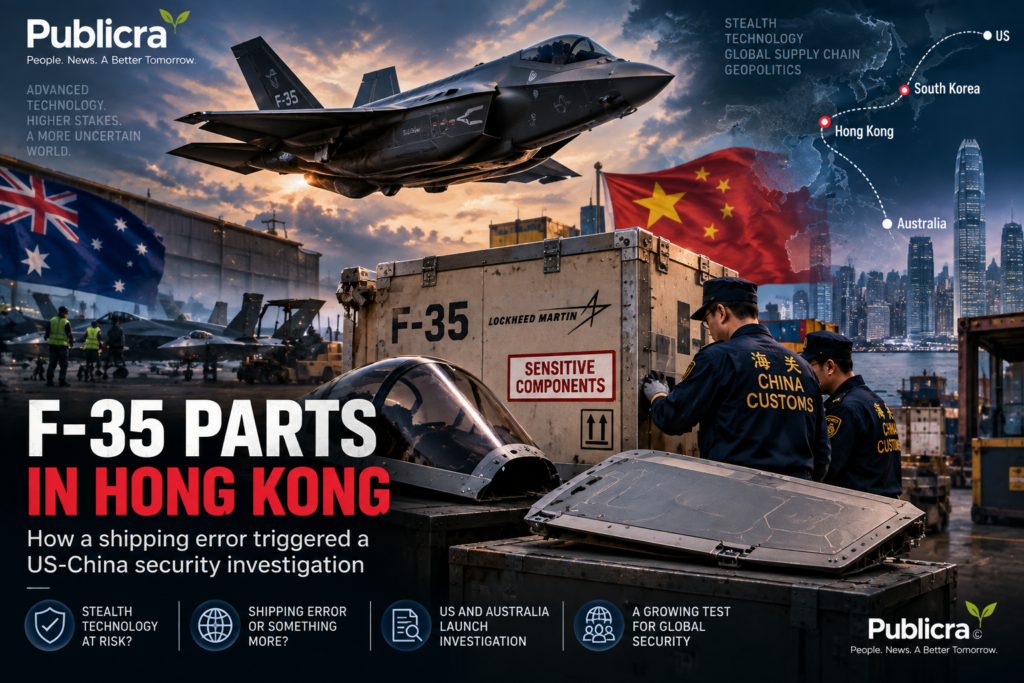
A cockpit canopy and weapons-bay door from an Australian F-35 were reportedly diverted while travelling to the United States, raising questions about stealth technology, export controls and the security of the fighter programme’s global supply chain
A routine shipment involving components from one of the world’s most sophisticated combat aircraft has turned into an international security investigation after parts from an Australian F-35 stealth fighter were unexpectedly diverted to Hong Kong while being transported to the United States.
The components were being shipped from Australia for inspection and possible repair or disposal when they travelled through South Korea and subsequently ended up in Hong Kong. Bloomberg reported, citing people briefed on the incident, that Chinese authorities later took possession of the components and that they had not been returned at the time of its report.
The shipment reportedly included two substantial pieces of an Australian military F-35 — a cockpit canopy and weapons-bay door. Both were reportedly manufactured by Lockheed Martin and incorporated radar-absorbing material associated with the aircraft’s low-observable, or stealth, characteristics. Australian Defence Minister Richard Marles has played down concerns that highly sensitive technology was compromised, while Lockheed Martin has described the parts as unserviceable and presenting a low risk of exploitation.
The incident is nevertheless being investigated by US and Australian authorities. Beyond the fate of two aircraft components, the episode raises a broader question: how can some of the world’s most closely controlled military technology be protected when spare parts routinely move through an international network of contractors, airports, freight companies and maintenance facilities?
How did F-35 parts end up in Hong Kong?
The incident reportedly began in late May 2026, when components removed from an Australian F-35 were being transported to the United States. According to Bloomberg’s reporting, UPS was carrying the cockpit canopy and weapons-bay door for inspection and possible repair or disposal.
The shipment reportedly stopped in South Korea while travelling towards the United States, but instead of continuing to its intended destination, the components were subsequently routed to Hong Kong. Exactly why that happened remains one of the central unanswered questions facing investigators.
It has not been publicly established whether the diversion resulted from an administrative mistake, incorrect cargo instructions, a computer or handling problem, or another logistics failure. There is also no publicly established evidence that Beijing deliberately caused the rerouting, making it important to distinguish the confirmed shipping incident from speculation about how it occurred.
Why the F-35 components have attracted attention
The components involved were not missiles, mission computers or the aircraft’s central electronic systems. However, reports that the canopy and weapons-bay door incorporated radar-absorbing material have generated particular interest because such materials contribute to the F-35’s low-observable characteristics.
Stealth is not produced by a single secret coating. The F-35’s ability to reduce its radar signature depends on numerous elements working together, including the aircraft’s shape, manufacturing tolerances, internal carriage of weapons, specialised materials and coatings, sensor integration and other engineering features. Radar-absorbing materials can contribute by reducing electromagnetic energy reflected back towards a radar receiver.
Possessing one damaged aircraft component would therefore not reveal the entire F-35 stealth design. Nevertheless, physical access to military equipment can potentially allow specialists to study its materials, manufacturing techniques or other characteristics. Investigators will consequently want to establish exactly what condition the components were in and whether anyone was able to examine them after the shipment left its authorised route.
Australia and Lockheed Martin play down the security risk
Australian officials have urged caution about suggestions that highly sensitive technology was compromised. Defence Minister Richard Marles confirmed that Canberra was working with the United States and Lockheed Martin to determine what happened and said Australian authorities were examining their part of the shipment.
Marles also said his understanding was that the incident did not involve technologically sensitive equipment. Lockheed Martin has taken a similar position, describing the components as unserviceable and saying they were assessed as presenting a low risk of exploitation.
Those statements do not necessarily mean the investigation is insignificant. A damaged component can be associated with a sensitive capability without itself containing enough information to represent a major technological compromise. The precise technical condition and classification of the parts have not been publicly disclosed in sufficient detail to determine independently how useful they might be to another country.
Did China actually take possession of the parts?
Bloomberg reported, citing people briefed on the incident, that the Chinese government took possession of the components after they reached Hong Kong and that they had not been returned. Other international news organisations subsequently reported the allegation.
China’s Foreign Ministry said it was not aware of the incident when questioned about it, while Hong Kong authorities have not publicly provided a detailed account resolving what happened to the shipment after it arrived. That leaves an important distinction between information attributed to sources familiar with the investigation and details formally confirmed by Chinese authorities.
US officials have said they are working with government and industry partners to retrieve the equipment, investigate the incident and establish measures designed to prevent another occurrence. Until more information is released, questions about exactly who handled or examined the components after their arrival remain unresolved.
Why the F-35 is so closely protected
The F-35 Lightning II is a fifth-generation multirole combat aircraft developed through a US-led international programme and manufactured primarily by Lockheed Martin. It combines low-observable design with advanced sensors, electronic warfare capabilities and networked information-sharing systems.
Three principal versions are produced. The F-35A is the conventional take-off and landing model operated by the US Air Force and numerous international customers. The F-35B provides short take-off and vertical landing capability, while the F-35C was designed for conventional aircraft-carrier operations.
Its importance extends far beyond the United States. Numerous US allies and security partners either operate or have ordered the fighter, making it a major component of allied air power. Protecting the aircraft’s technology is consequently not simply an American issue; it requires security procedures across a multinational network.
Australia’s central role in the Indo-Pacific F-35 network
Australia is one of the programme’s important international participants, with the Royal Australian Air Force operating 72 F-35A aircraft. The country also participates in the international sustainment network supporting the fighter.
That role is particularly significant in the Indo-Pacific. Aircraft operating thousands of kilometres from US manufacturing facilities require regional access to spare components, maintenance expertise, repairs and logistics infrastructure. Australia therefore serves not only as an operator but also as part of the wider system keeping F-35 fleets operational in the region.
This international structure offers considerable benefits, but it also creates vulnerabilities. Every additional maintenance facility, warehouse, contractor, airport and freight provider introduces another point at which procedures must work correctly. A logistics mistake involving an ordinary commercial product may cause inconvenience; a mistake involving controlled military equipment can quickly become a national-security issue.
A global supply chain creates new security challenges
Modern combat aircraft depend on enormous supply networks. Components are routinely removed for inspection, repair or replacement and may travel between military installations, specialist contractors and maintenance centres in different countries.
For the F-35, the challenge is magnified by the programme’s international scale. Regional maintenance facilities can reduce costs and turnaround times, while participating nations can share infrastructure and expertise. But those efficiencies depend on accurate tracking and strict control over components throughout their journey.
The Hong Kong incident illustrates how an apparently mundane logistics problem can create geopolitical consequences. A wrong routing instruction, database entry or cargo-handling decision can potentially move controlled equipment into a jurisdiction where it was never authorised to travel.
Export controls are now part of the investigation
US-origin military equipment is subject to extensive export-control requirements intended to prevent controlled technologies from reaching unauthorised destinations. The unexpected arrival of F-35 components in Hong Kong therefore raises regulatory questions alongside the military concerns.
According to Bloomberg’s reporting, UPS disclosed the incident to the US State Department’s Directorate of Defense Trade Controls. Investigators are expected to reconstruct the chain of custody and establish who prepared the original shipping documentation, why the cargo travelled through South Korea, what changed its destination and when authorities discovered the mistake.
Another critical question is how long the components remained outside authorised control and whether their packaging was opened or the parts were inspected. The answers could determine whether the incident ultimately proves to be an extraordinary but limited shipping mistake or evidence of a wider weakness in the F-35 logistics system.
US lawmakers want answers
The incident has also attracted congressional attention. Multiple US congressional committees have reportedly sought information, with the House and Senate Armed Services Committees examining the circumstances surrounding the shipment.
The scrutiny is unsurprising. The F-35 is one of the world’s largest and most strategically significant defence programmes, and lawmakers have previously examined its costs, readiness levels, maintenance arrangements, software development and supply-chain management.
The possibility that aircraft components could unexpectedly enter a jurisdiction where Chinese authorities might gain access adds another concern: technology security. Congressional investigators are likely to focus not only on what happened this time but on whether the same weakness could allow more sensitive equipment to be misdirected in the future.
Why Hong Kong makes the mistake particularly sensitive
A shipment mistakenly arriving in the territory of a close US ally would still require investigation. Hong Kong makes the case significantly more sensitive because of the broader strategic competition between Washington and Beijing.
The United States and China are already engaged in disputes over advanced semiconductors, artificial intelligence, Taiwan, cybersecurity, military operations in the Indo-Pacific and restrictions on sensitive technology. Washington has imposed extensive controls intended to prevent certain advanced US technologies from reaching China, while Beijing has criticised many of those measures as attempts to contain China’s development.
Against that backdrop, even an accidental shipment connected with America’s premier stealth fighter carries political significance. However, there is currently no publicly established evidence that Chinese authorities caused the original diversion, and the shipping investigation should not be conflated with unproven claims of an intelligence operation.
Could China reverse-engineer technology from the components?
Whether useful technical information could be extracted from the canopy and weapons-bay door cannot be determined from the publicly available information. Reverse engineering can involve examining a component’s materials, physical properties, manufacturing methods and design, but the intelligence value depends heavily on exactly what has been obtained and its condition.
Access to a single component does not provide the ability to reproduce an entire aircraft or automatically defeat its stealth capabilities. The F-35’s low observability depends on the integration of many different engineering features rather than one removable piece of equipment.
That does not mean physical access would be irrelevant. Even limited information can potentially contribute to a larger technical intelligence picture, which is why military planners seek to prevent potential adversaries from examining controlled hardware in the first place.
China’s own stealth aviation programme raises the stakes
China has invested heavily in advanced combat aircraft, sensors, missiles and aerospace manufacturing. Its J-20 stealth fighter is already operational, while the country continues developing additional advanced military aircraft and associated technologies.
The rapid development of Chinese military aviation means protection of Western low-observable technology remains an important priority for US defence planners. Washington has previously accused China of attempting to obtain American military and commercial technology through cyber operations and other means, allegations Beijing has rejected in many cases.
There is, however, no publicly established evidence that China orchestrated this particular shipment diversion. That remains an important distinction as the investigation continues.
The incident exposes a wider logistics problem
The most consequential lesson from the episode may ultimately concern logistics rather than espionage. Modern military systems rely heavily on civilian infrastructure, including warehouses, databases, cargo aircraft, freight companies, maintenance contractors and global transport networks.
Even the most sophisticated combat aircraft cannot remain operational without that system. Every handover between organisations creates opportunities for administrative or technical errors, and international programmes multiply those potential points of failure.
The F-35 programme has faced parts-management concerns before. A 2023 US Government Accountability Office assessment identified weaknesses involving accountability for government-owned F-35 spare parts managed through the contractor-led system. That earlier finding does not establish the cause of the Hong Kong incident, but it demonstrates the scale of the challenge involved in tracking components distributed across a multinational fleet.
What investigators still need to establish
The most important unanswered question remains straightforward: why did the shipment go to Hong Kong? Investigators will need to determine whether an incorrect routing code, carrier error, intermediary, computer system or another factor caused the diversion and whether the South Korean stop played any role.
Authorities also need to establish exactly what happened after the components arrived. Technical specialists may assess whether the packaging was opened, whether the parts were examined and whether any characteristics of potential intelligence value could have been recorded.
Until those investigations are completed, claims about the consequences should remain cautious. The confirmed shipping error is serious enough without assuming facts that investigators have not yet established.
What happens next
US authorities are seeking the return of the components and investigating how they reached Hong Kong. Australia is examining its involvement, while Lockheed Martin says it is cooperating and working with relevant partners on measures intended to prevent another occurrence.
Several points can currently be separated with reasonable clarity. F-35 components shipped from Australia were unexpectedly diverted to Hong Kong. Bloomberg reported that the shipment contained a cockpit canopy and weapons-bay door incorporating radar-absorbing material and that Chinese authorities subsequently took possession of them. Australian and industry officials have said the unserviceable components were not considered highly sensitive or presented a low exploitation risk.
What remains unresolved is potentially more important: why the shipment was diverted, who had access to the components after their arrival and whether anything technically useful could be learned from them. The answers will determine whether this episode is remembered mainly as an embarrassing international shipping error or as a more consequential weakness in the security system surrounding one of America’s most advanced military aircraft.