
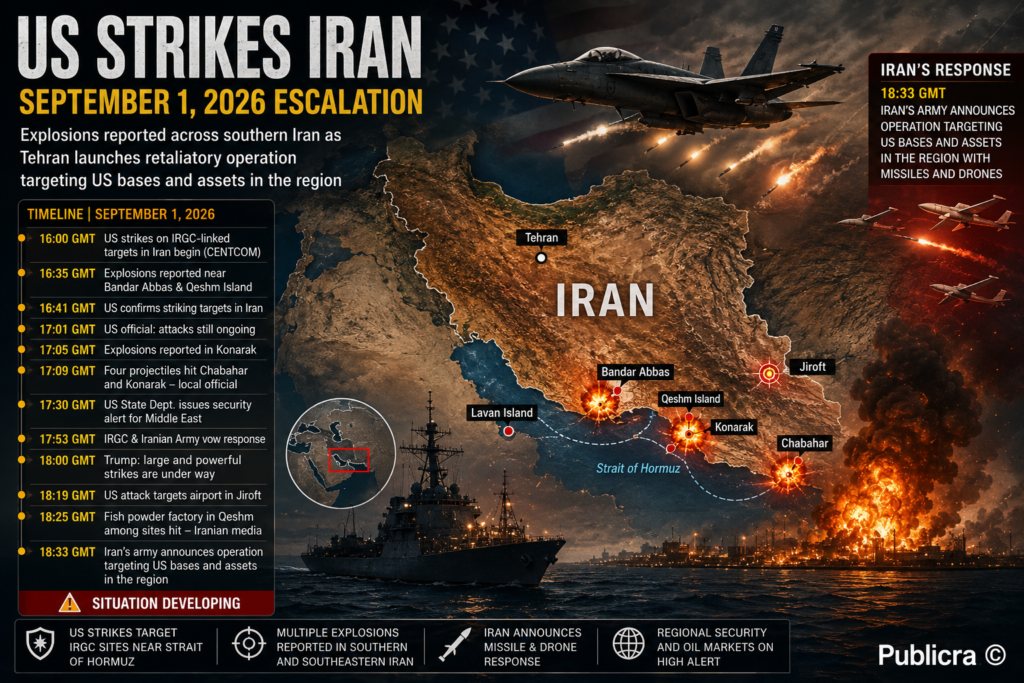
New US attacks reported across Bandar Abbas, Qeshm, Konarak, Chabahar and other areas as Iran says missiles and drones are targeting US bases and assets across the region
The confrontation between the United States and Iran sharply escalated on Tuesday, September 1, 2026, after the US military announced a new round of strikes against targets in Iran and Iranian authorities subsequently said they had begun a retaliatory military operation against American bases and interests in the region.
US Central Command, or CENTCOM, said its forces were attacking targets connected to Iran’s Islamic Revolutionary Guard Corps. Al Jazeera reported that CENTCOM said the operation followed recent attempted attacks against commercial shipping in the Strait of Hormuz and US personnel deployed in the Middle East.
Reuters separately reported that US President Donald Trump described the latest strikes as justified and warned Tehran against retaliation. Washington has linked the renewed military action to Iranian activity around the Strait of Hormuz and recent Iranian missile attacks against facilities used by American forces in Jordan.
By early evening GMT, Iranian media were reporting explosions from several locations in southern and southeastern Iran, including Bandar Abbas, Qeshm Island, Konarak and Chabahar. Reports later expanded to include Lavan Island, Jiroft and parts of Hormozgan province.
Then, at approximately 18:33 GMT, or 21:33 in Qatar, Iranian media reported that Iran’s armed forces had announced the beginning of a response operation. According to the Tasnim report cited in the live updates, Iranian missiles and drones were being directed against US bases and interests in the region.
Because events are unfolding rapidly, individual reports about targets, casualties and damage should be regarded as developing claims until independently confirmed.
EXACT TIMELINE OF THE SEPTEMBER 1 US ATTACKS AND IRANIAN RESPONSE
The following timeline reconstructs today’s escalation from the initial announcement of US military operations through Iran’s announcement of its retaliatory operation. Qatar is GMT+3, so Qatar times are provided alongside GMT.
| Time GMT | Qatar time | Reported development |
|---|---|---|
| 16:00 GMT | 19:00 Qatar | CENTCOM says US military strikes against targets in Iran begin. |
| 16:35 GMT | 19:35 Qatar | Iranian broadcaster IRIB reports explosions east of Bandar Abbas and around Qeshm Island. |
| 16:41 GMT | 19:41 Qatar | US military publicly confirms it is striking targets in Iran. |
| 17:01 GMT | 20:01 Qatar | A US official tells Al Jazeera that attacks against IRGC-linked targets remain under way. |
| 17:05 GMT | 20:05 Qatar | Iranian news agencies report explosions in Konarak in southeastern Iran. |
| 17:09 GMT | 20:09 Qatar | Iranian officials report four projectiles hitting areas in Chabahar and Konarak. |
| 17:20 GMT | 20:20 Qatar | Reports describe the strikes as part of a renewed escalation following the previous US-Iran exchange. |
| 17:30 GMT | 20:30 Qatar | US State Department issues heightened-vigilance guidance over possible escalation, airspace closures and travel disruption. |
| 17:33 GMT | 20:33 Qatar | Trump publicly warns Iran against retaliating and says further US action could be considerably stronger. |
| 17:45 GMT | 20:45 Qatar | IAEA concerns over lack of access to Iranian nuclear facilities return to focus amid the military escalation. |
| 17:53 GMT | 20:53 Qatar | IRGC and Iranian armed forces publicly vow a response to the US attacks. |
| 18:00 GMT | 21:00 Qatar | Trump confirms that major US strikes are under way. |
| 18:04 GMT | 21:04 Qatar | Iranian media report additional explosions in Bandar Abbas, Qeshm and Lavan Island. |
| 18:15 GMT | 21:15 Qatar | Senior Iranian lawmaker says Tehran’s deterrence doctrine has changed and warns of a stronger response. |
| 18:19 GMT | 21:19 Qatar | Iranian state broadcaster reports that an airport in Jiroft has been targeted. |
| 18:25 GMT | 21:25 Qatar | Iranian state media alleges strikes on a fish-powder factory on Qeshm and other facilities in Hormozgan, including areas around Sirik. |
| 18:30 GMT | 21:30 Qatar | Trump says Gulf allies were notified before the latest US operation, according to reporting on his Fox News interview. |
| 18:33 GMT | 21:33 Qatar | Iranian media report that Iran’s armed forces have begun an operation targeting US bases and interests in the region with missiles and drones. |
Important time clarification: reports stating that the American operation began at 12:00 p.m. US Eastern Time and 16:00 GMT correspond to daylight-saving time in the eastern United States. For international publication, 16:00 GMT / 19:00 Qatar time is the clearest reference.
WHERE THE US STRIKES WERE REPORTED
The geographical spread of the reported explosions is particularly important because several locations are close to the Strait of Hormuz, one of the world’s most strategically important maritime passages.
Bandar Abbas is Iran’s major southern port and an important military and commercial centre positioned immediately north of the strait.
Qeshm Island lies inside the Hormuz region and is strategically located near shipping lanes connecting the Persian Gulf with the Gulf of Oman.
Konarak and Chabahar, farther east on Iran’s coast, are positioned outside the narrowest section of the strait but remain important maritime and military locations.
Reports also referred to explosions or strikes involving Lavan Island, Jiroft and Sirik, although the exact military significance and damage at individual locations remained unclear at the time of writing.
Al Jazeera’s initial breaking report confirmed that Iranian media were reporting explosions in southern Iran, including Bandar Abbas, Qeshm and Konarak, after CENTCOM announced strikes against IRGC-related targets.
WHY THE UNITED STATES SAYS IT LAUNCHED THE ATTACK
The latest operation follows several days of renewed confrontation around the Strait of Hormuz.
Washington says Iranian forces have threatened commercial shipping and American military personnel. Sunday’s escalation included a US attack on Larak Island, where Washington alleged Iranian launchers were being prepared for operations involving naval mines.
Iran then launched missiles at bases used by American forces in Jordan. Reuters reported on August 31 that the exchange was the first direct US-Iran military confrontation in approximately a month and that Trump subsequently promised additional action.
The September 1 strikes therefore appear to represent the American response promised following those Iranian attacks.
Trump has also warned that any additional Iranian retaliation could lead to substantially larger US military action. Reuters reported on Tuesday that the president characterised the latest operation as justified and issued another warning to Tehran.
IRAN ANNOUNCES RETALIATORY OPERATION AGAINST US BASES AND ASSETS
The most consequential development came shortly after 18:30 GMT.
According to Iranian media cited in the live coverage provided for this report, Iran’s armed forces announced that an operation had begun in response to the US strikes.
Tasnim reported that Iranian missiles and drones were being used against US bases and American interests in the region.
At this stage, however, it is essential to distinguish between the announcement of an operation and independently verified impacts.
The precise US facilities targeted, the number of missiles or drones launched, interception rates, damage and casualties had not yet been independently established in the information available at approximately 18:33 GMT.
This means headlines claiming that particular Gulf countries or specific American installations were successfully hit should be avoided unless confirmed by authorities or multiple independent sources.
GULF STATES FACE RENEWED SECURITY CONCERNS
The escalation immediately affects the broader Gulf security environment because the United States maintains military forces and facilities across several countries in the region.
Earlier on Tuesday, the US State Department advised Americans in the Middle East to exercise heightened vigilance because the security environment could change quickly.
Potential consequences include airspace restrictions, cancelled flights, rerouted aviation, maritime warnings and increased security around military installations.
Past phases of the conflict have demonstrated how quickly fighting involving Iran and the United States can expand geographically. Earlier in 2026, Iranian retaliatory attacks were reported against American-linked assets in several Gulf countries.
That history explains why today’s Iranian announcement is being closely monitored across the region even before comprehensive information about the targets is available.
STRAIT OF HORMUZ AGAIN BECOMES THE CENTRAL FLASHPOINT
The Strait of Hormuz remains at the centre of the conflict.
The narrow maritime corridor connects the Persian Gulf with the Gulf of Oman and the Arabian Sea and is critically important for global energy transportation.
Commercial shipping has already experienced significant disruption during the conflict.
Reuters reported Tuesday that two tankers carrying Saudi crude had been attacked by unidentified projectiles while travelling through the Strait of Hormuz. No casualties were reported, and responsibility for those incidents had not been established.
The renewed fighting has intensified concerns among shipping companies, insurers, commodity traders and governments.
Any significant deterioration in maritime security could force more ships to delay voyages, increase war-risk insurance costs and deepen pressure on global energy markets.
OIL PRICES RISE AS WAR RISK RETURNS TO MARKETS
The financial consequences of the escalation were already visible Tuesday.
Reuters reported that oil prices rose about 4 percent as renewed US-Iran fighting revived concerns about supply disruptions from the Middle East. Brent crude climbed to roughly $93.93 a barrel, while West Texas Intermediate reached about $89.48 in the period covered by the report.
The Strait of Hormuz is especially sensitive to geopolitical shocks because energy exports from several Gulf producers normally move through or near the waterway.
The effects are not limited to crude oil.
Prolonged disruption could affect diesel, aviation fuel, petrochemicals, LNG shipping costs, insurance premiums and eventually consumer prices in energy-importing countries.
Reuters also reported that Asian refined-fuel imports fell sharply in August amid continuing disruption associated with the conflict and reduced availability of Middle Eastern products.
TRUMP SAYS GULF PARTNERS WERE INFORMED
According to the live reporting provided, Trump said during an interview with Fox News that Gulf allies had been notified before the latest American strikes.
If confirmed in fuller official accounts, that point is significant because governments hosting US military facilities face the risk of retaliatory attacks even when they are not directly participating in offensive operations.
Iran, meanwhile, has repeatedly warned that military facilities used to support attacks against Iranian territory could become targets.
Consequently, regional governments are likely to place air-defence systems, emergency authorities and critical infrastructure on heightened alert as the situation develops.
DIPLOMACY HAS NOT COMPLETELY DISAPPEARED
Despite the military confrontation, diplomatic signals have continued.
Reuters reported earlier Tuesday that Iranian President Masoud Pezeshkian said Tehran would reciprocate if Washington honoured commitments under an interim agreement. He also indicated that Iran remained open to a diplomatic route under certain conditions.
Those remarks contrast with the increasingly forceful language coming from military officials.
This creates two parallel tracks: Iranian political leaders continue discussing the possibility of agreements, while Iranian military institutions threaten and conduct retaliation against US military actions.
Whether diplomacy can survive the September 1 escalation will depend heavily on the scale of Iran’s response and whether the United States launches another round of attacks.
NUCLEAR CONCERNS ADD ANOTHER LAYER OF RISK
The confrontation also takes place against continuing uncertainty surrounding Iran’s nuclear programme.
The International Atomic Energy Agency has warned about insufficient access to Iranian nuclear facilities and information concerning nuclear material.
Restricted access complicates efforts to verify the condition of facilities and material following months of conflict.
The nuclear question therefore remains separate from, but closely connected to, the immediate confrontation over military bases, missile attacks, maritime security and the Strait of Hormuz.
A prolonged escalation could make renewed inspections and diplomatic negotiations substantially more difficult.
WHAT HAPPENS NEXT?
The key question is whether Iran’s announced response remains limited or produces another large-scale exchange.
The most important developments to watch are confirmation of which US facilities Iran targeted, whether missiles or drones crossed Gulf airspace, interception announcements from regional governments, casualties or infrastructure damage, further CENTCOM operations and any closure or restriction of regional airspace.
Shipping movements through the Strait of Hormuz will also be closely monitored.
A limited exchange followed by diplomatic intervention could contain the confrontation.
However, successful attacks on American personnel, Gulf infrastructure or major energy facilities could increase pressure on Washington to retaliate again.
Trump has already publicly warned that another Iranian attack could trigger stronger US military action.
That makes the period immediately following Iran’s announced operation particularly sensitive.
REPORTING NOTE: WHAT IS CONFIRMED AND WHAT REMAINS DEVELOPING
Several points can be reported with comparatively strong confidence: the United States announced new strikes against targets in Iran, explosions were reported in several southern Iranian locations, and both US and Iranian officials publicly issued warnings about retaliation. CENTCOM’s operation and the broader renewed confrontation are corroborated by current Reuters and Al Jazeera reporting.
Other details remain developing.
Claims concerning damage to individual Iranian civilian or military sites are partly based on Iranian state media. Likewise, Iran’s announcement that missiles and drones were targeting US bases should not automatically be interpreted as confirmation that those weapons successfully reached their targets.
For responsible breaking-news coverage, these claims should be updated as official US, Iranian and regional-government statements become available.
CONCLUSION
September 1, 2026 has become another major escalation point in the US-Iran conflict.
The US operation began at approximately 16:00 GMT, or 19:00 Qatar time, with attacks focused largely on southern Iran and areas strategically connected to the Strait of Hormuz. During the following two and a half hours, explosions were reported around Bandar Abbas, Qeshm, Konarak, Chabahar, Lavan, Jiroft and other locations.
By 18:33 GMT / 21:33 Qatar time, Iranian media were reporting that Tehran had launched its own operation using missiles and drones against American bases and interests in the region.
Markets are already responding, maritime security concerns are intensifying and governments across the Middle East are watching for indications that the confrontation could expand beyond Iran.
With both Washington and Tehran publicly threatening stronger responses, the next confirmed missile impact, military casualty or attack on critical infrastructure could determine whether the September 1 exchange becomes a contained confrontation or the beginning of another wider phase of the war.